
Bursitis Treatment in Oakville
Hip, shoulder, knee and elbow bursitis treated at the source, not just the flare.
Home > Conditions We Treat > Bursitis Treatment in Oakville

You’ve been told you have bursitis. The hip aches when you lie on it at night. The shoulder hurts when you reach overhead. The knee swells when you kneel. The doctor may have suggested rest, anti-inflammatories, or a cortisone injection. And maybe the cortisone helped for a few weeks, but then the pain came back. Bursitis treatment in Oakville at Wellmax targets the tendon driving the pain, not just the bursa.
Here is the thing about bursitis that changes how you should think about treatment: in most cases, the bursa is not the primary problem. The bursa is a small, fluid-filled sac that reduces friction between tendons, bones, and soft tissues. When it becomes inflamed, it’s usually because something else is irritating it. A tendon that’s degenerating. A muscle imbalance that’s creating abnormal friction. A movement pattern that’s overloading the area. The bursa is the symptom, not the cause.
This is why cortisone injections for bursitis often provide temporary relief but don’t produce lasting resolution. The injection calms the bursa, but the tendon or biomechanical problem that irritated the bursa in the first place is still there. Once the cortisone wears off, the cycle restarts.
At Wellmax Physiotherapy, our physiotherapists identify what’s actually driving the bursitis. In most cases, it’s a tendinopathy (tendon degeneration) underneath the bursa, combined with muscle weakness or movement dysfunction. Treatment targets the root driver with progressive loading, manual therapy, and for chronic cases, shockwave therapy. The bursa calms down as a result of fixing what’s irritating it.
We’re at 1148 Winston Churchill Blvd, Unit B3, Oakville, just south of the QEW. Patients from Clarkson, Clearview, Sheridan Park, Maple Grove, and south Mississauga come to us for bursitis treatment.
Bursitis by Joint: What’s Really Going On
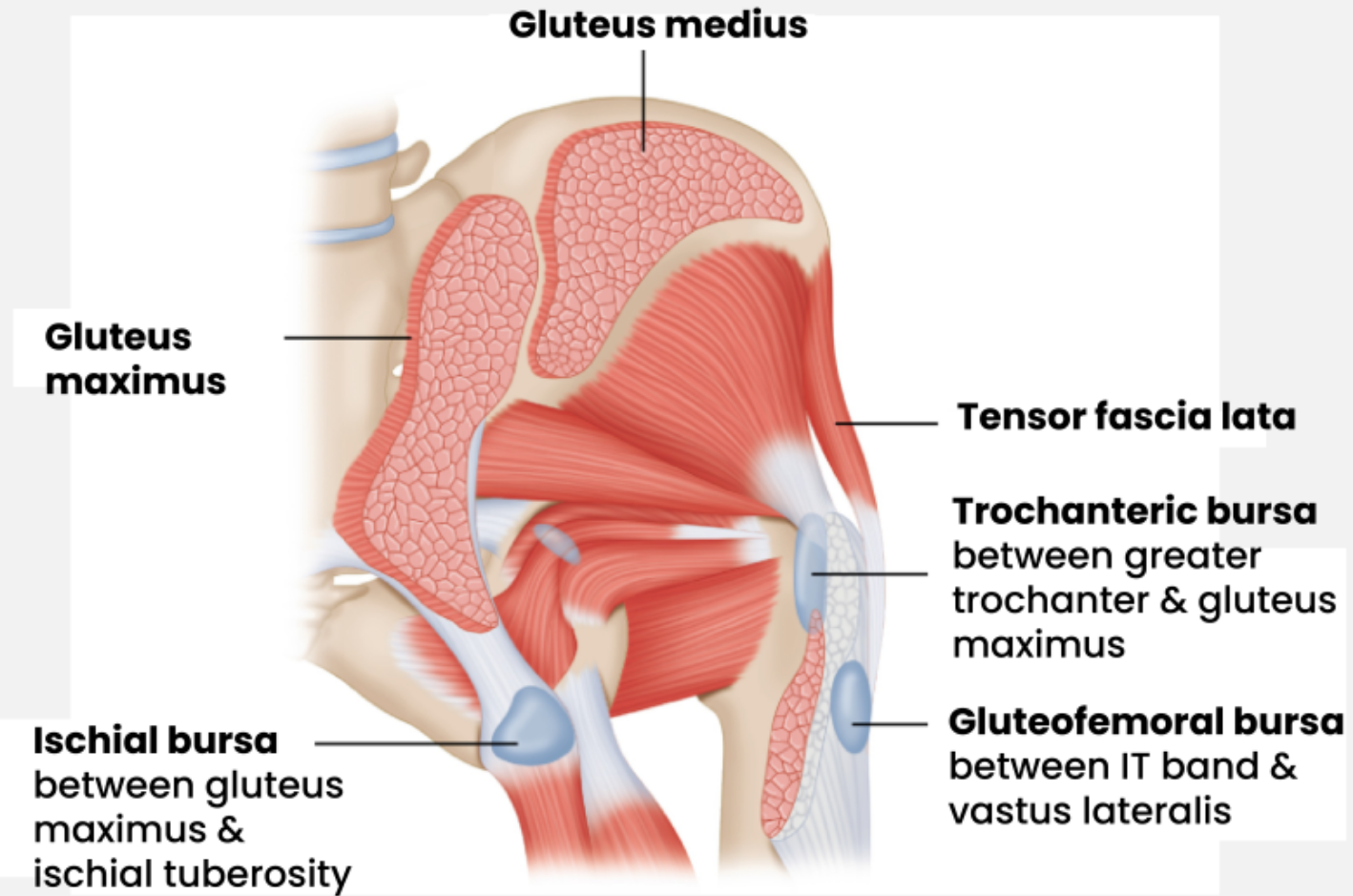
Hip Bursitis (Greater Trochanteric Pain Syndrome)
Pain on the outside of the hip, over the bony point (greater trochanter). Worse when lying on that side at night, walking upstairs, standing for long periods, or crossing the legs. This is the most common bursitis diagnosis we see, and it’s also the one most frequently mislabelled.
Current research has reframed this condition. What used to be called “trochanteric bursitis” is now understood to be primarily a gluteal tendinopathy, a degenerative problem with the gluteus medius and minimus tendons where they attach to the trochanter. The bursa sits on top of these tendons and becomes irritated secondarily. The condition is now more accurately called greater trochanteric pain syndrome (GTPS) or lateral hip pain.
This distinction matters enormously for treatment. If the primary problem is the tendon, not the bursa, then rest and cortisone won’t fix it. Progressive gluteal tendon loading will. Equally important: stretching the hip (pulling the knee across the body, crossing the legs, pigeon pose) compresses the gluteal tendons against the trochanter and typically makes the condition worse. Many patients come to us having been told to stretch and it’s been aggravating their symptoms for months.
Treatment at Wellmax focuses on gluteal strengthening (particularly side-lying abduction and isometric holds), avoiding compressive positions, manual therapy to the hip and pelvis, and shockwave therapy for chronic cases. See our Hip Pain page for comprehensive hip treatment details.
Shoulder Bursitis (Subacromial Bursitis)
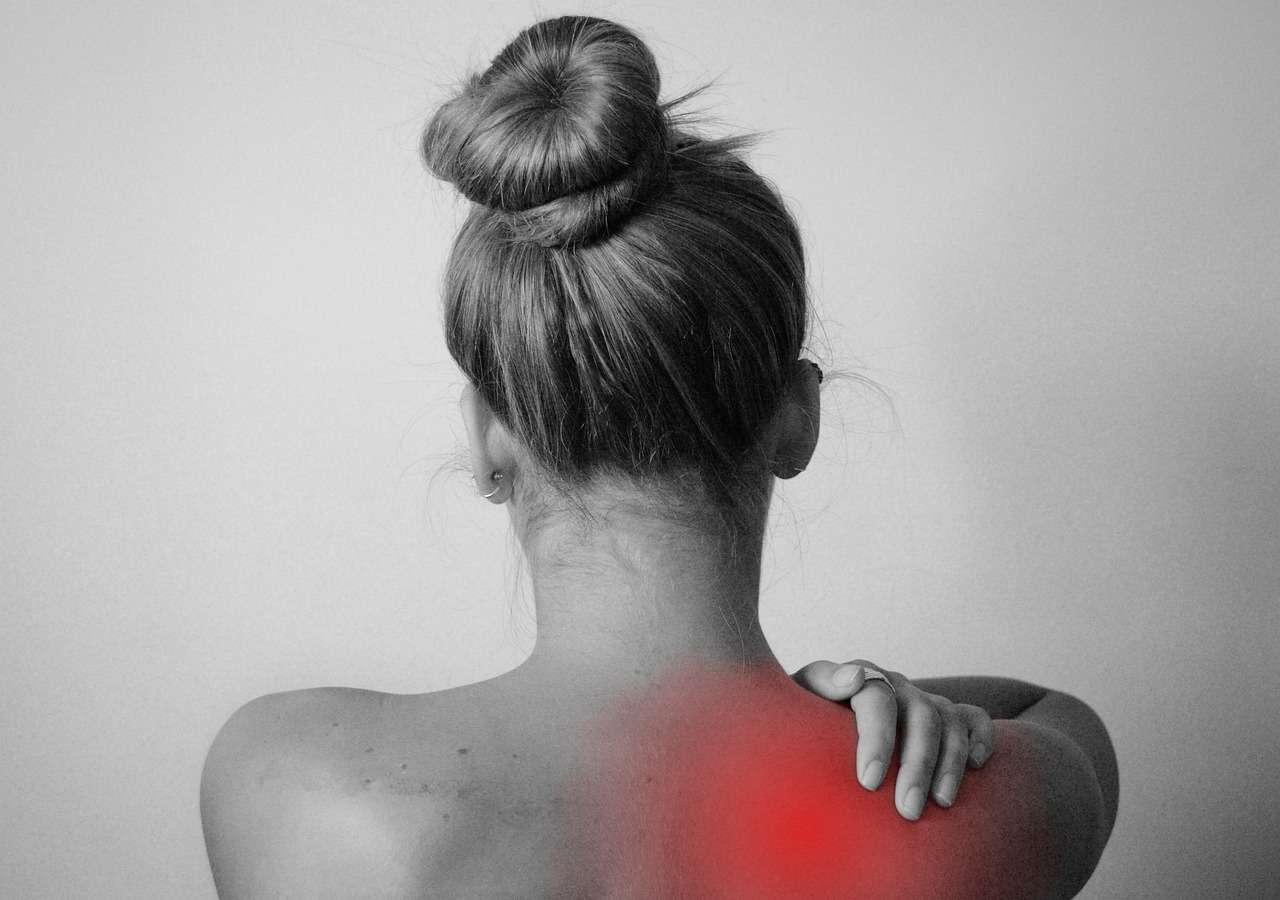
Pain when reaching overhead, reaching behind the back, or lying on the shoulder at night. The subacromial bursa sits in the space between the rotator cuff tendons and the acromion (the bony shelf at the top of the shoulder). When the rotator cuff tendons are weak, degenerative, or partially torn, they swell and reduce the space in the subacromial region. The bursa gets compressed and becomes inflamed.
Like hip bursitis, shoulder bursitis is usually secondary to the real problem: rotator cuff tendinopathy. The tendons (most commonly supraspinatus) are the primary issue. The bursa is caught in the crossfire. This is why cortisone into the subacromial space provides temporary relief but doesn’t produce lasting change unless the rotator cuff is strengthened.
Treatment follows the same principle: progressive rotator cuff and scapular stabilizer loading to address the tendon degeneration and improve the mechanics of the shoulder joint. As the tendons strengthen and the shoulder moves better, the bursa has more space and calms down. Manual therapy improves joint mobility and reduces compression. See our Rotator Cuff page for the detailed shoulder loading approach. See our Shoulder Pain page for broader shoulder condition management.
Knee Bursitis
The knee has several bursae that can become irritated.
Prepatellar bursitis (housemaid’s knee): Swelling directly over the kneecap, caused by prolonged or repetitive kneeling. Common in flooring installers, plumbers, gardeners, and anyone who spends time on their knees. The bursa fills with fluid and creates a visible, puffy swelling at the front of the knee. Treatment involves avoiding kneeling (or using knee pads), compression, gentle range-of-motion exercises, and in some cases, aspiration by a physician if the swelling is significant.
Pes anserine bursitis: Pain on the inside of the knee, just below the joint line. Common in runners, women with wider hips (greater valgus angle at the knee), and people with knee osteoarthritis. The pes anserine bursa sits where three hamstring tendons attach to the shin bone. Like hip bursitis, this is often driven by the tendons rather than the bursa alone. Treatment involves hamstring and medial knee strengthening, manual therapy, and addressing any biomechanical factors contributing to the overload.
Baker’s cyst (popliteal cyst): A fluid-filled swelling at the back of the knee. Not technically a bursitis but often grouped with knee bursitis conditions. Baker’s cysts are usually secondary to an intra-articular problem, most commonly knee osteoarthritis or a meniscal tear. Treatment addresses the underlying joint problem. See our Knee Pain page for detailed knee condition management.
Elbow Bursitis (Olecranon Bursitis)
A swollen, puffy lump at the point of the elbow. The olecranon bursa sits between the skin and the elbow bone. It gets irritated from leaning on hard surfaces (desk workers, students), direct trauma (falls, bumps), or repetitive elbow extension. Most cases are non-infected and resolve with activity modification, protective padding, and compression. If the bursa is hot, red, and painful, infection (septic bursitis) needs to be ruled out by a physician.
See our Elbow Pain page for complete elbow condition treatment.
Why Most Bursitis Treatment Fails (And What Works Instead)
The Cortisone Cycle
Cortisone injections for bursitis are one of the most commonly prescribed treatments. They work by reducing inflammation in the bursa. The problem is that in most cases, the bursa inflammation is secondary to tendon degeneration or biomechanical dysfunction. The cortisone calms the bursa temporarily, but the tendon problem persists. When the cortisone wears off (typically 6-12 weeks), the bursa becomes irritated again because nothing has changed underneath it. Some patients end up in a cycle of repeated injections without lasting improvement.
There are situations where cortisone is appropriate. Acute, highly irritable bursitis where pain is so severe it prevents the patient from sleeping or starting an exercise program can benefit from a cortisone injection as a bridge. The injection reduces the acute inflammation enough to allow the loading program to begin. But cortisone alone, without addressing the underlying cause, is not a long-term solution.
Rest Doesn’t Fix Tendon Problems
If bursitis is driven by tendon degeneration (which it usually is in the hip and shoulder), rest makes the problem worse, not better. The tendon needs mechanical loading to stimulate collagen repair and rebuild its structural capacity. Complete rest deconditions the tendon further, making it more vulnerable when activity resumes. The correct approach is modified activity (avoiding the specific positions that compress and aggravate) combined with progressive loading of the affected tendon.
Stretching Can Aggravate Bursitis
This is the biggest misconception, particularly with hip bursitis. Stretching the hip (crossing the leg over the body, pigeon pose, figure-four stretches) compresses the gluteal tendons against the trochanter. If the tendons are already degenerative and the bursa is already irritated, compression makes both worse. Many patients come to us having been stretching for months and getting progressively more painful. Removing the compressive stretches and replacing them with strengthening exercises often produces improvement within weeks.
What Actually Works
Progressive tendon loading. Strengthening the tendon that sits underneath the irritated bursa. For hip bursitis, that means gluteal strengthening. For shoulder bursitis, rotator cuff loading. For pes anserine bursitis, hamstring and medial knee strengthening. The tendon repairs, the biomechanics improve, the bursa has less friction and more space, and the inflammation resolves.
Manual therapy. Improving joint mobility, reducing muscle tightness, and normalizing movement patterns that contribute to abnormal bursal loading.
Activity modification. Avoiding the specific positions and activities that compress and irritate the bursa while the loading program builds the tendon’s capacity. For hip bursitis: stop crossing the legs, don’t sleep on the affected side, avoid stretching the hip into adduction. For shoulder bursitis: modify overhead reaching, use a pillow between the arm and body when sleeping.
Shockwave therapy for chronic cases that need additional stimulus beyond loading alone. Shockwave has strong evidence for gluteal tendinopathy and rotator cuff tendinopathy, the two conditions most commonly behind hip and shoulder bursitis.
Bursitis Recovery Timelines by Joint
| Type | Typical Recovery | Primary Treatment |
|---|---|---|
| Hip bursitis / GTPS (gluteal tendinopathy) | 8-14 weeks | Gluteal loading, avoid compressive positions, shockwave for chronic cases |
| Shoulder bursitis (subacromial / rotator cuff tendinopathy) | 8-12 weeks | Rotator cuff and scapular loading, manual therapy, activity modification |
| Prepatellar bursitis (housemaid’s knee) | 2-6 weeks | Avoid kneeling, compression, ROM exercises, knee pads for return to work |
| Pes anserine bursitis | 4-8 weeks | Hamstring/medial knee strengthening, manual therapy, biomechanical correction |
| Olecranon bursitis (elbow) | 2-6 weeks | Activity modification, protective padding, compression |
| Post-cortisone recurrence (any joint) | 8-16 weeks (tendon rehab after injection wears off) | Progressive loading of the underlying tendon + activity modification |
These timelines depend on how long the condition has been present, whether the underlying tendon problem is addressed, and consistency with the loading program. Your physiotherapist provides a specific timeline based on your assessment findings and the joint involved.
Why Oakville Patients Choose Wellmax for Bursitis Treatment
We Treat the Tendon, Not Just the Bursa
Most bursitis is driven by tendon degeneration underneath the inflamed bursa. We identify the root driver at the first assessment and build the treatment plan around fixing it. Progressive tendon loading produces lasting resolution. Treating only the bursa (cortisone, ice, rest) produces temporary relief.
We Know When Cortisone Makes Sense (and When It Doesn’t)
We’re not anti-cortisone. For acute, highly irritable bursitis that prevents sleep and exercise, a cortisone injection can be a useful bridge. But cortisone alone without addressing the tendon and biomechanical problem is a short-term fix. We coordinate with your physician when injection is warranted and build the rehabilitation plan around it so the improvement lasts.
Shockwave + Laser for Chronic Cases
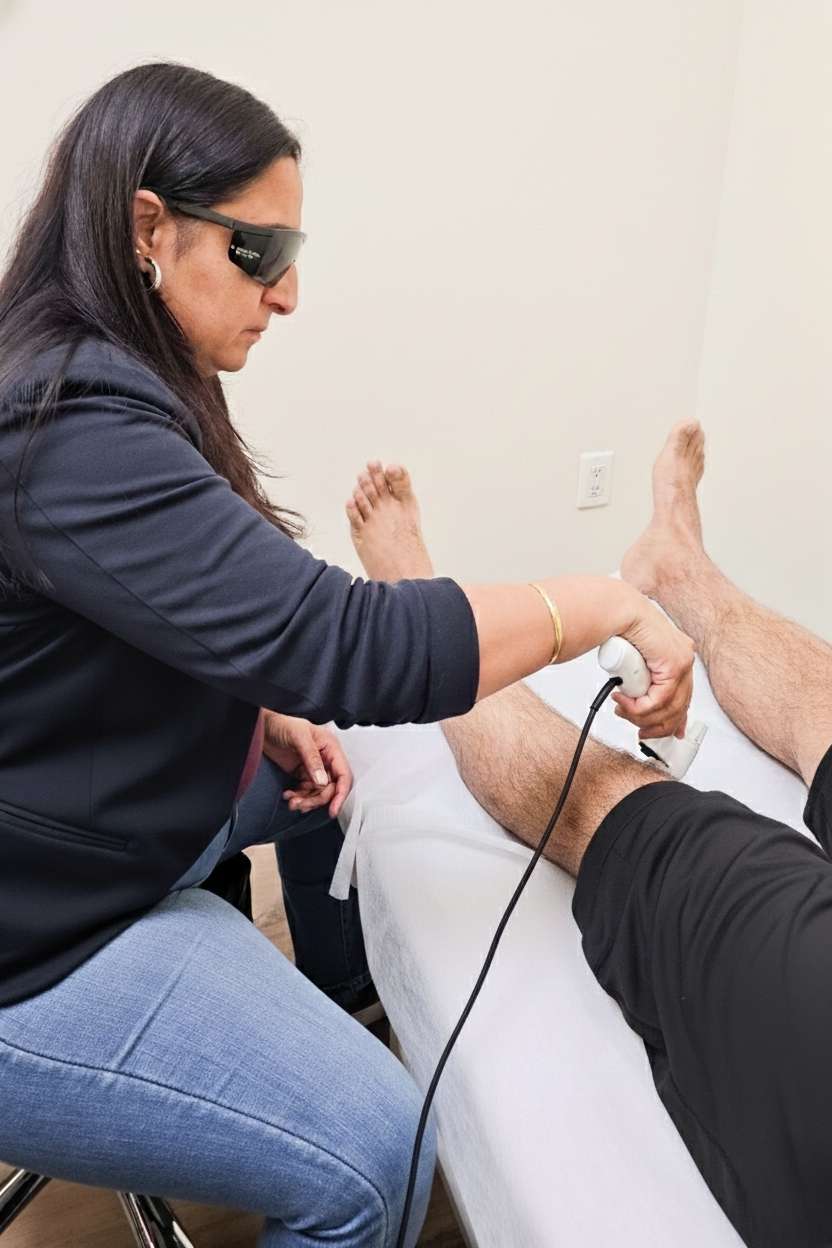
Having both shockwave therapy and deep tissue laser means we can match the modality to your presentation. Shockwave for chronic tendinopathy driving the bursitis. Laser for acute pain flare-ups that limit the loading program. Most Oakville clinics have one or the other, not both.
Local Bursitis Patients
We treat bursitis across Oakville’s community. Runners and walkers from the Waterfront Trail and Sixteen Mile Creek paths with hip bursitis that flares up at night. Active adults and gym athletes from CrossFit Radix, Element Movement, and local studios with shoulder bursitis from overhead pressing. Tradespeople and gardeners with knee bursitis from hours of kneeling. Office workers in Winston Park and Clarkson who lean on their elbows all day. And people who’ve had 2-3 cortisone injections and are looking for a treatment that actually addresses the underlying problem.
We’re at 1148 Winston Churchill Blvd, Unit B3, Oakville. Just south of the QEW in the Winston Park plaza. Free parking, ground-level access, private treatment rooms. Patients come from Clarkson, Clearview, Sheridan Park, Maple Grove, River Oaks, and south Mississauga.
What Our Patients Say
Helen O.“I began seeing Gurmeet as I was struggling with a painful shoulder and limited range of motion. Her knowledge and experience were evident from the start and within a short period of time I not only got relief from the pain but begin to see a change in how I was able to use my shoulder. Gurmeet and her staff employ a hands on approach which I appreciate and have found great success with. She was provided a recovery plan and exercises, which have been very effective. I have also began seeing her for sciatic/SI joint pain and already I am seeing a difference. I also appreciate that they are always able to accommodate my appointments!”
Neha T.“Great experience with Gurmeet and Jhanvi for a rotator cuff injury. They were knowledgeable, patient, and explained everything clearly throughout my recovery. The treatment plan was effective and tailored to my needs, and I noticed steady improvement in my shoulder pain and mobility. Highly recommend for anyone dealing with shoulder issues.”
Nilson A.“Physio therapy on my left shoulder, amazing. Felt relief right away. Gurmeet is excellent and I recommend Wellmax to everyone. The staff are friendly and courteous and professional. Genuinely care about the patients.”
Lu M.“Kind, caring, knowledgeable and magical hands. Came in about 6 weeks ago with lots of pain from a torn rotator cuff. Dhrushi and the team provided various treatments and exercises to help reduce my shoulder pain, and now I can sleep through the night. They worked with my medical diagnosis, my schedule and my insurance to build a treatment schedule, and now I’m on my way to recovery. I’m feeling great and look forward to returning to racquet sports this fall.”
Farwah R.“Gurmeet deeply cares about her patients and her work, and it is rare to find such Healthcare providers. I went to her for physio after suffering with terrible shoulder & right hand pain. Doctors continued to gaslight me and after 2 years when the pain got unbearable, I finally went for physio. The pain immediately started getting better. Cannot recommend her enough.”
Zafar H.“Extraordinary relief from my shoulder pain in few minutes. Gurmeet magically brought my arm back to work instantly. It’s more than three hours after my appointment and I have no pain at all.”
N.A. T.“I recently had physiotherapy sessions here for my neck and shoulder pain. After just 6 sessions, I’m feeling much, much better. The whole team is amazing, very supportive, friendly, and professional. I truly appreciate all the effort and care they put into my treatment. Highly recommended”
John C.“Fully recommendable. Gurmeet is very knowledgeable and a well experienced Physiotherapy. I’ve been going to this place for a couple of times they really managed to recover my shoulder issues that I have been suffering for more than a decade. Thank you Wellmax Physiotherapy.”
See all our Google reviewsRead more patient storiesLeave a review
Frequently Asked Questions
What is bursitis?+–
Bursitis is inflammation of a bursa, a small fluid-filled sac that reduces friction between tendons, bones, and soft tissues. Bursae exist throughout the body, with the most commonly affected locations being the hip (greater trochanter), shoulder (subacromial space), knee (prepatellar and pes anserine), and elbow (olecranon). While the bursa inflammation causes pain, it is usually secondary to another problem, most commonly tendon degeneration or abnormal joint mechanics.
Is my hip bursitis actually bursitis?+–
In most cases, no. Research over the past decade has shown that what was traditionally called trochanteric bursitis is primarily a gluteal tendinopathy, a degenerative problem with the gluteus medius and minimus tendons. The bursa sits on top of these tendons and becomes irritated secondarily. The condition is now more accurately called greater trochanteric pain syndrome (GTPS). This distinction changes the treatment: the tendon needs progressive loading to repair, not just anti-inflammatory treatment for the bursa.
Should I get a cortisone injection for bursitis?+–
It depends. For acute, severely painful bursitis that prevents you from sleeping or starting an exercise program, cortisone can be a useful bridge. It reduces the acute inflammation enough to allow rehabilitation to begin. But cortisone alone does not address the underlying tendon or biomechanical problem, so the bursitis often returns once the injection wears off. For lasting resolution, the tendon needs progressive loading. We coordinate with your physician when injection is appropriate and build the rehab plan around it.
Will stretching help my bursitis?+–
For hip bursitis, stretching typically makes it worse. Stretches that pull the hip into adduction (crossing the leg over the body, pigeon pose, figure-four position) compress the gluteal tendons against the trochanter, increasing irritation. Removing compressive stretches and replacing them with gluteal strengthening exercises is one of the most effective first steps in treatment. For shoulder bursitis, aggressive overhead stretching can also aggravate the condition. Controlled loading is more beneficial than stretching for tendon-driven bursitis.
Why does my hip bursitis hurt more at night?+–
Lying on the affected side compresses the inflamed bursa and irritated gluteal tendons against the trochanter. Even lying on the unaffected side can aggravate it if the top leg falls forward into adduction. Sleeping with a pillow between the knees keeps the hip in a neutral position and reduces compression. Addressing the gluteal tendinopathy through progressive loading reduces the night pain over time as the tendon strengthens and the inflammation resolves.
Is shockwave therapy effective for bursitis?+–
Shockwave therapy has strong evidence for the tendinopathy that drives most bursitis. For chronic gluteal tendinopathy (behind hip bursitis) and rotator cuff tendinopathy (behind shoulder bursitis), shockwave combined with progressive loading produces better outcomes than either alone. It is most appropriate for cases that have persisted for three months or more and have not fully responded to loading alone.
Can I exercise with bursitis?+–
Yes, with modifications. Exercise is actually essential for resolving bursitis because the underlying tendon needs progressive loading to repair. The modifications depend on the joint involved. For hip bursitis: avoid deep lunges, cross-body stretches, and side-lying on the affected side. For shoulder bursitis: modify overhead movements and reduce pressing volume. For knee bursitis: use knee pads and limit kneeling time. Your physiotherapist will specify which exercises to continue, which to modify, and which to temporarily avoid.
Is bursitis physiotherapy covered by insurance?+–
Yes. Treatment at Wellmax is billed as physiotherapy and covered by most extended health plans. WSIB covers work-related bursitis (common in trades involving kneeling or repetitive upper body work). We direct bill to Sun Life, Manulife, Canada Life, Green Shield, Great-West Life, Blue Cross, Desjardins, and most other major providers. No referral needed. See our insurance page for details.
What is the difference between bursitis and tendinitis?+–
They often travel together. Tendinitis (or tendinopathy) is a problem in the tendon itself, while bursitis is irritation of the cushioning sac that sits near that tendon. In the hip and shoulder especially, the tendon is usually the real driver and the bursa flares up second. That is why a plan built around progressive tendon loading tends to outperform treatment aimed at the bursa alone.
When should I see a doctor for bursitis?+–
Most bursitis is well managed with physiotherapy, but a bursa that is suddenly hot, red, swollen, and very painful, especially with a fever, can signal infection (septic bursitis) and needs same-day medical care. A direct fall or injury with rapid swelling, or pain that is severe and not improving at all, also warrants a medical opinion. When in doubt, get assessed rather than wait.
What is the difference between bursitis and tendinopathy?+–
Bursitis is inflammation of a bursa, the small fluid-filled sac that cushions a joint. Tendinopathy is a condition affecting the tendon itself, usually from overuse and degeneration of the tendon fibres. The two can occur simultaneously in the same area, such as the hip or shoulder. Symptoms can overlap and distinguishing them often requires a hands-on clinical assessment. Treatment approaches differ, which is why an accurate diagnosis matters before starting rehabilitation.
Can bursitis come back after it has resolved?+–
Yes, bursitis can recur, particularly if the underlying cause such as repetitive movement, poor posture, muscle weakness, or biomechanical factors has not been addressed. Resolving the inflammation alone without correcting the contributing factors leaves you vulnerable to flare-ups. A physiotherapy program that identifies and addresses the root cause, not just the pain, gives you the best chance of long-term resolution.
Is bursitis treated differently depending on which joint is affected?+–
The underlying principles are the same, reduce irritation and address contributing factors, but the specific approach varies by location. Hip bursitis often involves hip abductor strengthening and gait correction; shoulder bursitis typically requires rotator cuff rehabilitation and postural work; knee bursitis often involves quadriceps strengthening and activity modification. A physiotherapist will assess the specific joint, loading pattern, and muscle imbalances relevant to your location before building a tailored plan.
What exercises can I do at home for bursitis?+–
Gentle range-of-motion and the early stages of strengthening can be done at home once a physiotherapist has assessed the joint and confirmed what is safe. For hip bursitis this often means clamshells and sidelying hip abduction. For shoulder bursitis it typically starts with pendulum exercises and progresses to rotator cuff work. Exercises done at the wrong stage or with the wrong load can aggravate the bursa further, so home work should follow a plan from your physiotherapist rather than be self-prescribed.
Related Conditions and Services
- Hip Pain: Greater trochanteric pain syndrome (GTPS), gluteal tendinopathy, hip arthritis, and complete hip management.
- Shoulder Pain: Subacromial impingement, rotator cuff tendinopathy, and shoulder bursitis in full context.
- Rotator Cuff Injury: Detailed rotator cuff tendinopathy treatment, the condition behind most shoulder bursitis.
- Knee Pain: Prepatellar bursitis, pes anserine bursitis, Baker’s cysts, and knee management.
- Elbow Pain: Olecranon bursitis and complete elbow condition treatment.
- Shockwave Therapy: Evidence-based treatment for chronic tendinopathy driving bursitis.
- Deep Tissue Laser Therapy: Deep tissue laser for acute bursitis pain flare-ups.
- Arthritis: Joint arthritis that can co-exist with and contribute to bursitis.
- Sports Injury Rehabilitation: Activity-related tendon overload and bursitis in active patients.
Book Your Bursitis Assessment
If bursitis has been diagnosed and cortisone hasn’t lasted, if the hip keeps waking you up at night, if the shoulder won’t let you reach overhead, or if you’ve been told to rest and stretch and it’s only getting worse, get it assessed properly. Your physiotherapist will identify whether the bursa is the primary problem or whether a tendinopathy or biomechanical issue is driving it, and build a treatment plan that addresses the actual cause.
Wellmax Physiotherapy
1148 Winston Churchill Blvd, Unit B3, Oakville, ON L6J 0A3
Phone: (905) 829-1100
Email: info@wellmaxphysiotherapy.ca
Proudly Serving Our Local Communities:
- East Oakville: Winston Park, Clearview, and the QEW/403 Corridor.
- South Oakville: Eastlake, Maple Grove, Lorne Park, and Old Oakville.
- North Oakville: Joshua Creek, Falgarwood, Iroquois Ridge, and Upper Middle Road.
- Mississauga Border: Clarkson, Sheridan Park, Sheridan Homelands, and Southdown.
Insurance: Direct billing to most major providers. WSIB and MVA claims accepted. No referral needed. See our insurance and direct billing page for details.
Hours: Monday to Friday: 9am to 7pm | Saturday: 9am to 2pm | Sunday: 9am to 2pm (by appointment only)
Registered & Regulated
Regulated & Recognized Across Every Discipline
Wellmax is in good standing with the regulatory colleges and leading associations for physiotherapy, chiropractic, massage therapy, and naturopathic medicine in Ontario.