Plantar Fasciitis Treatment in Oakville
Loading-first treatment for morning heel pain, arch pain and stubborn plantar fascia tendinopathy.
Home > Conditions We Treat > Plantar Fasciitis Treatment in Oakville
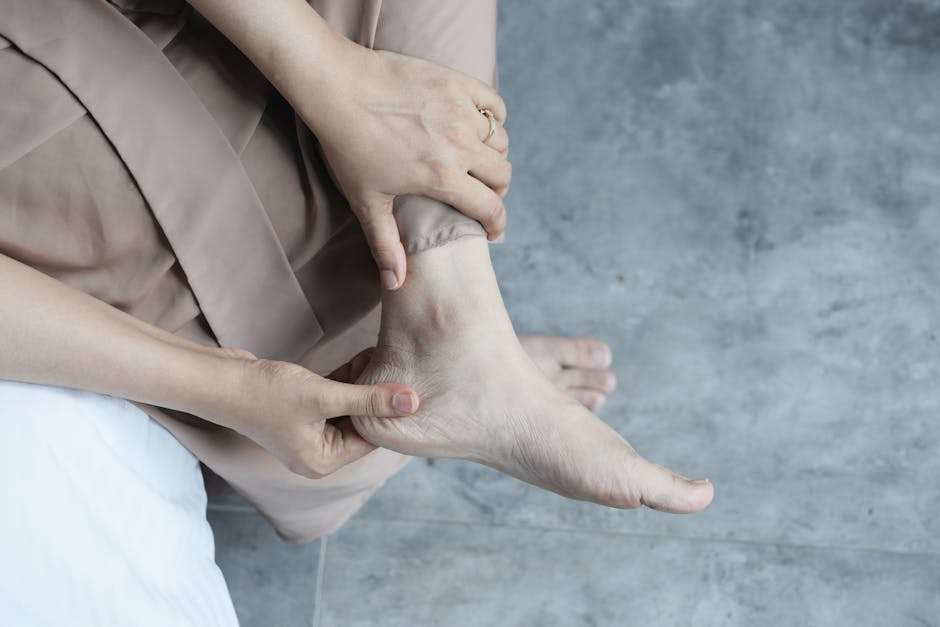
It hits you the moment your feet touch the floor in the morning. That sharp, stabbing pain right under the heel. You limp to the bathroom, hobble down the stairs, and after a few minutes of walking it starts to ease up. By the time you leave the house it’s manageable. But then you sit at your desk for an hour, stand up, and the pain is back. Same thing after driving. Same thing after the gym. Every time you rest and then load the foot again, the heel screams at you. Plantar fasciitis treatment in Oakville at Wellmax tackles the cause of the heel pain, not just the symptom.
That pattern is plantar fasciitis. And if you’ve been dealing with it for a while, you’ve probably already tried the usual advice: stretch your calves, roll a frozen water bottle under your foot, buy new shoes with better arch support, rest more. Maybe you even got a cortisone injection that worked for a few weeks and then the pain came back. The good news is that plantar fasciitis physiotherapy in Oakville at Wellmax targets the actual cause of the problem, not just the symptoms, so the heel pain resolves and stays resolved.
Here’s why most of that advice doesn’t fix the problem: plantar fasciitis isn’t an inflammation problem (despite the “itis” in the name). In most cases that have lasted more than a few weeks, it’s a tendinopathy. The fascia is degenerating, not inflaming. And degenerated tissue doesn’t respond to rest and anti-inflammatories. It responds to progressive loading. The same principle that treats Achilles tendinopathy, rotator cuff tendinopathy, and tennis elbow applies to the plantar fascia: the tissue needs to be loaded gradually and progressively to stimulate the repair process.
This is the most common mistake we see with plantar fasciitis patients who come to Wellmax after months of failed treatment elsewhere. They’ve been resting and stretching. Nobody told them to load the fascia. And the longer plantar fasciitis goes untreated with appropriate loading, the more stubborn it becomes.
At Wellmax Physiotherapy, we treat plantar fasciitis with a loading-first approach: progressive calf strengthening, intrinsic foot muscle training, manual therapy, and for chronic cases that need an extra push, shockwave therapy and deep tissue laser. Your physiotherapist reassesses how your heel responded last week and adjusts the load accordingly.
We’re at 1148 Winston Churchill Blvd, Unit B3, Oakville, just south of the QEW. Patients come from Clarkson, Clearview, Sheridan Park, Maple Grove, and south Mississauga for plantar fasciitis treatment.
- Understanding Plantar Fasciitis: What's Actually Happening in the Heel
- Plantar Fasciitis Treatment in Oakville: Treatment at Wellmax
- Plantar Fasciitis Recovery Timelines
- Why Patients Choose Wellmax for Plantar Fasciitis Treatment in Oakville
- Plantar Fasciitis Treatment for Oakville's Community
- Related Conditions & Services
- Book Your Plantar Fasciitis Assessment
- Frequently Asked Questions
Understanding Plantar Fasciitis: What’s Actually Happening in the Heel
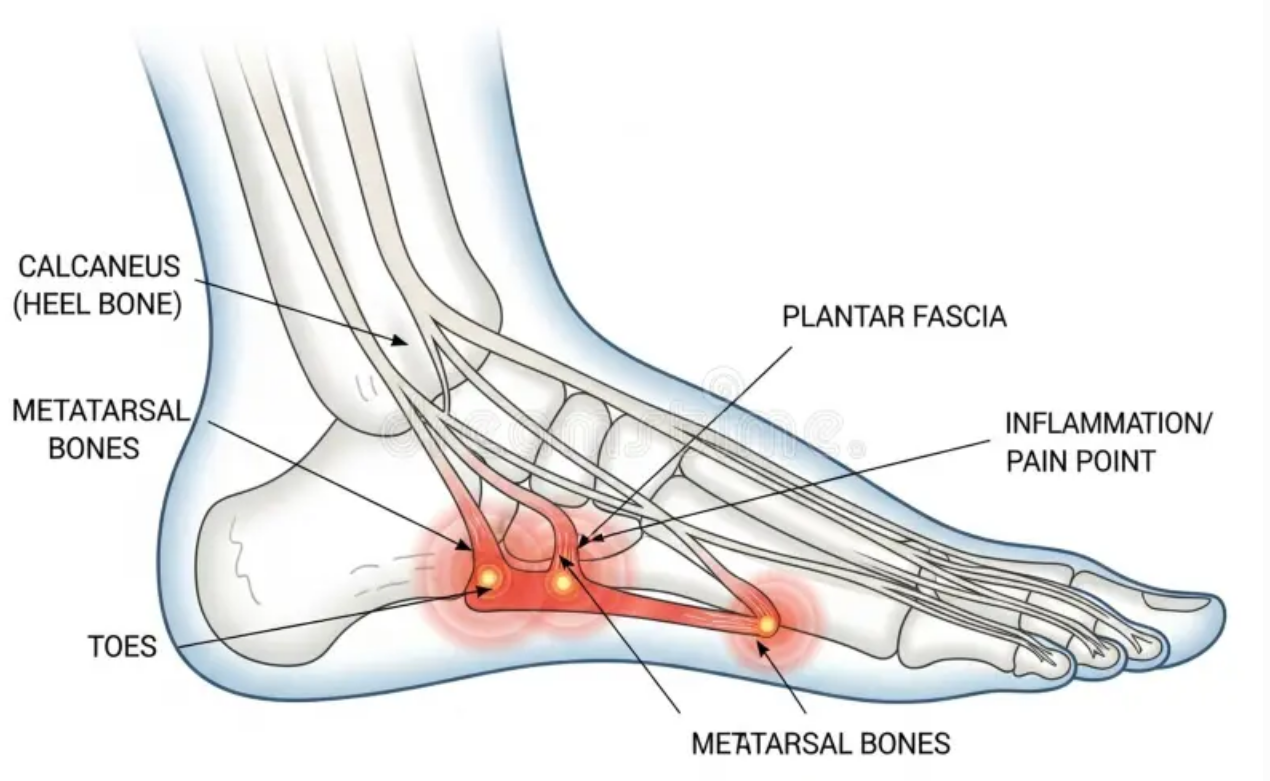
The Anatomy
The plantar fascia is a thick band of connective tissue that runs along the bottom of the foot from the heel bone (calcaneus) to the base of the toes. It supports the arch of the foot and acts like a spring mechanism during walking and running, storing and releasing energy with each step. Every time you push off during a stride, the plantar fascia absorbs load. In a typical day of walking, that’s thousands of loading cycles.
What Goes Wrong
Plantar fasciitis develops when the loading on the fascia exceeds its capacity to tolerate that load. The tissue begins to degenerate at the calcaneal insertion (where it attaches to the heel bone). In the early stages, there may be some inflammation. But in most cases that last beyond a few weeks, the condition has progressed to a degenerative tendinopathy. The collagen fibers within the fascia become disorganized, the tissue thickens, and the blood supply to the area decreases.
This is why the “itis” in plantar fasciitis is misleading. The condition behaves more like a tendinopathy than an inflammatory condition. And that distinction matters because it changes the treatment approach entirely. Anti-inflammatory strategies (ice, NSAIDs, cortisone) might manage symptoms temporarily, but they don’t address the underlying tissue degeneration. Progressive loading does.
Why It Hurts Most in the Morning
This is the signature symptom that almost every plantar fasciitis patient describes. During sleep, the plantar fascia shortens as the foot relaxes into a pointed position. The degenerative tissue partially stiffens overnight. When you take your first steps in the morning, the fascia gets abruptly loaded and stretched before it’s warmed up. The result is that sharp, stabbing pain that eases after a few minutes of walking as the tissue gradually loosens. The same pattern happens after any prolonged period of rest: sitting at a desk, driving, watching a movie. Stand up, load the heel, pain flares, then gradually settles.
Who Gets Plantar Fasciitis
Runners are the most commonly affected athletic population. The repetitive loading of distance running puts enormous cumulative stress on the plantar fascia. But plantar fasciitis is far from a runners-only condition. We see it in people who stand for long hours at work (retail, healthcare, teaching, manufacturing). People who’ve recently increased their walking or activity level after a period of being sedentary. People who gained weight (increased body mass increases the load on the fascia with every step). People with tight calves (the calf and plantar fascia are connected through the Achilles tendon complex, so calf tightness increases fascial tension). People in their 40s-60s as the fat pad under the heel naturally thins with age, reducing the cushioning. And people who wear flat, unsupportive shoes (flip flops, ballet flats, worn-out running shoes). Read more about Running Injuries Physiotherapy.
In Oakville, we commonly treat plantar fasciitis in runners from the Waterfront Trail, Sixteen Mile Creek paths, and Bronte Creek trails. Office workers in the Winston Park business district who stand at adjustable desks but wear dress shoes with no support. Retail and service workers in the Clarkson commercial area. Manufacturing workers along Royal Windsor Drive who stand on concrete all day. And parents of young kids who are suddenly doing a lot more walking and running around than their feet were prepared for.
Heel Spurs: The Misunderstood Finding
If you’ve had an X-ray, you might have been told you have a “heel spur.” Many patients are told the spur is causing their pain. The research says otherwise. Heel spurs are present in about 50% of people with plantar fasciitis AND about 20% of people with zero heel pain. The spur is the body’s response to chronic tension at the fascial insertion. It’s a consequence of the problem, not the cause. Treatment should target the fascial degeneration and loading tolerance, not the spur.
Plantar Fasciitis Treatment in Oakville: Treatment at Wellmax
The Foundation: Progressive Calf and Foot Loading
Research published in the Scandinavian Journal of Medicine and Science in Sports demonstrated that high-load progressive calf strengthening (the Rathleff protocol) produced superior outcomes to traditional stretching for plantar fasciitis. This makes sense because the treatment mimics what works for other tendinopathies: the degenerative tissue needs progressive mechanical loading to stimulate collagen remodeling and repair.
At Wellmax, the loading program starts with what the heel can tolerate and progresses systematically. Heavy slow resistance calf raises (standing on a rolled towel to increase fascial stretch at the end of range) are the cornerstone exercise. We also incorporate intrinsic foot muscle strengthening (the small muscles within the foot that support the arch and control toe function). These muscles are frequently weak in plantar fasciitis patients and strengthening them offloads the fascia.
Manual Therapy
Hands-on treatment to the calf complex (gastrocnemius and soleus), the plantar fascia itself, the foot joints (particularly the first metatarsophalangeal joint and midfoot joints), and the ankle. Calf tightness is one of the strongest risk factors for plantar fasciitis because the calf muscles and plantar fascia form a continuous kinetic chain through the Achilles tendon. Improving calf length and ankle dorsiflexion range directly reduces the tension on the fascia. We also assess and treat the hip, because emerging research shows that hip weakness (particularly gluteus medius) alters foot loading patterns and contributes to plantar fascia overload. Read more about Achilles Tendinopathy Physiotherapy.
Shockwave Therapy for Chronic Plantar Fasciitis
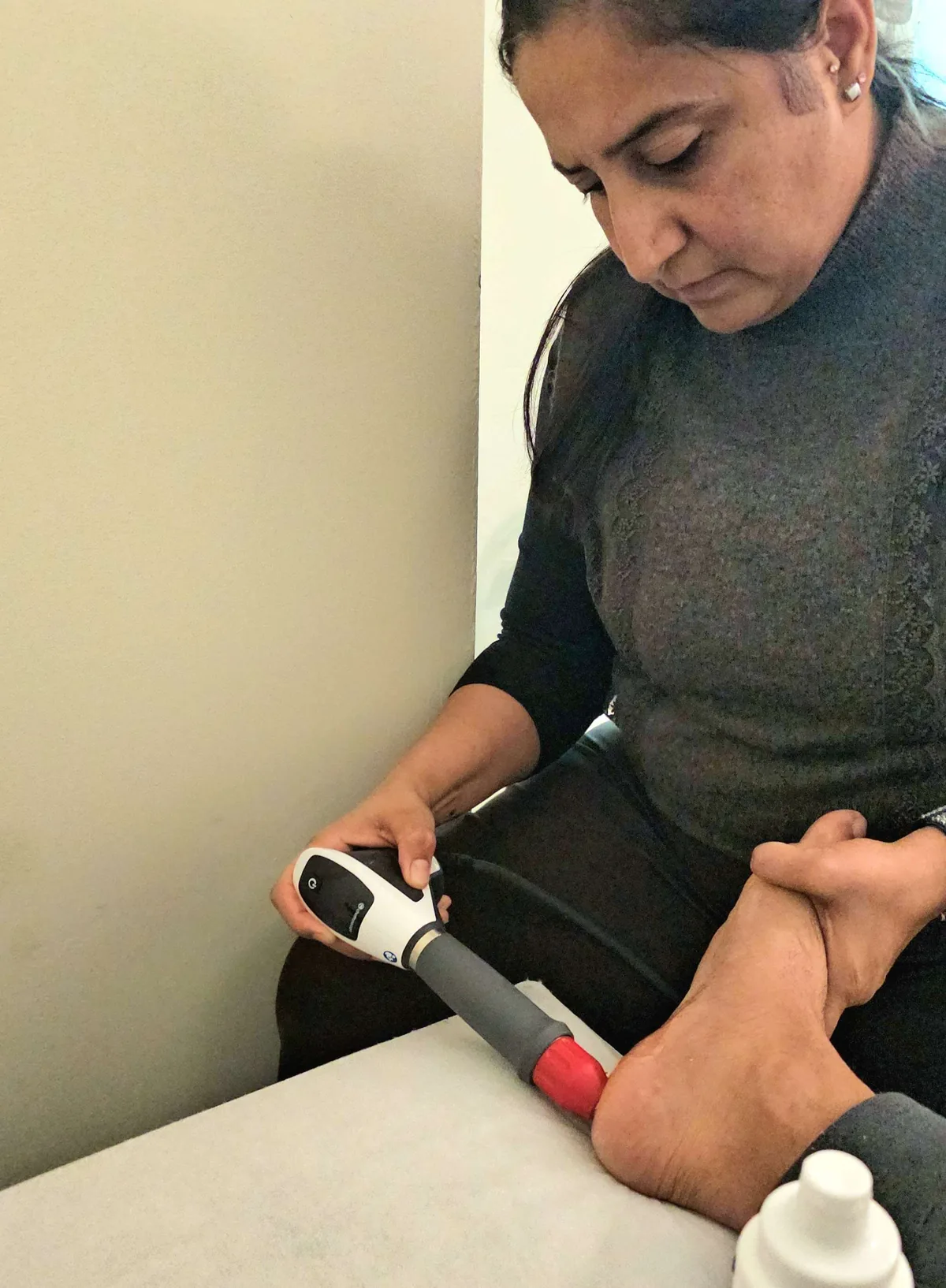
For plantar fasciitis that has persisted for more than 3 months and hasn’t responded adequately to loading and manual therapy alone, shockwave therapy is one of the most evidence-supported interventions available. Shockwave sends acoustic waves into the degenerative tissue, stimulating a healing response, promoting new blood vessel formation (neovascularization), and breaking down disorganized collagen so the body can replace it with healthier tissue. Multiple systematic reviews and meta-analyses support shockwave therapy for chronic plantar fasciitis. We typically deliver 3-6 shockwave sessions over 3-6 weeks, combined with the loading program.
Deep Tissue Laser Therapy for Acute Flare-Ups
When the heel is acutely inflamed and painful (during early-stage plantar fasciitis or during flare-ups of chronic cases), deep tissue laser therapy reduces inflammation and pain at the fascial insertion. The laser enhances blood flow to the area, promotes cellular repair, and helps patients tolerate the loading program that drives long-term recovery. It’s particularly useful in the first 2-3 weeks of treatment when pain is the main barrier to doing the exercises.
Orthotics and Footwear
Custom or prefabricated orthotics can provide symptom relief by supporting the arch and redistributing the load across the foot. Footwear guidance is part of every plantar fasciitis treatment plan at Wellmax: shoes with adequate cushioning, arch support, and a slight heel-to-toe drop reduce fascial tension during standing and walking. We do orthotic assessments and can help determine whether custom orthotics, over-the-counter insoles, or simply better shoes are the right call for your situation. See our Orthotics & Braces page for more detail.
Taping
Low-dye taping of the foot can provide immediate pain relief by mechanically supporting the arch and reducing the load on the plantar fascia during weight bearing. It’s a useful short-term strategy in the acute phase while the strengthening program builds the foot’s ability to support itself.
What We Don’t Recommend (and Why)
Complete rest. Rest makes plantar fascia tissue weaker, not stronger. Modification of aggravating activities is appropriate, but the foot still needs controlled loading to heal.
Cortisone injections as a first-line treatment. Cortisone can provide short-term relief but research shows higher recurrence rates and potential for fascial rupture with repeated injections. It has a role in severe cases but shouldn’t be the first thing tried.
Night splints as standalone treatment. Night splints maintain a stretch position during sleep, which can reduce morning pain. But they don’t address the underlying tissue degeneration or build the loading capacity the fascia needs.
Plantar Fasciitis Recovery Timelines
| Presentation | Typical Recovery | Treatment Approach |
|---|---|---|
| Acute plantar fasciitis (under 6 weeks) | 4-8 weeks | Progressive loading, calf stretching, manual therapy, laser for pain management |
| Sub-acute plantar fasciitis (6 weeks to 3 months) | 6-12 weeks | Heavy slow resistance loading, manual therapy, footwear modification |
| Chronic plantar fasciitis (3+ months) | 8-16 weeks | Progressive loading + shockwave therapy, laser, potential orthotics |
| Chronic with prior failed treatments | 12-20 weeks | Shockwave + progressive loading + laser + biomechanical correction |
| Runner with plantar fasciitis | 8-14 weeks to return to full mileage | Load management, progressive return to running, gait assessment, calf loading |
| Post-cortisone recurrence | 10-16 weeks | Careful progressive loading (fascia may be weakened), shockwave, strengthening |
These timelines depend on how long symptoms have been present, what treatments have already been tried, body weight, activity level, and consistency with the home exercise program. Gurmeet provides a specific timeline at your first assessment based on your individual presentation. The one universal truth with plantar fasciitis: the earlier you start proper treatment, the faster it resolves.
Why Patients Choose Wellmax for Plantar Fasciitis Treatment in Oakville
Loading-First Approach, Not Passive Treatment
Most plantar fasciitis treatment at other clinics consists of ultrasound, ice, stretching, and maybe a cortisone referral. That approach manages symptoms but doesn’t fix the underlying problem. At Wellmax, progressive calf and foot loading is the foundation of treatment because that’s what the evidence supports. The modalities (shockwave, laser) accelerate the process. The exercises are what produce lasting resolution.
Shockwave + Laser: Both Available Under One Roof
Most Oakville clinics offer either shockwave therapy or laser therapy. Few offer both. Having access to shockwave for chronic fascial degeneration and deep tissue laser for acute inflammation gives us flexibility to match the treatment to where the fascia is at each stage. First few weeks with acute pain? Laser helps you tolerate the loading program. Plateau at 6 weeks? Shockwave breaks through it.
We Look Beyond the Foot
Plantar fasciitis doesn’t happen in isolation. Tight calves, limited ankle dorsiflexion, weak hip stabilizers, and poor foot mechanics all contribute. Gurmeet assesses the entire lower limb chain and addresses the factors that created the overload, not just the heel that’s hurting. For broader foot and ankle problems, see our Ankle & Foot Pain page.
Expert Care, Consistent Progression
The loading program needs to progress at the right rate. Too slow and nothing changes. Too fast and the heel flares up. Your physiotherapist manages the progression week to week based on how the heel responds, with honest guidance on where you are in the program.
Direct Billing, No Referral
Treatment at Wellmax is billed as physiotherapy and covered by most extended health plans. We direct bill to Sun Life, Manulife, Canada Life, Green Shield, Great-West Life, Blue Cross, Desjardins, and most other major providers. No referral needed. See our insurance and direct billing page for details.
Plantar Fasciitis Treatment for Oakville’s Community
Plantar fasciitis is an equal-opportunity condition. We treat it in runners training for the Waterfront Trail half-marathon and Sixteen Mile Creek paths who ramped their mileage too fast. Office workers in the Winston Park business district who switched to standing desks and developed heel pain within weeks. Retail workers in the Clarkson and Sheridan Park commercial areas who stand on hard floors all day in unsupportive shoes. Manufacturing and trades workers along Royal Windsor Drive who wear steel-toed boots on concrete. New parents in Clearview and Maple Grove who are suddenly doing ten times more walking than they were six months ago. And people in their 50s and 60s across Oakville whose heel fat pad has thinned over the years and can no longer absorb the impact it used to.
The common thread in all of these cases: the loading on the plantar fascia exceeded what the tissue was prepared to handle, and the fix is building it back up gradually.
We’re at 1148 Winston Churchill Blvd, Unit B3, Oakville. Just south of the QEW in the Winston Park plaza. Free parking, ground-level access, private treatment rooms. Patients come from Clarkson, Clearview, Sheridan Park, Maple Grove, River Oaks, and south Mississauga.
What Our Patients Say
Hazel V.“I was suffering from plantar fasciitis. I went to other physio, shockwave nothing helped. Until I found Wellmax Physiotherapy. This is a great place!”
Kevin O.“Look no further if you want the best physiotherapy clinic in Oakville. I was dealing with plantar fasciitis that made taking my first steps out of bed every morning absolutely agonizing. I had tried custom insoles and resting, but nothing worked permanently. Dhrushi assessed my foot mechanics and put together a great plan using shockwave therapy. I also saw Cynthia for deep tissue massage on my tight calf muscles. The combination of their treatments worked wonders. I am finally walking normally again. They are honest, professional, and do not pressure you into endless treatment packages.”
Michael R.“If you are dealing with sports injuries, this is easily the best physiotherapy clinic in Oakville. I was struggling with Achilles tendinopathy from running, and the pain in my heel was getting worse every week. Dhrushi was my physiotherapist and she was absolutely fantastic. She did not just look at my ankle but assessed my entire walking and running mechanics. She explained exactly why the tendon was inflamed and built a personalized treatment plan with manual therapy and specific eccentric exercises for me to do at home. The clinic always runs on time and the entire team is so friendly. I am finally back to running pain-free and I will not hesitate to return if I ever need care again.”
Zakaria S.“I came in with a locked and sore ankle and Gurmeet was able to identify the root cause very quickly. The soft tissue release, electrical therapy, manual manipulation and assigned stretches have all been beneficial for my situation. They’ve got a customer for life. Gurmeet and her team are friendly and knowledgeable.”
Christopher N.“Gurmeet and her team are awesome 🙂 They really helped me to recover from my ankle sprain. Thanks team Wellmax. Highly Recommended!”
Tia D.“My experience with Gurmeet and her team was truly wonderful. I arrived with a painful ankle sprain and a lot of uncertainty about how well I would heal. After just a few sessions with her, I already felt more hopeful and confident again. I was able to walk more comfortably, the swelling went down significantly, and they helped me manage the pain so much better. Gurmeet and her team are incredibly caring, supportive, and knowledgeable. They made sure I felt looked after not only during my visits but also gave me everything I needed to continue healing well at home. I trusted them completely, and I still feel so grateful that I did. I would wholeheartedly recommend them to anyone.”
Pamela V.“10/10!! I came to this physio after spraining my ankle with a grade 3 ankle sprain in late August 2025. I was on crutches, couldn’t walk and could barely move my ligaments in my foot to do an ankle circle. I came to this clinic and was so impressed with the new team and new physiotherapist, Gurmeet. She does her work exceptionally well. She explains things so easily and told me she wants patients to understand what’s going on so it can help them. …”
Sunil R.“Gurmeet figured out the cause of my knee pain and is working hard on fixing it. Already feel much more pain relief and better walking ability. Thanks to you and your team! Not only are you all very professional and knowledgeable, but also very kind and caring! As an update, Gurmeet’s techniques have significantly improved the mobility in my foot/ankle, and the recommended stretches and modalities have all helped so much too! Thankful to Nav and Cynthia too. Everyone is so skilled and polite and friendly! Cynthia is the best massage therapist I’ve had in years! She really works on the tight muscles and listens to feedback well if you ask for less or more pressure. …”
See all our Google reviewsRead more patient storiesLeave a review
Frequently Asked Questions
What causes plantar fasciitis?+–
Plantar fasciitis develops when the loading on the plantar fascia exceeds its capacity. Common contributing factors include tight calf muscles, increased body weight, sudden increases in activity (new running program, standing desk, more walking), flat or unsupportive footwear, high arches or flat feet, weak intrinsic foot muscles, and age-related thinning of the heel fat pad. Often it’s a combination of several factors.
Why does my heel hurt first thing in the morning?+–
During sleep, the plantar fascia shortens as the foot relaxes. The degenerative tissue stiffens overnight. When you take your first steps, the fascia gets abruptly loaded and stretched before it’s warmed up. That’s what causes the sharp, stabbing pain. It eases after a few minutes of walking as the tissue gradually loosens. The same pattern happens after any prolonged rest period.
Should I rest if I have plantar fasciitis?+–
Complete rest actually makes plantar fasciitis worse because the tissue becomes weaker and more sensitive without loading stimulus. The correct approach is modifying activities that aggravate symptoms while starting a progressive loading program (calf strengthening, intrinsic foot exercises) that builds the fascia’s capacity. Controlled loading heals the tissue. Rest does not.
How long does plantar fasciitis take to heal?+–
With proper treatment, acute cases (under 6 weeks of symptoms) typically resolve in 4-8 weeks. Cases that have been present for 3+ months may take 8-16 weeks. Cases that have persisted for over 6 months with prior failed treatments may take 12-20 weeks. The earlier you start evidence-based treatment, the shorter the recovery timeline.
Is shockwave therapy effective for plantar fasciitis?+–
Yes. Shockwave therapy is one of the most evidence-supported treatments for chronic plantar fasciitis (symptoms lasting 3+ months). Multiple systematic reviews show significant pain reduction and functional improvement. At Wellmax, we combine shockwave therapy with progressive loading and hands on therapy for the best outcomes. Shockwave alone without the exercise program produces inferior results.
Do I need custom orthotics for plantar fasciitis?+–
Not everyone does. Custom orthotics can provide symptom relief by supporting the arch and redistributing load, particularly for people with structural foot issues (flat feet, high arches, significant pronation). Prefabricated insoles are sufficient for many patients. Better footwear alone solves the problem for some. Gurmeet assesses your foot mechanics and advises whether orthotics, insoles, or footwear changes are the right call for your situation.
Will a cortisone injection fix my plantar fasciitis?+–
Cortisone injections can provide short-term pain relief (2-4 weeks) but research shows higher recurrence rates compared to physiotherapy, and repeated injections carry a risk of fascial rupture or fat pad atrophy. At Wellmax, we use cortisone as a last resort, not a first-line treatment. The loading program and shockwave therapy address the tissue degeneration that cortisone doesn’t fix.
Can I still run with plantar fasciitis?+–
In many cases, yes, with modification. The key is keeping the running volume and intensity below the level that provokes significant pain (above 3-4 on a 0-10 pain scale during or after the run is too much). Reducing mileage, slowing pace, avoiding hills, and choosing softer surfaces can allow continued running while the treatment program builds the fascia’s capacity. Gurmeet will assess whether your running can continue and at what level, or whether a temporary break is needed.
Is the heel spur causing my pain?+–
Almost certainly not. Heel spurs are present in about 50% of people with plantar fasciitis and about 20% of people with zero heel pain. The spur is the body’s response to chronic tension at the fascial insertion, not the cause of the pain. Treatment targets the plantar fascia degeneration and loading tolerance, not the spur. Surgical spur removal is rarely indicated.
Is plantar fasciitis physiotherapy covered by insurance?+–
Yes. Treatment at Wellmax is billed as physiotherapy and covered by most extended health plans. Shockwave therapy and laser therapy are included as part of your physiotherapy session at no extra charge. We direct bill to most major providers. No referral needed. See our insurance page for details.
Does plantar fasciitis affect one foot or both?+–
It can be either. Most people develop plantar fasciitis in one foot, usually the dominant or more heavily loaded side, but roughly a third of cases involve both heels at the same time. When both feet are affected together, it is worth looking more closely at systemic contributors such as a sudden jump in walking or standing volume, body weight changes, tight calves on both sides, or footwear that offers no support. The loading-first treatment approach is the same for one foot or two.
When should I see a physiotherapist instead of waiting it out?+–
If the heel pain has lasted more than two weeks, keeps returning every morning, or is changing the way you walk, that is the point to get it assessed rather than wait. Plantar fasciitis tends to become more stubborn the longer it goes without proper loading, and early treatment shortens recovery significantly. You do not need a referral, and Wellmax offers a free consult so you can find out what is driving your heel pain before committing to anything.
Who is the best doctor to see for plantar fasciitis?+–
A physiotherapist is the first specialist to see for plantar fasciitis in most cases. Physiotherapists are trained to assess foot mechanics, loading patterns and the contributing factors behind plantar fascia degeneration, then apply the evidence-based loading program that produces the best long-term results. If a cortisone injection or imaging is needed, your physiotherapist can refer you to a sports medicine doctor or orthopaedic specialist. At Wellmax, we offer a free consult so you can get a clear diagnosis and a loading plan without any upfront cost.
What is the most successful treatment for plantar fasciitis?+–
Progressive loading exercise has the strongest evidence for plantar fasciitis. A high-load calf and arch strengthening program consistently outperforms stretching alone, orthotics alone and cortisone injections for long-term outcomes. For cases that have lasted 3 or more months, adding shockwave therapy to the loading program significantly improves results. At Wellmax, we combine both in a structured program tailored to your loading history and foot mechanics.
What do the Japanese do for plantar fasciitis?+–
Japanese treatment research has explored acupuncture as a complementary approach for plantar fasciitis, targeting points along meridians that run through the foot and heel. Some clinical trials show acupuncture can reduce heel pain in the short term alongside other treatments. At Wellmax, we offer acupuncture as a pain management tool alongside the progressive loading program, not as a replacement for it. Our team can discuss whether acupuncture fits your specific presentation.
Can L5 S1 cause plantar fasciitis?+–
Yes. The nerves that supply the plantar fascia originate from the lower lumbar spine (L4, L5) and sacrum (S1). A disc herniation or nerve root compression at L5-S1 can sensitize the tibial nerve and its branches, producing heel and arch pain that closely mimics plantar fasciitis. This is one reason plantar fasciitis does not always respond to standard foot-focused treatment. At Wellmax, we assess the full lumbar and lower-leg nerve pathway to identify whether the spine is contributing to your heel pain before building a treatment plan.
Related Conditions & Services
- Arch Pain: Targeted physiotherapy for pain in the arch of the foot, including causes, at-home relief, and when to seek help.
- Ankle & Foot Pain: Comprehensive foot and ankle pain treatment including tendinopathy, sprains, and structural issues.
- Ankle Sprain: Ankle sprains and plantar fasciitis frequently co-exist due to altered gait mechanics.
- Achilles Tendinopathy: Calf and Achilles tendinopathy that share the same kinetic chain as the plantar fascia.
- Running Injuries: Load-related running injuries and a structured return-to-running progression.
- Shockwave Therapy: Evidence-based treatment for chronic plantar fasciitis and calcific deposits.
- Deep Tissue Laser Therapy: Deep tissue laser for acute inflammation and pain management during early treatment.
- Orthotics & Braces: Custom orthotics assessment and fitting for arch support and load redistribution.
- Sports Injury Rehabilitation: Running injuries, overuse conditions, and return-to-sport programming.
- Chronic Pain: When heel pain has persisted for months and involves central sensitization.
- Arthritis: Foot and ankle arthritis management alongside plantar fascia treatment.
Book Your Plantar Fasciitis Assessment
If the heel pain greets you every morning, if cortisone wore off and the pain came back, if you’ve been resting and stretching for months with no lasting change, or if it’s starting to affect the way you walk, get it assessed properly. Your physiotherapist will identify what’s driving your plantar fascia overload and build a loading-first treatment plan that addresses the actual cause. Wellmax offers a free consult so you can understand what’s going on before committing to treatment.
Wellmax Physiotherapy
1148 Winston Churchill Blvd, Unit B3, Oakville, ON L6J 0A3
Phone: (905) 829-1100
Email: info@wellmaxphysiotherapy.ca
Proudly Serving Our Local Communities:
- East Oakville: Winston Park, Clearview, and the QEW/403 Corridor.
- South Oakville: Eastlake, Maple Grove, Lorne Park, and Old Oakville.
- North Oakville: Joshua Creek, Falgarwood, Iroquois Ridge, and Upper Middle Road.
- Mississauga Border: Clarkson, Sheridan Park, Sheridan Homelands, and Southdown.
Insurance: Direct billing to most major providers. WSIB and MVA claims accepted. No referral needed. See our insurance and direct billing page for details.
Hours: Monday to Friday: 9am to 7pm | Saturday: 9am to 2pm | Sunday: 9am to 2pm (by appointment only)
Registered & Regulated
Regulated & Recognized Across Every Discipline
Wellmax is in good standing with the regulatory colleges and leading associations for physiotherapy, chiropractic, massage therapy, and naturopathic medicine in Ontario.