
Pregnancy Pelvic Pain Physiotherapy in Oakville
Pelvic Girdle Pain, SI Joint Pain and SPD Treatment During Pregnancy
Home > Conditions We Treat > Pregnancy Pelvic Pain Physiotherapy in Oakville
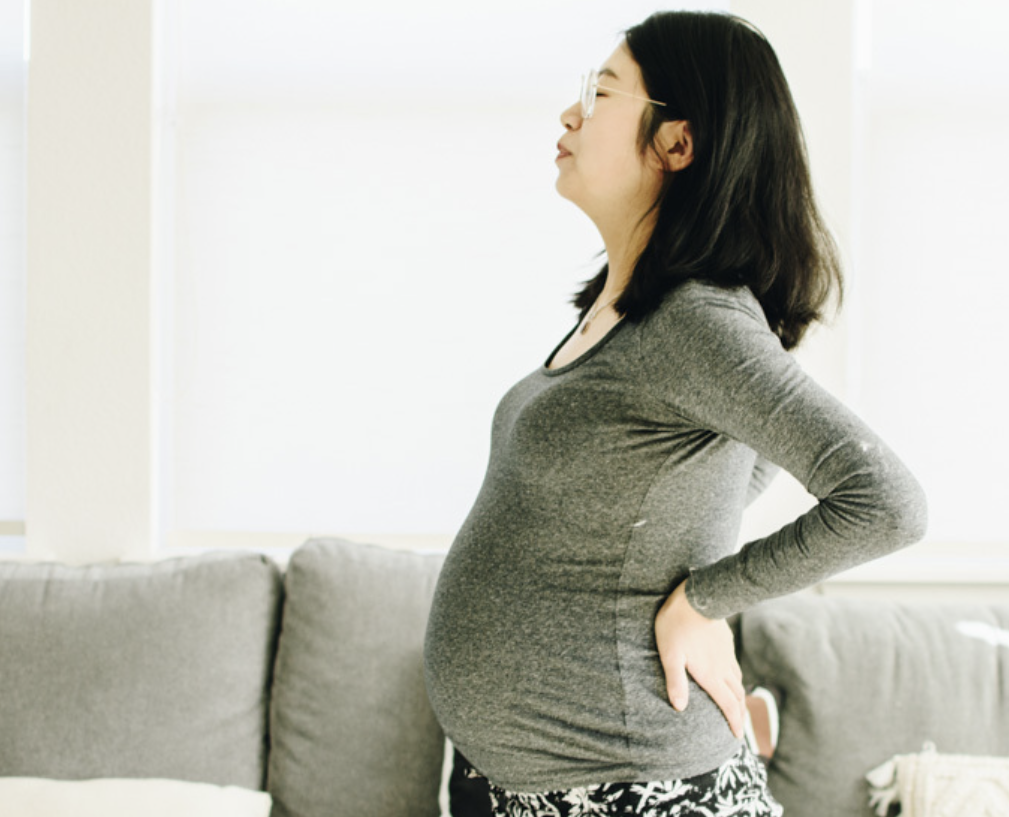
Rolling over in bed wakes you up. Not because of the baby. Because of sharp pelvic pain.
Pelvic girdle pain during pregnancy is common but not something you have to live with. Physiotherapy has strong evidence for reducing SI joint pain, SPD and pubic symphysis pain in pregnancy, often producing meaningful improvement within 2 to 4 weeks. Our Oakville physiotherapists specialize in prenatal pelvic assessment and treatment at every trimester.
Direct billing to most insurers. No referral needed. Babies and toddlers welcome.
Wellmax Physiotherapy provides expert pregnancy pelvic pain physiotherapy in Oakville for SI joint pain, symphysis pubis dysfunction (SPD), pelvic girdle pain, and related prenatal musculoskeletal conditions.
Rolling over in bed wakes you up. Not because of the baby. Because of the sharp, stabbing pain in your pelvis. Getting out of the car feels like your hips are splitting apart. Walking up stairs sends a jolt through your pubic bone. By the third trimester, even putting on pants requires a strategy.
You mention it to your OB or midwife. They tell you it is normal. That it is just part of pregnancy. That it will go away after the baby comes. And while pelvic pain is common during pregnancy (up to 70 to 80% of pregnant women experience some form of it), common does not mean you have to suffer through it. Pelvic girdle pain during pregnancy is treatable. Most women see significant improvement within a few weeks of starting the right physiotherapy program.
At Wellmax Physiotherapy in Oakville, our physiotherapists specialize in prenatal pelvic pain. We treat the specific structures causing your pain (SI joint, pubic symphysis, round ligaments, pelvic floor), teach you how to move and sleep in ways that reduce the load on your pelvis, and build the strength your body needs to carry a growing baby with less pain. We also prepare your pelvic floor for labour and delivery. Treatment is safe at every stage of pregnancy.
We are at 1148 Winston Churchill Blvd, Unit B3, Oakville. Free parking, ground-level access, no stairs. Babies and toddlers are welcome at your appointments. See our Pelvic Floor Physiotherapy page for the full range of pelvic health conditions we treat.
- The Three Types of Pregnancy Pelvic Pain
- Other Pregnancy Pains We Treat
- What Treatment Looks Like During Pregnancy
- When to Start Prenatal Physiotherapy
- Pregnancy Pelvic Pain Timelines
- Why Oakville Moms Choose Wellmax
- Related Conditions and Services
- Book Your Prenatal Pelvic Assessment
- Frequently Asked Questions
The Three Types of Pregnancy Pelvic Pain
Pelvic pain during pregnancy is not one condition. It is an umbrella term for several related but distinct problems. Identifying which structures are involved determines the treatment approach.
Posterior Pelvic Girdle Pain (SI Joint Pain)
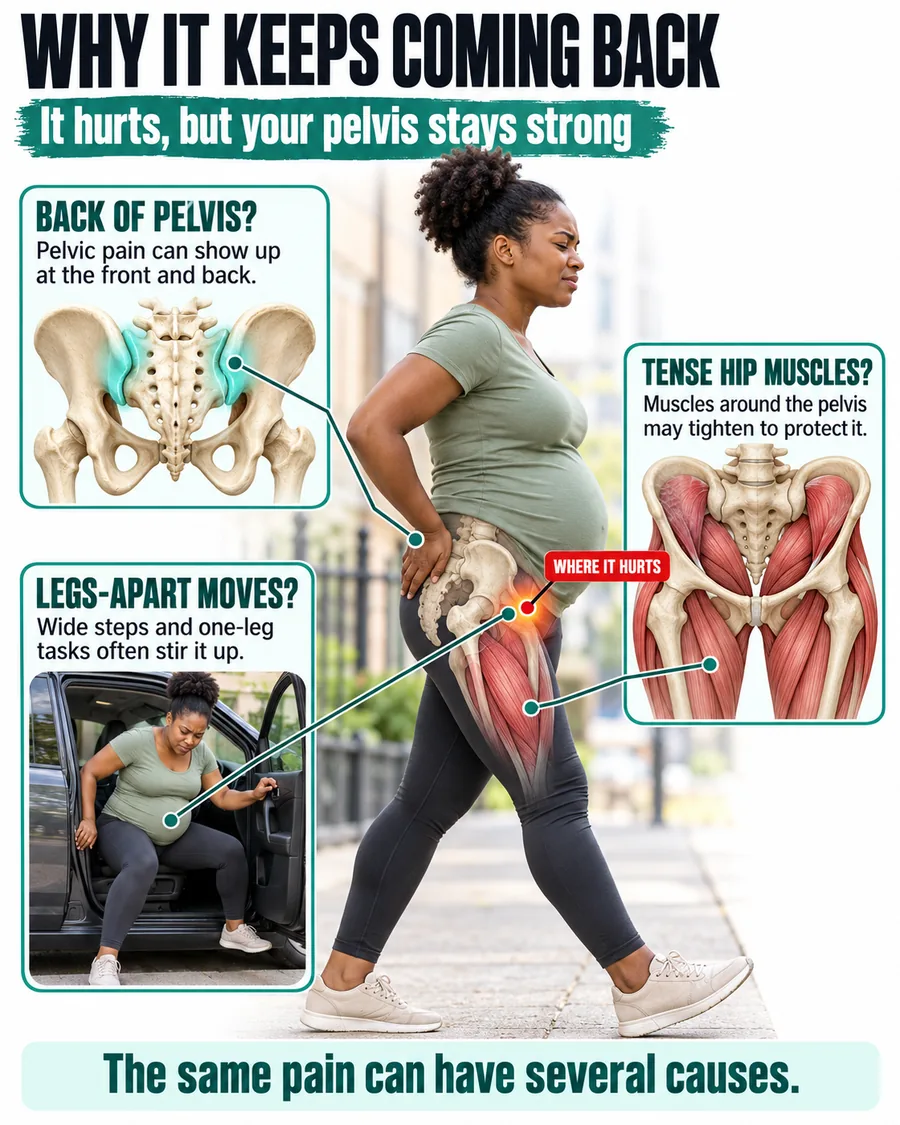
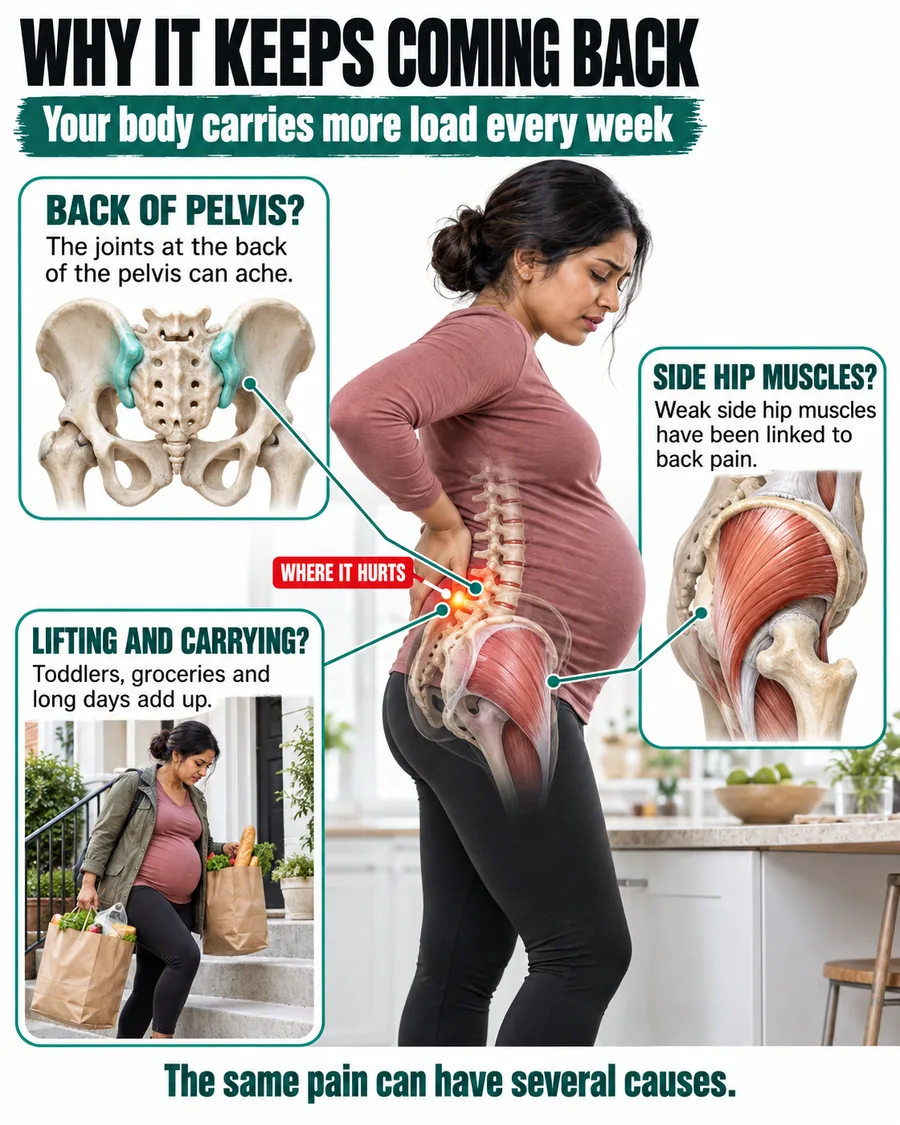
This is the most common type. Pain in one or both SI joints (sacroiliac joints), located at the back of the pelvis where the spine meets the pelvis. You feel it deep in the buttock, sometimes radiating into the back of the thigh. It is often worse on one side. Rolling over in bed, standing on one leg (getting dressed, climbing stairs), and prolonged sitting all aggravate it.
During pregnancy, the hormone relaxin loosens the ligaments around the pelvis to prepare for delivery. This is necessary and normal. But it reduces the stability of the SI joints, and the increasing weight of the baby shifts your centre of gravity forward. The combination of looser ligaments and higher load means the muscles around the pelvis (gluteals, deep hip rotators, pelvic floor, deep core) have to work harder to stabilize the joints. When they cannot keep up, the SI joint becomes overloaded and painful.
Treatment focuses on improving pelvic stability through targeted muscle activation (not general exercise), using a pelvic support belt to reduce joint stress, modifying daily activities that overload the SI joint, and manual therapy to address joint stiffness and muscle guarding. See our Back Pain page for more on SI joint treatment outside of pregnancy.
Anterior Pelvic Pain (Symphysis Pubis Dysfunction / SPD)
Pain at the front of the pelvis, directly over the pubic bone. It can feel like a sharp, stabbing sensation or a deep ache. Walking (especially longer distances), going up and down stairs, turning over in bed, and getting in and out of the car are the classic aggravators. In severe cases, you might hear or feel a clicking at the pubic symphysis.
The pubic symphysis is a cartilage joint that connects the two halves of the pelvis at the front. Like the SI joints, it becomes more mobile during pregnancy due to relaxin. When mobility becomes excessive, the joint surfaces shift under load and produce pain. Some women with SPD experience pain so severe it affects their ability to walk.
Treatment includes pelvic belt support (positioned low across the pelvis, not at the hips), avoiding asymmetric loading (getting in and out of the car with knees together, taking stairs one step at a time), inner thigh and deep core strengthening, and manual therapy. SPD responds well to physiotherapy, and most women experience meaningful improvement within 2 to 4 weeks of starting treatment.
Combined Pelvic Girdle Pain
Many pregnant women have both posterior (SI joint) and anterior (pubic symphysis) pain simultaneously. The entire pelvic ring is under stress. This is the most limiting presentation, and it responds best to a comprehensive approach that addresses all three pelvic joints (both SI joints and the pubic symphysis) together rather than treating one area in isolation.
Other Pregnancy Pains We Treat
Round Ligament Pain
A sharp, sudden pain in the lower abdomen or groin, usually on one side. It happens when the round ligaments (which support the uterus) stretch as the uterus grows. Quick movements, sneezing, coughing, or rolling over can trigger it. Round ligament pain is usually brief but can be alarming. Treatment involves gentle stretching, positional strategies, and reassurance that it is a normal response to uterine growth.
Pregnancy-Related Low Back Pain
Low back pain during pregnancy is distinct from pelvic girdle pain, though they often overlap. As the baby grows, the lumbar spine increases its curve (lordosis) to accommodate the shifted centre of gravity. This puts more compression on the lumbar facet joints and discs. Treatment includes postural education, lumbar stabilization exercises, manual therapy, and modification of sitting and sleeping positions. See our Back Pain page for detailed lumbar spine treatment.
Sciatica During Pregnancy
Some pregnant women develop true sciatica (pain radiating down the leg from a nerve root) or piriformis-related sciatic pain (the piriformis muscle in the buttock compresses the sciatic nerve as it tightens in response to pelvic instability). Pregnancy-related sciatica is treatable with specific exercises and manual therapy. See our Sciatica page for the full approach to nerve pain.
Rib and Thoracic Pain
As the baby grows and pushes the diaphragm upward, the lower ribs flare outward. This can cause pain at the rib attachments, mid-back stiffness, and difficulty breathing deeply. Manual therapy to the thoracic spine and ribs, combined with breathing exercises and positional strategies, provides relief.
What Treatment Looks Like During Pregnancy
Every session is one-on-one in a private treatment room. We use a pregnancy pillow system so you can lie comfortably on your side or in a semi-reclined position. Treatment is modified for your stage of pregnancy and your comfort level throughout.
Assessment
We identify exactly which pelvic structures are causing pain. SI joint provocation tests, pubic symphysis palpation, active straight leg raise testing, hip strength assessment, and pelvic floor screening. This takes about 30 minutes at the first visit and determines the entire treatment direction.
Hands-On Treatment
Gentle manual therapy to the SI joints, lumbar spine, hips, and surrounding muscles. Soft tissue release of the gluteal muscles, hip flexors, and piriformis. All techniques are modified for pregnancy and performed in comfortable positions. Nothing is done lying flat on your back past the first trimester.
Targeted Strengthening
The muscles that stabilize the pelvis during pregnancy: gluteus medius, deep hip rotators, transversus abdominis (the deepest core layer), and pelvic floor. These are not generic “prenatal exercises.” They are specific to the structures that are failing to stabilize your pelvis. The exercises are progressed as your strength improves and modified as your pregnancy advances.
Pelvic Belt Fitting
A pelvic support belt (not a maternity belly band) can significantly reduce SI joint and pubic symphysis pain by providing external compression across the pelvic ring. Proper fitting matters. Too high and it does nothing. Too tight and it is uncomfortable. We fit and adjust the belt at the clinic so you get the positioning and tension right.
Activity and Sleep Modification
Practical strategies that make an immediate difference. How to get in and out of bed without aggravating the pubic symphysis. How to position pillows for sleep (between knees, under the belly). How to modify stairs, car entry, and lifting. How to stay active (walking, swimming, prenatal yoga) while protecting the pelvis. These modifications often provide relief within days.
Pelvic Floor Preparation for Labour
The pelvic floor muscles stretch to approximately three times their resting length during vaginal delivery. Preparing these muscles (strengthening, learning to relax on demand, perineal massage education) reduces the risk of significant tearing and supports a smoother delivery. We integrate pelvic floor preparation into the treatment plan as you approach your due date. See our Pelvic Floor page for more on pelvic floor assessment.
When to Start Prenatal Physiotherapy
Ideally: before the pain starts. A pelvic assessment at 12 to 16 weeks identifies risk factors and begins the strengthening program before the pelvic joints become overloaded. Think of it as preventive maintenance.
Realistically: as soon as the pain appears. Most women come to us in the second or third trimester when pelvic pain has become limiting. Treatment is effective at any stage. Even starting at 32 or 36 weeks produces meaningful improvement for the remaining weeks of pregnancy and sets up a better foundation for postpartum recovery.
It is never too late. If you are 38 weeks and the pain is unbearable, there are still things we can do. Pelvic belt fitting, sleep positioning, SI joint mobilization, and activity modification can provide relief even in the final weeks.
Pregnancy Pelvic Pain Timelines
| Condition | Improvement Timeline | What to Expect |
|---|---|---|
| SI joint pain (posterior pelvic girdle pain) | 2 to 4 weeks for significant improvement | Reduced night pain, easier rolling in bed, less pain on stairs |
| SPD (pubic symphysis dysfunction) | 2 to 4 weeks with belt + strengthening | Less pain walking, easier car entry, reduced clicking |
| Combined pelvic girdle pain (anterior + posterior) | 3 to 6 weeks | Gradual return to walking, better sleep, reduced daily pain |
| Pregnancy-related low back pain | 2 to 4 weeks | Easier sitting and standing, reduced lumbar stiffness |
| Piriformis / sciatic pain in pregnancy | 3 to 6 weeks | Reduced leg pain, improved sitting tolerance |
Pain often improves faster than expected once the right structures are identified and the activity modifications are in place. Your physiotherapist provides a specific timeline at your first visit based on the assessment findings and your stage of pregnancy.
Why Oakville Moms Choose Wellmax
Pelvic Health Is Our Specialty
Pelvic floor physiotherapy is one of our core services, not a side offering. Our lead clinician, Gurmeet Rai, is a registered physiotherapist with specialized training in prenatal and postpartum pelvic health. She understands the specific biomechanics of the pregnant pelvis and how to treat it safely and effectively at every trimester.
Babies Are Welcome
You do not need to find childcare to come to your appointment. Bring the baby. Bring the toddler. We have a private treatment room, and we are used to working around nap schedules, feedings, and the occasional meltdown. Your care should not be delayed because childcare is not available.
Prenatal to Postpartum Care
The pelvic health care you receive during pregnancy carries straight into your postpartum recovery. Our Postpartum Physiotherapy program addresses diastasis recti, pelvic floor rehabilitation, c-section scar management, and return to exercise. One clinic, one plan, no gaps.
We Coordinate with Your Care Team
We work alongside OB-GYNs and midwives in the Oakville and Halton region. If your midwife or OB has referred you, or if you would like us to communicate with them about your progress, we coordinate care. We also complement prenatal yoga programs and prenatal fitness classes by providing the clinical assessment and individualized treatment that group classes cannot offer.
Oakville’s Pregnant Patients

We treat pregnant women from across the local area. First-time moms in Clearview and Winston Park whose SI joint pain started at 20 weeks and keeps getting worse. Second-time moms in Maple Grove who did not have pelvic pain with their first pregnancy but can barely walk this time. Women in Clarkson and Sheridan Park whose midwife told them to “just wait it out.” Moms from south Mississauga who tried prenatal yoga and still cannot roll over in bed without sharp pelvic pain. And women in any trimester who want to prepare their pelvic floor for delivery, not just treat pain after it appears.
We are at 1148 Winston Churchill Blvd, Unit B3, Oakville. Just south of the QEW in the Winston Park plaza. Free parking, ground-level access, private treatment rooms.
What Our Patients Say
Jolean L.“Do not hesitate to book an appointment if you are pregnant and are experiencing any pelvic pain. The team was able to help me improve my ambulation quality of life in a very short time. Highly recommend!!”
Victoria D., Oakville“Within just a handful of sessions, Gurmeet took issues I had been struggling with for months (and honestly, years after my first birth) and had me feeling like myself again. She’s the reason I went from debilitatingly painful periods to completely manageable ones — something I didn’t think was possible!”
Verified Patient“I was referred to pelvic health physio after having bladder urgency issues for months. I was nervous about the internal assessment but the therapist at Wellmax explained every single step before doing anything and I never felt rushed or uncomfortable. The treatment room was completely private. By the end of my treatment plan I went from running to the bathroom every 30 minutes to being able to hold comfortably for hours. I wish I had done this sooner instead of just assuming I had to live with it.”
Shamaila R.“Gurmeet Rai is not only an amazing physiotherapist, but also a truly wonderful person. Her smiling face and unique approach to treatment completely set her apart from other therapists. I first came to her with severe lower back and leg pain, and after her treatments, I experienced massive relief. When my younger sister visited from the UK suffering from pelvic floor issues, I immediately recommended Gurmeet. After just a few sessions, she is already feeling so much better! The clinic staff are also incredibly welcoming and helpful. Thank you, Gurmeet Rai, for your exceptional therapy and care!”
Marilyn’s E.“If you are looking for expert physiotherapy, look no further than Gurmeet Rai, who has just opened her own clinic, Wellmax Physiotherapy, in East Oakville. The space is freshly decorated and designed and the staff are welcoming. Treatment rooms are relaxing with calming colours and soft lighting. But the real bonus is the quality of the treatment and care you’ll receive. I began with pelvic floor therapy, but have continued on with Gurmeet to address some life-long postural issues. Gurmeet is a very experienced and highly skilled practitioner and I have no reservations in recommending her whatever your needs.”
Verified Patient“After my second baby I was dealing with leakage every time I coughed, sneezed, or tried to exercise. I put off getting help for almost a year because I felt embarrassed and thought it was just something that happens after kids. The pelvic floor assessment at Wellmax was private, respectful, and way less uncomfortable than I expected. Gurmeet explained exactly what was happening with my pelvic floor muscles and gave me a program that was nothing like the generic Kegels my doctor had suggested. Four sessions in and the leakage had improved significantly. I can actually jump with my kids again without worrying.”
Emily C.“I can confidently say this is the best physiotherapy clinic in Oakville for postpartum care. After having my baby, I was experiencing pelvic floor discomfort and lower back pain that was making daily life very difficult. I booked an appointment with Gurmeet, and she made me feel completely comfortable and heard right from the start. She asked detailed questions about my daily routine and explained how pelvic health physiotherapy could help rebuild my core strength safely. The hands-on treatment and tailored home exercises made a massive difference in just a few weeks. The atmosphere is welcoming and professional, and they truly focus on long-term results rather than just a quick fix.”
Amara W.“I can’t recommend Gurmeet enough for post-partum recovery. She has been incredibly supportive, knowledgeable, and attentive throughout my healing journey. An incredible pelvic floor physio she is. From week 1 Postpartum I am seeing Gurmeet and thats the best decision I ever made!”
See all our Google reviewsRead more patient storiesLeave a review

Level 3 Pelvic Health Certified
 Advanced training with
Pelvic Health Solutions
Pregnancy changes how your pelvis, back and hips share load, and pelvic girdle pain can make walking, stairs or rolling in bed uncomfortable. Gurmeet tests how your pelvis moves and what eases or provokes the pain, then adjusts the plan for your trimester. You leave with practical tips for sleep, work and daily movement, plus pelvic floor preparation for birth.
Frequently Asked Questions
Is physiotherapy safe during pregnancy?+–
Yes. Prenatal physiotherapy is safe at all stages of pregnancy. Treatment is modified for each trimester. You will not lie flat on your back. All manual therapy techniques and exercises are adjusted for your comfort and safety. Our physiotherapists have specialized training in prenatal care and work within the guidelines of the Canadian Physiotherapy Association for pregnancy.
When should I start prenatal physiotherapy for pelvic pain?+–
Ideally at 12 to 16 weeks for preventive pelvic floor and stability work, before the pelvic joints become overloaded. But any time symptoms appear is the right time to start. Even in the third trimester, treatment produces meaningful improvement. It is never too late to begin, and even starting at 36 weeks can provide real relief for the final weeks and set you up better for postpartum recovery.
My midwife says pelvic pain is normal during pregnancy. Should I just wait?+–
Pelvic pain is common during pregnancy but common does not mean untreatable. Up to 70 to 80% of pregnant women experience some form of pelvic or low back pain. Physiotherapy has strong evidence for reducing this pain and improving function. Waiting it out often means the pain gets worse as the pregnancy progresses and the baby gets heavier. Early treatment consistently produces better outcomes than waiting.
What is SPD and how is it treated?+–
SPD stands for symphysis pubis dysfunction. It is pain at the front of the pelvis where the two halves meet at the pubic symphysis joint. During pregnancy, this joint becomes more mobile due to the hormone relaxin. When mobility becomes excessive, the joint shifts under load and produces sharp, stabbing pain, especially walking, climbing stairs, or getting in and out of the car. Treatment includes pelvic belt support, activity modification (knees together for asymmetric movements), inner thigh and deep core strengthening, and manual therapy. Most women improve within 2 to 4 weeks.
What is pelvic girdle pain and how is it different from regular back pain?+–
Pelvic girdle pain (PGP) refers to pain at the SI joints, pubic symphysis, or both, caused by reduced stability of the pelvic ring during pregnancy. Unlike lumbar back pain, which is higher in the spine, PGP is felt deep in the buttock, over the tailbone, or at the front of the pelvis. The two conditions often overlap but require different treatments. PGP responds to pelvic stability exercises and belt support; lumbar back pain responds to core strengthening and postural work. An accurate assessment at the first visit identifies which is which.
Can I bring my baby or toddler to the appointment?+–
Yes. Babies and toddlers are welcome. We treat in private rooms and we are used to working around feeds, naps, and the occasional fuss. Do not delay your care because childcare is not available.
Will I need a pelvic support belt?+–
Many women with pregnancy pelvic pain benefit from a pelvic support belt. It provides external compression across the pelvic ring, reducing stress on the SI joints and pubic symphysis. Not everyone needs one, and the type and positioning matter significantly. A belt worn too high does nothing for the pelvis. Your physiotherapist will assess whether a belt is appropriate and fit it properly if so, adjusting the tension and position to your anatomy.
Can pelvic floor physiotherapy help prepare me for labour?+–
Yes. Pelvic floor preparation includes strengthening exercises, learning to relax the pelvic floor on demand (which is critical for the pushing stage of delivery), perineal massage education, and breathing strategies for labour. Women who complete pelvic floor preparation before delivery tend to have lower rates of significant perineal tearing. We integrate this preparation into your treatment plan as you approach your due date. See our Pelvic Floor page for details.
Is prenatal physiotherapy covered by insurance?+–
Yes. Treatment is billed as physiotherapy and covered by most extended health plans. We direct bill to Sun Life, Manulife, Canada Life, Green Shield, Great-West Life, Blue Cross, Desjardins, and most other major providers. No referral is needed. See our insurance page for the full list of providers we bill directly.
Will pelvic girdle pain go away on its own after the baby is born?+–
For most women, pregnancy-related pelvic girdle pain does resolve after delivery as relaxin levels drop and the pelvis restabilizes. However, recovery is faster and more complete with physiotherapy. Some women continue to have pelvic pain postpartum, particularly if there was significant ligament laxity, diastasis recti, or pelvic floor weakness. Our postpartum physiotherapy program specifically addresses these issues to support full recovery after delivery.
Related Conditions and Services
- Pelvic Floor Physiotherapy: Comprehensive pelvic floor assessment and treatment for all pelvic health conditions.
- Postpartum Physiotherapy: Diastasis recti, pelvic floor recovery, c-section rehab, and return to exercise after delivery.
- Women’s Health Physiotherapy: The full hub for women’s pelvic and musculoskeletal care across all life stages.
- Diastasis Recti: Abdominal separation treatment during and after pregnancy.
- Bladder Leakage and Incontinence: Pelvic floor physiotherapy for urinary leakage common in pregnancy and postpartum.
- Back Pain and Sciatica: Lumbar and SI joint conditions during and outside of pregnancy.
- Sciatica: Piriformis-related sciatic pain common during pregnancy.
- Hip Pain: Hip conditions that co-exist with pelvic girdle pain during pregnancy.
- Massage Therapy: Prenatal massage for muscle tension and relaxation alongside pelvic physio.
- Naturopathic Medicine: Holistic prenatal support including nutrition, supplementation, and wellness.
- Prenatal Chiropractic Care: Gentle chiropractic care for pregnancy-related spine and pelvic discomfort.
Book Your Prenatal Pelvic Assessment
If pregnancy pelvic pain is limiting your daily life, if you cannot sleep because rolling over hurts, if walking has become painful, or if you want to prepare your pelvic floor for delivery before problems start, get assessed. Your physiotherapist will identify the specific structures involved, start treatment at the first visit, and give you an honest timeline for improvement. Babies and toddlers are welcome at your appointment.
Wellmax offers a free 15-minute consult. Call or book online to get started.
Book a Prenatal Pelvic Assessment Call (905) 829-1100
Wellmax Physiotherapy
1148 Winston Churchill Blvd, Unit B3, Oakville, ON L6J 0A3
Phone: (905) 829-1100
Email: info@wellmaxphysiotherapy.ca
Hours: Monday to Friday 9am to 7pm; Saturday 9am to 2pm; Sunday 9am to 2pm (by appointment only).
Proudly Serving Our Local Communities:
- East Oakville: Winston Park, Clearview, and the QEW/403 Corridor.
- South Oakville: Eastlake, Maple Grove, Lorne Park, and Old Oakville.
- North Oakville: Joshua Creek, Falgarwood, Iroquois Ridge, and Upper Middle Road.
- Mississauga Border: Clarkson, Sheridan Park, Sheridan Homelands, and Southdown.
Insurance: Direct billing to most major providers. WSIB and MVA claims accepted. No referral needed.
Find Us in Oakville
Registered & Regulated
Regulated & Recognized Across Every Discipline
Wellmax is in good standing with the regulatory colleges and leading associations for physiotherapy, chiropractic, massage therapy, and naturopathic medicine in Ontario.