Pre and Post-Surgical Rehabilitation in Oakville
Prehab before surgery and structured rehabilitation after. One-on-one care, surgeon protocol compliance, direct billing.
Home > Our Services > Pre and Post-Surgical Rehabilitation in Oakville

Your surgery is scheduled. But what happens before and after it may matter just as much as the procedure itself.
Research consistently shows that patients who start physiotherapy before surgery recover faster, experience less pain, and regain function sooner. And structured post-surgical rehabilitation is the difference between a good outcome and a great one. At Wellmax, we provide both sides of the surgical equation.
Direct billing to most insurers. No referral needed.
Wellmax Physiotherapy provides trusted pre and post-surgical rehabilitation in Oakville for patients preparing for or recovering from orthopaedic surgery.
Your surgery is scheduled. But here is what most patients are not told: what you do in the weeks before surgery has a significant impact on how quickly and how well you recover afterward. Entering the operating room stronger, more mobile, and better educated about the recovery process leads to measurably better outcomes. Research consistently demonstrates that patients who complete prehabilitation recover faster, experience less pain, regain function sooner, and have better long-term results.
At Wellmax, we provide both sides of the surgical equation: prehab to get you into the best possible condition before your procedure, and structured post-operative rehabilitation to maximize your recovery and return to full function. Whether you are preparing for a knee replacement, recovering from an ACL reconstruction, or working through rotator cuff repair rehabilitation, our team follows evidence-based protocols and your surgeon’s specific guidelines to move you through recovery safely and efficiently.
We are at 1148 Winston Churchill Blvd, Unit B3, Oakville, just south of the QEW. Ground-level access, no stairs to navigate when you are on crutches or in a sling.
- Prehabilitation: What Happens Before Surgery Matters
- Types of Surgeries Covered Under Pre and Post-Surgical Rehabilitation in Oakville
- How Post-Surgical Rehabilitation Works
- What Results to Expect
- Why Patients Choose Wellmax for Surgical Rehabilitation
- Related Conditions and Services
- Book Your Pre-Surgical or Post-Surgical Assessment in Oakville
- Frequently Asked Questions
Prehabilitation: What Happens Before Surgery Matters
Prehabilitation (prehab) is structured physiotherapy and education before a planned surgery. The goal is to enter your procedure in the best possible physical condition: stronger supporting muscles, optimized joint range of motion, better cardiovascular fitness, and a clear understanding of what recovery will involve.
The evidence is clear:
- Knee replacement prehab: patients recover faster, have better early range of motion, and are more likely to meet discharge milestones on schedule.
- Hip replacement prehab: associated with shorter hospital stays, less post-operative pain, and faster return to independent walking.
- ACL reconstruction prehab: patients with stronger quads before surgery have significantly better knee function at 6 and 12 months post-surgery.
- Rotator cuff repair prehab: better shoulder function and less pain in the early post-operative period compared to no prehab.
What Prehab Includes
A prehab program at Wellmax is individualized to you, your surgery, your surgeon’s preferences, and your baseline fitness. It typically includes:
- Targeted strengthening: building the muscles that will support the joint during recovery, so you are not starting from zero after surgery.
- Range of motion optimization: maximizing joint mobility before surgery, because surgery temporarily reduces motion and you recover from a higher starting point.
- Education: understanding the surgery, the recovery timeline, the restrictions you will need to follow, and the rehabilitation milestones you are working toward.
- Cardiovascular fitness: maintaining overall conditioning without stressing the joint or surgical site.
The typical prehab timeline is 4 to 8 weeks before surgery, with 1 to 2 sessions per week plus a daily home program. Even 2 to 3 weeks of focused prehab produces meaningful benefit if your surgery is sooner.
Types of Surgeries Covered Under Pre and Post-Surgical Rehabilitation in Oakville
Wellmax provides pre and post-surgical rehabilitation for a wide range of orthopaedic procedures. The most common surgeries we see at our Oakville clinic include:
- Total Knee Replacement: One of the most common elective orthopaedic procedures. Rehabilitation focuses on range of motion (regaining flexion) in the first 6 to 8 weeks, progressive quadriceps and hip strengthening, balance and gait retraining, and functional movement recovery. Full rehabilitation typically spans 3 to 6 months. Prehab is strongly recommended to maximize early range of motion gains and reduce post-operative pain.
- Total Hip Replacement: Rehabilitation restores hip mobility (especially rotation and flexion), rebuilds gluteal and hip stabilizer strength, retrains gait and balance, and returns you to all daily activities. Full recovery takes 3 to 6 months. Prehab is associated with shorter hospital stays and faster return to independent walking.
- ACL Reconstruction: One of the most intensive rehabilitation programs in orthopaedic physiotherapy. The return-to-sport timeline is 9 to 12 months minimum before returning to pivoting sports like hockey and soccer. Phases include early motion and swelling management (weeks 1 to 6), progressive loading and strengthening (weeks 6 to 16), running introduction (months 4 to 6), and sport-specific training (months 6 to 9+). Patients who cut rehab short have significantly higher re-tear rates. See our ACL rehabilitation page for more detail.
- Rotator Cuff Repair: Rehabilitation must carefully balance protecting the repaired tendon while preventing stiffness. Passive and assisted range of motion begins early; active strengthening typically starts at 6 to 12 weeks depending on tear size and surgeon protocol. Return to overhead activity is typically 4 to 6 months. See our rotator cuff page for more. Prehab is associated with better early post-operative shoulder function.
- Meniscus Surgery (Meniscectomy or Repair): Recovery timeline depends on procedure type. Partial meniscectomy has faster recovery (4 to 8 weeks); meniscus repair requires protected weight-bearing for 4 to 6 weeks and full recovery over 3 to 5 months. Rehabilitation focuses on swelling reduction, range of motion, quadriceps strengthening, and return to activity. See our meniscus rehabilitation page.
- Shoulder Stabilization (Bankart Repair / Labral Repair): Immobilization is typically required for 4 to 6 weeks post-surgery. Progressive range of motion follows, then rotator cuff and scapular strengthening, then proprioceptive training. Return to contact or throwing sport is typically 4 to 6 months. See our shoulder rehabilitation page.
- Spinal Surgery (Discectomy, Laminectomy, Fusion): Walking begins immediately after spinal surgery. Structured physiotherapy typically starts at 6 to 12 weeks post-operation, focusing on progressive core and spinal stabilizer strengthening, mobility restoration within surgical constraints, and return to full daily and work activities. See our back pain rehabilitation page.
- Hip Replacement (Partial or Resurfacing): Similar rehabilitation approach to total hip replacement. Gait retraining and hip stabilizer strengthening are the primary focus areas.
- Ankle and Foot Surgery: Restores ankle mobility and dorsiflexion range of motion, rebuilds calf and peroneal muscle strength, retrains proprioception, and guides progressive weight-bearing. See our ankle and foot page.
- Sports Injuries Requiring Surgery: Including sports injury surgeries for high-grade ligament tears, cartilage procedures, and tendon repairs. Rehabilitation is sport-specific with criteria-based return to play.
How Post-Surgical Rehabilitation Works
Phase 1: Protection and Early Recovery (Weeks 1 to 6)
The first phase focuses on managing the acute post-operative response while respecting tissue healing timelines. Surgical tissues including ligament grafts, repaired tendons, and bone-implant interfaces take months to mature to full strength, even if surface-level pain has resolved. Stopping rehabilitation early or progressing too quickly in this phase is strongly associated with complications and poor long-term outcomes.
Phase 1 treatment at Wellmax includes:
- Gentle range of motion within the limits set by your surgeon.
- Swelling management: education on ice, elevation, and compression to control post-operative swelling and pain.
- Early muscle activation: isometric contractions to prevent atrophy without loading the healing tissue.
- Pain management education: understanding normal versus concerning pain, and how to manage it at home.
- Wound and scar management: once the wound is healed, scar tissue mobilization to prevent adhesions that limit joint mobility.
Phase 2: Progressive Loading and Mobility (Weeks 6 to 16)
As tissue healing progresses, the rehabilitation focus shifts to rebuilding strength and recovering functional range of motion. This phase is where the most intensive strength and movement work happens.
- Progressive strengthening with gradual resistance increases as the tissue tolerates load.
- Active range of motion recovery working toward full or near-full joint mobility.
- Manual therapy for scar tissue and joint mobility restrictions that develop post-operatively.
- Functional movement retraining: stairs, squatting, reaching, carrying, and the specific movements you need for daily life and work.
- Cardiovascular fitness recovery starting with low-impact options (cycling, swimming, aqua walking) before higher-impact activities.
Phase 3: Functional Recovery and Return to Activity (Months 4 to 12)
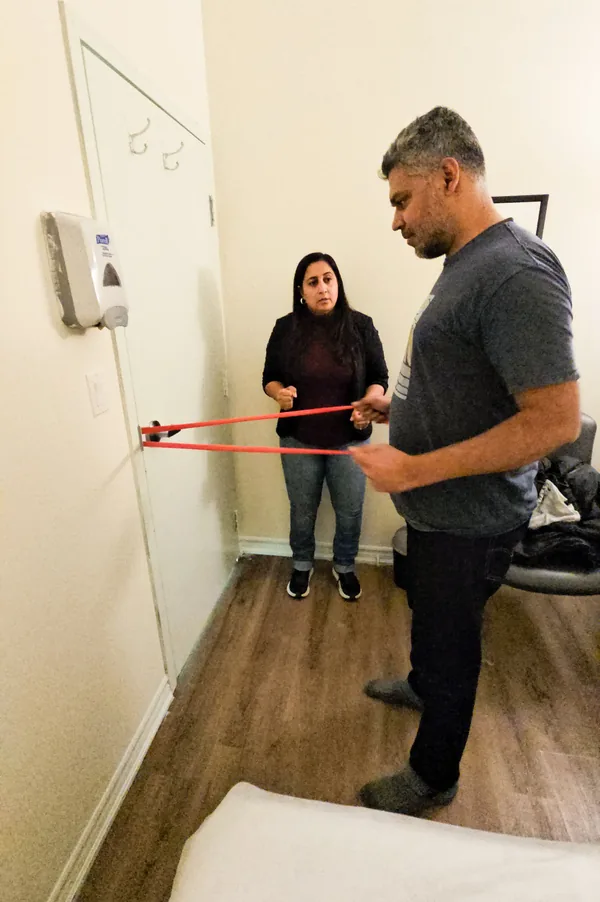
The final phase bridges from clinic-based rehabilitation to full return to work, sport, and daily life. The focus is on advanced strength, movement quality, confidence, and sustainability.
- Advanced strengthening to restore full strength symmetry between the operated and non-operated limb.
- Sport-specific or job-specific training: returning to the specific demands of your activity, whether that is hockey, golf, a physical trade, or carrying grandchildren.
- Balance and proprioceptive training: restoring the neuromuscular control that protects the joint from re-injury.
- Confidence building through progressive exposure to activities that feel uncertain after surgery.
- Discharge planning: a maintenance program to protect your investment in the surgical and rehabilitation process long-term.
What Results to Expect
| Surgery | Expected Outcome | Rehab Duration |
|---|---|---|
| Total knee replacement | Full functional recovery | 3 to 6 months |
| Total hip replacement | Full functional recovery | 3 to 6 months |
| ACL reconstruction | Full return to sport | 9 to 12 months |
| Rotator cuff repair | Full shoulder function | 4 to 6 months |
| Partial meniscectomy | Full recovery | 4 to 8 weeks |
| Meniscus repair | Full recovery with protected loading | 3 to 5 months |
| Lumbar discectomy | Significant improvement | 8 to 16 weeks |
| Shoulder stabilization (Bankart) | Full return to sport | 4 to 6 months |
| Achilles tendon repair | Full recovery | 6 to 9 months |
These are general timelines. Your physiotherapist provides a specific timeline and milestone targets at your first assessment based on your surgery, your surgeon’s protocol, and your individual baseline.
Why Patients Choose Wellmax for Surgical Rehabilitation
Prehab AND Rehab: Both Sides of the Equation
Most clinics only see you after surgery. We prefer to see you before AND after. Patients who prehab with us and then return for post-operative rehabilitation have the advantage of a documented baseline for strength and mobility, so recovery progress can be compared against where they started. That makes a difference, especially in the early weeks when progress can feel slow.
We Follow Your Surgeon’s Protocol
Every surgeon has specific protocols regarding weight-bearing restrictions, range of motion limits, and strengthening timelines. These are not arbitrary rules; they are based on the specific surgical technique, implant type, or tissue repair involved. We follow your surgeon’s protocol precisely and communicate with your surgical team when needed. You will never be asked to do something that conflicts with your surgeon’s instructions.
Expert Care from Assessment to Discharge
Post-surgical rehabilitation spans months. Your therapist tracks your progress against benchmarks, knows exactly which exercises to progress and when, and notices when something is not healing as expected. You get honest guidance at every stage, and the goal is independence, not an endless string of appointments. See our physiotherapy page for more on how we structure care.
Ground-Level Accessibility
Our clinic is on the ground floor at 1148 Winston Churchill Blvd, Unit B3, Oakville. No stairs to navigate when you are on crutches, in a sling, or recovering from spinal surgery. Free parking directly outside.
Direct Insurance Billing
We direct bill to most major insurers including Sun Life, Manulife, Canada Life, Green Shield, Great-West Life, Blue Cross, and Desjardins. WSIB and MVA claims accepted. No referral needed. If you had an overnight hospital admission or day surgery in the last 12 months, you may also qualify for OHIP-funded physiotherapy through the Ontario Community Physiotherapy Clinic Program; ask us at your first visit.
What Our Patients Say
Fred & Gail G.“My wife underwent back surgery (Decompression, Fusion L4/L5) in September 2025 following an extensive search for a surgeon we met who put her on his wait list. Complications arose post surgery because of reported soft bones & the need for a rare treatment to strengthen them. Pain continued & after months meeting with several Specialists covering numerous areas, we met Gurmeet @ Wellmax Physiotherapy. From the day we met, she has been: Highly Professional, Knowledgeable, Focused, Good Listener, Encouraging, all with the goal to provide treatments to get my wife back to her healthy self that preceded her severe back challenges. We are very confident Gurmeet’s wealth of knowledge, skills, guidance & determination are working to get her there!”
Palkin K.“I have been seeing Gurmeet Rai for physiotherapy for the past few months following my surgery. When I started, I was dealing with significant pain and limitations, but her treatment and guidance truly changed my recovery journey. She is incredibly skilled, patient, and compassionate, and she always took the time to understand my condition and tailored the therapy accordingly. Because of her support, my pain reduced. I highly recommend to anyone looking for effective and genuine physiotherapy care.”
Farrah S.“I saw Gurmeet for Pelvic Floor Therapy, before and after my Hysterectomy. She always made me feel comfortable and is very knowledgeable, helpful, and educated me during the whole process and at each visit. The front desk staff are always inviting and professional. I would recommend Wellmax to my friends and family.”
Maria G.“My experience here with knee osteoarthritis was too good not to share, making it the best physiotherapy clinic in Oakville in my opinion. I was having a lot of difficulty climbing stairs and my knee felt very unstable. Gurmeet was so patient and encouraging. Instead of just telling me to rest, she explained how strengthening the muscles around my knee would reduce the joint pain. The manual therapy provided instant relief, and the exercise program she designed was very easy to follow at home. My knee feels much stronger now and the sharp pain is gone. The entire staff is wonderful.”
Keith T.“Gurmeet Rai, Owner and Registered Physiotherapist, at Wellmax Physiotherapy in Oakville, has been treating my wife Claudia for spinal curvature conditions, Scoliosis and Kyphosis. Gurmeet has also treated me for hip and side pain issues. Gurmeet Rai is a very caring, well trained and knowledgeable professional, and she carefully addresses all related health issues. Gurmeet also recommends personal exercises, which can be done at home to make sure that her patient is getting the maximum recovery in-between visits. We have the fullest confidence in Gurmeet’s capabilities and we are very happy to have her looking after us. We recommend her highly.”
Sukhleen B.“I had been suffering from severe chronic back and hip pain for a long time and had tried physical therapy at many different places. Most of them relied on machines, massage guns, and heat or cold therapy, but no one was ever able to truly pinpoint the real problem. Meeting Gurmeet changed everything for me. She took the time to do a very detailed analysis of my gait and pain points and focused on hands-on manual therapy. She truly has magic in her hands. The relief and improvement I felt were something I hadn’t experienced in years. In addition to her manual therapy, she gave me exercises that were simple, practical, and extremely helpful in supporting my recovery. …”
Puja D.“I went to Gurmeet for knee tendinitis when I was struggling with climbing stairs and jogging. With her knowledge and techniques, she helped me recover and get back to feeling normal again. She is extremely helpful, friendly, and professional, and she never once made the sessions feel awkward. She explains things clearly and genuinely cares about your progress. I’m very grateful for her support and would highly recommend her.”
Verified Patient“Tore my meniscus playing soccer at Sixteen Mile Sports Complex and needed a physio who understood returning to sport, not just getting out of pain. Gurmeet built a rehab program that started with reducing the swelling and restoring range of motion and progressed all the way to cutting, pivoting, and sport-specific drills before she cleared me to play again. Most physios would have discharged me when the pain stopped. She made sure I was actually ready to compete. Back on the pitch now with full confidence in the knee.”
See all our Google reviewsRead more patient storiesLeave a review
Frequently Asked Questions
When should I start physiotherapy before surgery (prehab)?+–
Ideally 4 to 8 weeks before your surgery date, with 1 to 2 sessions per week plus a daily home exercise program. Even 2 to 3 weeks of focused prehab produces meaningful benefit if your surgery is sooner. The goal is to build the strength, range of motion, and body awareness that will accelerate your recovery after the procedure. Your physiotherapist will tailor the program to your surgery type and baseline fitness.
How long is physiotherapy after a knee replacement?+–
Most patients attend formal physiotherapy for 3 to 6 months after total knee replacement. The most critical window is the first 6 to 8 weeks, when regaining flexion range of motion is the priority. If stiffness sets in during this period, it becomes significantly harder to reverse. Sessions are typically 2 to 3 times per week early on, reducing to once a week or less as you become more independent with your home program.
How long does ACL rehabilitation take before I can return to sport?+–
A minimum of 9 to 12 months is recommended before returning to pivoting sports like hockey, soccer, or basketball after ACL reconstruction. This is not arbitrary; it reflects the time required for the graft to biologically mature to sufficient strength. Patients who return before this window have significantly higher re-tear rates. Return-to-sport decisions should be based on objective strength testing, not just time, and your physiotherapist will guide this assessment.
Is physiotherapy covered by insurance after surgery in Ontario?+–
Most extended health insurance plans (Sun Life, Manulife, Canada Life, Green Shield, Blue Cross, Desjardins) cover physiotherapy after surgery, typically between $500 and $2,000 per year. Wellmax direct bills most major insurers. If you had an overnight hospital stay or day surgery within the last 12 months, you may also qualify for OHIP-funded physiotherapy through the Ontario Community Physiotherapy Clinic Program. WSIB and MVA claims are also accepted.
Is prehab (pre-surgical physiotherapy) actually worth it?+–
Yes, the research supports it clearly. Patients who complete prehabilitation before knee or hip replacement enter surgery stronger and recover faster. ACL patients with stronger quadriceps before surgery have measurably better knee function at 6 and 12 months. Rotator cuff repair patients who prehab report less post-operative pain. Even 2 to 3 weeks of focused strengthening and education before surgery provides benefit, so it is worth starting as soon as your procedure is scheduled.
How long is physiotherapy after rotator cuff repair surgery?+–
Rotator cuff repair rehabilitation typically spans 4 to 6 months, and up to 9 to 12 months for large or massive tears. The first 6 to 8 weeks are passive and gentle, protecting the repaired tendon while preventing stiffness. Active strengthening starts around weeks 6 to 12 depending on tear size and your surgeon’s protocol. Overhead activity is usually cleared at 4 to 6 months. Stopping early risks stiffness and re-tear, so it is important to complete the full program.
When should I start physiotherapy after surgery?+–
The sooner the better for most surgeries. After knee or hip replacement, physiotherapy typically begins within 24 to 48 hours in hospital and continues within the first week as an outpatient. After ACL reconstruction, outpatient physiotherapy starts within the first week. After rotator cuff repair, gentle passive range of motion begins at 1 to 2 weeks. After spinal surgery, walking starts immediately and structured rehabilitation begins at 6 to 8 weeks. Early mobilization reduces swelling, prevents stiffness, and speeds recovery.
What happens if I stop physiotherapy early after surgery?+–
Stopping rehabilitation early is one of the most common reasons for poor surgical outcomes. After knee surgery, stiffness that sets in during the first 6 to 8 weeks can require additional procedures to reverse. After ACL reconstruction, patients who cut rehab short have significantly higher re-tear rates and lasting weakness. Surgical tissues like grafts, repaired tendons, and bone-implant interfaces continue maturing for months after the surface-level pain is gone. The length of rehabilitation reflects the actual biology of tissue healing, not just pain levels.
Do I need a referral for physiotherapy after surgery?+–
No. You can book directly with Wellmax without a referral for physiotherapy after any surgery. Bring your discharge summary or surgeon’s notes if you have them, as they contain weight-bearing restrictions and protocol guidelines that your physiotherapist needs. Some insurance plans or OHIP-funded physiotherapy programs may require a physician referral; your therapist can advise at your first visit. Walk-ins are welcome and same-day appointments are often available.
How long is physiotherapy after hip replacement?+–
Hip replacement rehabilitation typically runs 3 to 6 months. Most patients begin gentle range of motion and gait training within 1 to 2 days of surgery (often in hospital). Outpatient physiotherapy starts within the first week and focuses on restoring hip mobility, rebuilding gluteal and stabilizer strength, and retraining gait and balance. The 3 to 6 month timeline applies to full functional recovery; most patients are walking well by 6 to 8 weeks and back to most activities by 3 months.
Can physiotherapy help before a spinal surgery like a discectomy or fusion?+–
Yes, prehab before spinal surgery is beneficial. Strengthening the core and spinal stabilizers before surgery gives you a stronger foundation for recovery afterward. Education about post-operative restrictions and proper movement mechanics prepares you for what to expect. After spinal surgery, structured physiotherapy typically starts at 6 to 12 weeks with progressive core strengthening, mobility restoration, and return to full activities. See our back pain page for more on spinal rehabilitation.
Will my physiotherapist follow my surgeon's restrictions and protocol?+–
Yes, always. Bring your discharge summary, surgeon’s letter, or protocol sheet to your first post-operative appointment. Your physiotherapist will follow your surgeon’s specific instructions for weight-bearing, range of motion limits, and activity restrictions, and will communicate with your surgical team if questions arise. You will never be asked to do anything that conflicts with your surgeon’s protocol. We see this coordination as essential to safe, effective rehabilitation.
Related Conditions and Services
- Knee Pain Treatment: Conservative physiotherapy for knee pain, and rehabilitation after knee replacement and ACL surgery.
- ACL Injury Rehabilitation: Detailed ACL-specific prehab and post-surgical recovery protocols.
- Meniscus Tear Treatment: Conservative management and post-surgical rehabilitation after meniscectomy or repair.
- Shoulder Pain Treatment: Rehabilitation for shoulder surgery including Bankart repair, labral repair, and subacromial decompression.
- Rotator Cuff Injury: Prehab and post-surgical rehabilitation for rotator cuff repairs of all sizes.
- Hip Pain Treatment: Hip rehabilitation for hip replacement and hip arthroscopy recovery.
- Back Pain Treatment: Post-surgical rehabilitation after discectomy, laminectomy, and spinal fusion.
- Sports Injury Treatment: Criteria-based return-to-sport rehabilitation after surgery.
- Physiotherapy: The full range of one-on-one, hands-on physiotherapy at Wellmax.
Book Your Pre-Surgical or Post-Surgical Assessment in Oakville
Whether you are preparing for surgery or already in recovery, getting the right rehabilitation in place early makes a measurable difference in your outcome. The sooner you start, the more you can do. Wellmax offers a free 15-minute consultation if you want to talk through your situation before booking a full assessment.
Book a Surgical Rehab Assessment Call (905) 829-1100
Wellmax Physiotherapy
1148 Winston Churchill Blvd, Unit B3, Oakville, ON L6J 0A3
Phone: (905) 829-1100
Email: info@wellmaxphysiotherapy.ca
Hours: Monday to Friday 9am to 7pm; Saturday 9am to 2pm; Sunday 9am to 2pm (by appointment only).
Proudly Serving Our Local Communities:
- East Oakville: Winston Park, Clearview, and the QEW/403 Corridor.
- South Oakville: Eastlake, Maple Grove, Lorne Park, and Old Oakville.
- North Oakville: Joshua Creek, Falgarwood, Iroquois Ridge, and Upper Middle Road.
- Mississauga Border: Clarkson, Sheridan Park, Sheridan Homelands, and Southdown.
Insurance: Direct billing to most major providers. WSIB and MVA claims accepted. No referral needed.
Find Us in Oakville
Registered & Regulated
Regulated & Recognized Across Every Discipline
Wellmax is in good standing with the regulatory colleges and leading associations for physiotherapy, chiropractic, massage therapy, and naturopathic medicine in Ontario.