Knee Pain Treatment in Oakville
Home > Conditions We Treat > Knee Pain Treatment in Oakville

If you are looking for knee pain treatment in Oakville, you are not alone. Knee pain is one of the most common reasons people visit a physiotherapy clinic, and at Wellmax we see the full range: new sports injuries, chronic arthritis, recovering surgical patients, and people who have been told to “just rest it” for months without improvement.
Going downstairs has become the test. If the knee aches on the way down, you know it’s a bad day. Or maybe it’s the stiffness after sitting for more than 20 minutes, that feeling where you need a few steps before the knee “loosens up.” Or the sharp catch that hits when you pivot, squat, or try to kneel.
Knee pain affects everything. Walking, driving, exercising, sleeping, getting in and out of a car. And because you cannot exactly stop using your knees, the problem tends to linger and slowly get worse until you finally do something about it.
The good news is that most knee conditions respond well to physiotherapy. Even many ligament tears and meniscus injuries that people assume need surgery can improve significantly with the right rehabilitation. The key is getting an accurate assessment first, because the knee does not work in isolation. It absorbs force from the hip above and the ankle below. Effective treatment almost always involves more than just the knee itself, and that distinction is what separates lasting results from temporary relief.
At Wellmax Physiotherapy, every knee assessment includes the hip, the ankle, and the way you move. We are looking for what is driving the problem, not just where it hurts.
We are at 1148 Winston Churchill Blvd, Unit B3, Oakville, in the Winston Park area just south of the QEW. Clarkson, Clearview, Sheridan Park, Maple Grove, and south Mississauga are all under 10 minutes away.
Understanding the Knee
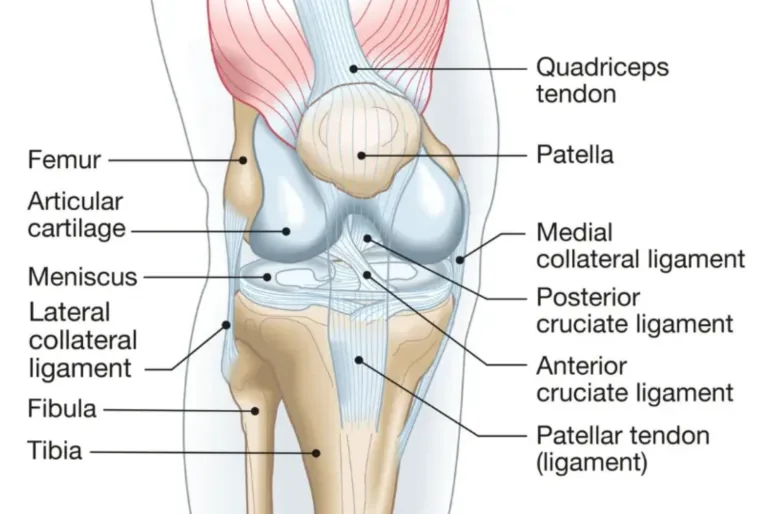
The knee is the largest joint in the body and one of the most mechanically demanding. It has to be stable enough to support your full body weight during walking, running, and jumping, and mobile enough to bend deeply for squatting, kneeling, and sitting. That combination of stability and mobility is what makes it vulnerable to injury when something in the system is not working properly.
The Bones and Joint Surfaces
The knee joint is formed by three bones: the femur (thigh bone), the tibia (shin bone), and the patella (kneecap). The femur and tibia form the main hinge of the knee. The patella sits in a groove on the front of the femur and acts as a pulley for the quadriceps muscle, increasing its mechanical advantage when you straighten the leg. The surfaces where these bones meet are covered with articular cartilage, a smooth, slippery tissue that allows frictionless movement. When this cartilage wears down, that is osteoarthritis.
The Ligaments
Four major ligaments hold the knee together and control its movement. The ACL (anterior cruciate ligament) sits inside the joint and prevents the tibia from sliding forward on the femur. It is the ligament most commonly torn in sports. The PCL (posterior cruciate ligament) prevents the tibia from sliding backward. The MCL (medial collateral ligament) runs along the inside of the knee and prevents it from buckling inward. The LCL (lateral collateral ligament) runs along the outside and prevents the knee from buckling outward. Each ligament has a specific job, and the symptoms of injury depend on which ligament is involved and how severely it is damaged.
The Meniscus
Two C-shaped pieces of fibrocartilage sit between the femur and tibia: the medial meniscus (inside) and the lateral meniscus (outside). They act as shock absorbers, distribute weight across the joint surface, and improve joint stability. The outer edge of each meniscus has good blood supply and can heal after injury. The inner edge has almost no blood supply, which is why tears in this zone often do not heal on their own and may require surgical intervention if conservative treatment does not work. See our meniscus tear treatment page for more detail.
The Muscles
The quadriceps (front of the thigh) are the primary extensors of the knee and the most important muscle group for knee function and protection. Quadriceps weakness is a factor in almost every knee condition we treat. The hamstrings (back of the thigh) bend the knee and help control rotation. The gluteal muscles at the hip control how the femur rotates and angles during weight-bearing, directly influencing how forces are distributed across the knee joint. Weak glutes are one of the most common hidden drivers of knee pain, the knee absorbs the consequences of what the hip fails to control.
Why the Hip and Ankle Matter
The knee sits between two powerful joints and essentially does what they tell it to. When the hip is weak (particularly the gluteus medius), the femur rotates inward during walking, running, and squatting, changing the angle at which force hits the knee. When the ankle is stiff (particularly limited dorsiflexion), the knee has to compensate by bending at different angles during squats and stairs. Both of these patterns show up as knee pain, but treating only the knee without addressing the hip or ankle above and below it is why many knee problems keep coming back. This is why every knee assessment at Wellmax includes the hip and ankle as standard.
Knee Conditions We Treat
ACL Injuries (Anterior Cruciate Ligament)
The ACL prevents the shin bone from sliding forward on the thigh bone. ACL tears typically happen during sports with sudden stops, direction changes, or landing from a jump. That “pop” followed by immediate swelling is the classic presentation.
Signs of an ACL tear include a popping sound or sensation at the moment of injury, rapid swelling within the first few hours, the knee feeling unstable or like it might buckle or give way, difficulty bearing full weight, and loss of full knee extension. Women are 2 to 8 times more likely to tear their ACL than men in the same sports, due to differences in anatomy, hormone effects on ligament laxity, and neuromuscular control patterns.
Not every ACL tear needs surgery. The decision depends on age, activity level, degree of knee instability, and what activities you want to return to. For people who do not play pivoting sports, structured physiotherapy can produce excellent stability and function without surgical reconstruction. Research calls these patients “copers,” they cope well without an intact ACL because the surrounding muscles compensate effectively. For athletes returning to cutting and pivoting sports (soccer, basketball, hockey, skiing), surgical reconstruction followed by 9 to 12 months of comprehensive rehabilitation is the typical path.
Whether surgical or non-surgical, physiotherapy is the treatment. Pre-surgical rehab (prehab) improves post-surgical outcomes significantly. Post-surgical rehab determines whether you actually get back to your sport. The surgery reconstructs the ligament. Rehab restores the strength, stability, neuromuscular control, and confidence to use it.
MCL Injuries (Medial Collateral Ligament)
The MCL runs along the inside of the knee and prevents it from buckling inward. MCL sprains are common from direct contact to the outside of the knee (hockey, football, skiing) or from awkward landings and cutting movements.
Symptoms include pain and tenderness along the inside of the knee, swelling along the inner knee line, a feeling of looseness or instability when the knee is pushed sideways, pain with walking especially on uneven ground, and stiffness after rest that gradually eases with movement.
MCL injuries are graded by severity. Grade I (mild stretch, intact fibres) recovers in 1 to 3 weeks. Grade II (partial tear) recovers in 4 to 6 weeks. Grade III (complete tear) typically heals in 6 to 10 weeks with bracing and structured rehabilitation. Most MCL sprains heal without surgery, even complete tears. The MCL has excellent blood supply compared to the ACL, which is why it heals well on its own. Treatment focuses on protecting the ligament during early healing, then progressively loading it to restore full strength and stability.
Meniscus Tears
The meniscus acts as a shock absorber between the thigh bone and shin bone. Tears can happen acutely from twisting the knee under load (sports injuries, stepping off a curb awkwardly) or develop gradually from wear and tear in people over 40 (degenerative tears).
Meniscus tears typically cause a catching or locking sensation in the knee, sharp pain with twisting or deep squatting, swelling that comes and goes (worse after activity), difficulty fully straightening or bending the knee, and sometimes a feeling that something is “stuck” inside the joint.
This is important: degenerative meniscus tears (common in people over 40) respond very well to physiotherapy. Multiple high-quality studies, including large randomized controlled trials published in the New England Journal of Medicine and BMJ, show that structured exercise therapy produces outcomes equal to or better than arthroscopic surgery for degenerative tears. Surgery removes damaged tissue but does not address the underlying weakness and deconditioning that contribute to symptoms. Physiotherapy addresses both. Acute traumatic tears in younger people may require surgical repair, particularly if the knee is mechanically locking or if the tear is in the outer zone where blood supply supports healing.
Patellofemoral Pain (Runner’s Knee)
Pain around or behind the kneecap, typically worse with squatting, stairs (especially going down), prolonged sitting, and running. This is the most common knee problem we see in recreational runners and active adults. It is usually caused by how the kneecap tracks in its groove on the femur, which is influenced by hip strength, quadriceps balance, and foot mechanics.
Common signs include aching behind or around the kneecap, pain that is worse going downstairs (more than upstairs), discomfort after sitting for long periods (the “movie theatre sign”), a grinding or crunching sensation when bending the knee, and pain during or after running, squatting, or lunging.
Patellofemoral pain is highly treatable with physiotherapy. The research is clear and consistent: hip strengthening (particularly gluteus medius) and quadriceps strengthening, combined with load management, resolves this condition in most people within 6 to 10 weeks. The reason downstairs is worse than upstairs is that descending requires the quadriceps to work eccentrically (lengthening under load), which increases compression behind the kneecap. Strengthening the quads to handle this load is the solution.
Knee Arthritis (Osteoarthritis)
Gradual wearing of the cartilage in the knee joint, leading to pain, stiffness, and sometimes swelling. Common in people over 50, but can develop earlier after previous injuries (ACL tears, meniscus removal, and fractures all accelerate cartilage wear).
Knee arthritis typically feels like stiffness first thing in the morning that eases within 30 minutes of moving, aching after prolonged walking, standing, or activity, swelling that comes and goes (often worse after busy days), grinding or crunching with movement, gradual loss of full knee bending or straightening, and for some people worse symptoms on cold, damp days.
Physiotherapy is the first-line treatment for knee arthritis, recommended ahead of surgery by every major clinical guideline worldwide. It is often more effective than pain medication alone. Strengthening the muscles around the knee reduces load on the joint surfaces, improves stability, and can significantly reduce pain. The X-ray showing “bone on bone” does not determine your pain or function. Many people with severe arthritis on imaging function well with a regular exercise program, and many people with mild changes on imaging are significantly limited. The modifiable factors (muscle strength, activity levels, weight, movement patterns) matter more than the imaging findings. Many patients delay or avoid knee replacement for years with proper exercise-based management.
IT Band Syndrome
The iliotibial band runs along the outside of the thigh from the hip to just below the knee. IT band syndrome causes sharp or burning pain on the outer side of the knee, typically in runners and cyclists. It tends to come on at a predictable point during a run (say, at the 3km mark every time) and worsens until you stop.
IT band syndrome is almost always driven by hip weakness, specifically the gluteus medius. When the hip cannot control the femur during single-leg stance (which is what running essentially is), the IT band becomes overloaded as it tries to compensate. Foam rolling the IT band might feel good temporarily, but it does not address the cause. Progressive hip strengthening combined with load management (adjusting running volume and intensity) is what produces lasting resolution. Shockwave therapy can be effective for stubborn cases that have not responded to exercise alone.
Patellar Tendinopathy (Jumper’s Knee)
Pain at the base of the kneecap where the patellar tendon attaches, common in basketball players, volleyball players, runners, and anyone who does repetitive jumping or squatting. The tendon becomes irritated and degenerates from repetitive overloading. Treatment is exercise-based, specifically heavy slow resistance training of the quadriceps, which stimulates tendon remodeling and strengthening. Isometric quadriceps exercises (holding a position under load) are excellent for immediate pain reduction while the progressive loading program takes effect.
Other Knee Conditions We Treat
- Bursitis (prepatellar bursitis, pes anserine bursitis)
- Baker’s cyst (popliteal cyst), often secondary to other knee pathology
- Post-fracture rehabilitation (tibial plateau, patella fractures)
- Total and partial knee replacement rehabilitation
- Ligament reconstruction rehabilitation (ACL, PCL, MCL)
- Osgood-Schlatter disease (adolescent knee pain)
- Knee hyperextension injuries
- Post-arthroscopy rehabilitation
- Pre- and post-surgical rehabilitation
How We Treat Knee Pain at Wellmax
Full Assessment Including Hip and Ankle
The knee does not work in isolation. Hip weakness (especially the gluteus medius) is one of the most common underlying causes of knee pain, from runner’s knee to IT band syndrome to ACL injury risk. Poor ankle mobility, specifically limited dorsiflexion, forces the knee to compensate during squats, stairs, and running. We assess the entire kinetic chain: hip strength and stability, knee joint movement and ligament integrity, patellar tracking, ankle mobility, and foot mechanics. This is how you find the actual driver of the problem, not just where it hurts.
Hands-On Manual Therapy
Manual therapy for knee conditions includes patellar mobilization (improving how the kneecap tracks in its groove), tibiofemoral joint mobilization (restoring full knee extension and flexion), soft tissue work for the quadriceps, hamstrings, IT band, and calf muscles, hip joint mobilization when the hip is contributing to the knee problem, and ankle mobilization when limited dorsiflexion is driving compensatory knee mechanics. Every session includes hands-on treatment alongside exercise.
Progressive Strengthening
The evidence for knee pain is overwhelmingly in favour of strengthening. Whether it is patellofemoral pain, arthritis, ligament injuries, or post-surgical rehab, the muscles around the knee need to be strong enough to support and protect the joint. Quadriceps strength is the single most important predictor of knee function across almost every condition. We build structured programs that start with pain-free loading (isometrics and supported exercises) and progress through full range strengthening, functional loading (squats, lunges, stairs), and sport-specific or work-specific demands.
Shockwave Therapy
Effective for chronic patellar tendinopathy (jumper’s knee) and IT band syndrome that has not responded to 6 to 8 weeks of exercise alone. Shockwave therapy stimulates blood flow, promotes tendon remodeling, and breaks down calcifications. Used as part of an integrated treatment plan, not as a standalone fix.
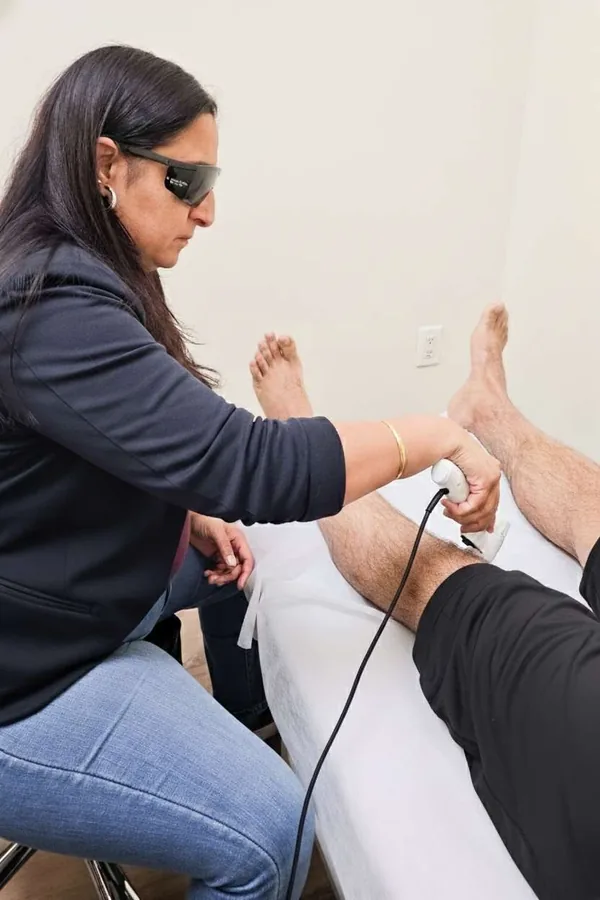
Deep Tissue Laser Therapy
Used for acute inflammatory conditions, post-surgical swelling, acute bursitis flare-ups, Baker’s cyst inflammation, to reduce swelling and accelerate the healing process. Also used for chronic knee conditions where tissue-level healing support is beneficial alongside the exercise program. See our deep tissue laser therapy page for more detail.
Custom Braces
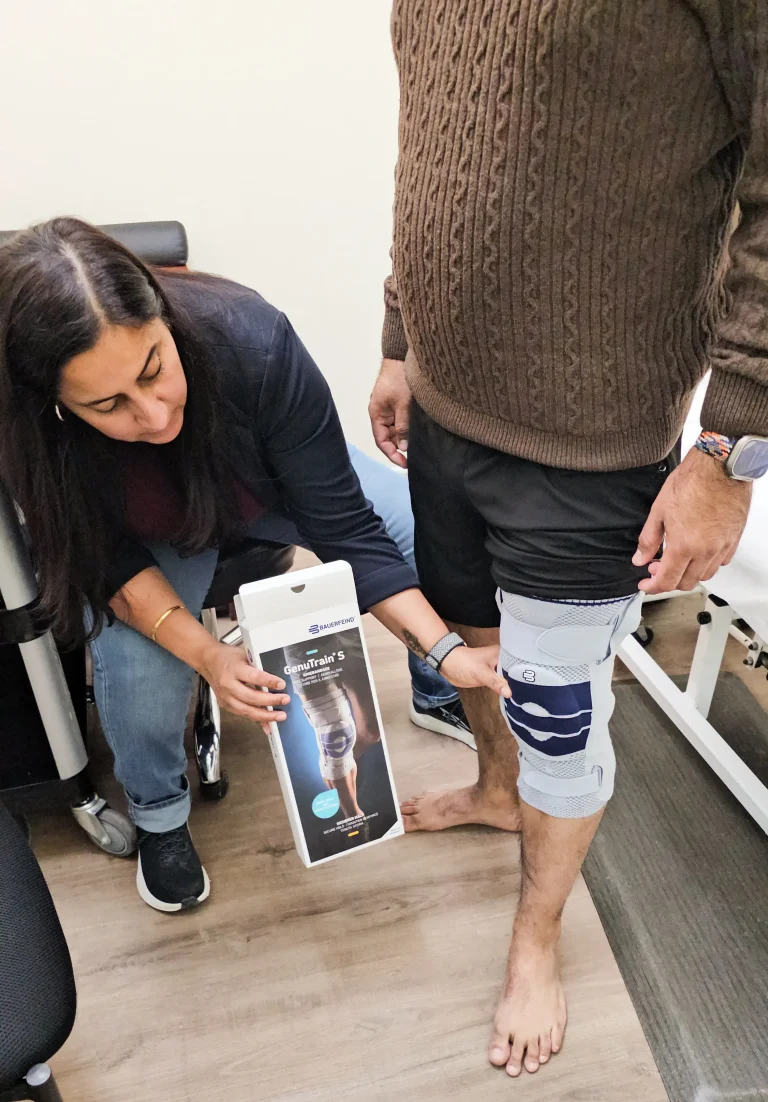
Custom braces for knee protection from high-impact activities, post-surgical recovery, and osteoarthritis. Unlike generic store-bought sleeves, our custom-measured braces provide medical-grade joint stability and offload pressure exactly where you need it, giving you the confidence to return to the activities you love without fear of re-injury. See our custom braces and orthotics page for details.
Your Recovery Timeline
Recovery timelines vary by condition, severity, and how long the problem has been present. Here is the general framework we use for most knee conditions.
Phase 1: Pain Management and Early Mobility (Weeks 1 to 3)
What we are doing: Manual therapy, gentle range of motion exercises, modalities for swelling if needed, early muscle activation (particularly the quadriceps, which shut down quickly after knee injury).
What you will notice: Swelling decreases, walking becomes more comfortable, you start bending and straightening the knee with less pain, the quad starts “waking up” again.
Your homework: Ice after activity if swollen, gentle range of motion exercises daily, quadriceps activation exercises multiple times per day, avoiding the specific aggravating movements we identify.
Phase 2: Strengthening and Functional Loading (Weeks 4 to 8)
What we are doing: Progressive quadriceps and hip strengthening (the two most important muscle groups for knee function), balance and proprioception training, functional movement patterns (squats, stairs, lunges, step-ups).
What you will notice: Stairs become easier, you can walk longer distances without pain, confidence in the knee increases, you start doing things you had been avoiding.
Your homework: Strengthening program 3 to 4 times per week, walking program with gradually increasing distance, activity-specific modifications we have discussed.
Phase 3: Return to Full Activity (Weeks 8 to 12+)
What we are doing: Advanced strengthening to full functional capacity, sport-specific training if applicable, running progression (structured return-to-running program for runners), maintenance planning for long-term knee health.
What you will notice: Full knee function restored, return to gym, sport, or activities without restriction, self-management confidence and knowledge to maintain progress.
Your homework: Ongoing maintenance exercises 2 to 3 times per week (this becomes permanent for many knee conditions, 15 minutes of targeted work protects the knee long-term).
Post-surgical timelines are longer: ACL reconstruction rehab runs 9 to 12 months before return-to-sport clearance. Total knee replacement rehab takes 12 to 24 weeks for functional recovery. These programs follow specific milestone-based progressions rather than arbitrary calendar dates.
What Results to Expect Based on Scientific Evidence
| Condition | Expected Outcome | Typical Timeline |
|---|---|---|
| Patellofemoral pain (runner’s knee) | 80 to 90% resolution | 6 to 10 weeks |
| ACL tear (non-surgical) | Functional stability restored | 12 to 20 weeks |
| ACL reconstruction (rehab) | Return to sport clearance | 9 to 12 months |
| MCL sprain (Grade I to II) | 90 to 95% full recovery | 3 to 6 weeks |
| MCL sprain (Grade III) | Full recovery with bracing and rehab | 6 to 10 weeks |
| Meniscus tear (degenerative) | Significant improvement | 6 to 12 weeks |
| Knee arthritis | Pain reduction, improved function | 6 to 12 weeks |
| Patellar tendinopathy | 75 to 85% improvement | 8 to 12 weeks |
| IT band syndrome | 85 to 90% resolution | 4 to 8 weeks |
| Total knee replacement (rehab) | Functional recovery | 12 to 24 weeks |
These timelines represent typical ranges. Individual results depend on injury severity, how long the condition has been present, adherence to the home exercise program, and overall health. Your physiotherapist will give you a specific estimate at your first assessment.
Why Choose Wellmax for Knee Pain Physiotherapy in Oakville
We Assess the Whole Chain
Knee pain that keeps coming back is usually being driven by something above (hip weakness) or below (ankle stiffness). Every knee assessment at Wellmax includes the hip, ankle, and foot as standard, not as an add-on or afterthought. This is how you find the actual driver and stop the cycle of temporary relief followed by recurrence.
Expert Care, Every Visit
Knee rehab is a progression. Your therapist needs to know where you were last week, how your knee responded to the last exercise progression, and whether the loading tolerance has improved enough to advance. That kind of precision requires expert hands and clinical judgment applied to your case from start to finish.
Evidence-Based Approach to Surgery Decisions
We do not default to “you need surgery” or “you definitely do not need surgery.” We assess your specific situation against the current evidence. For degenerative meniscus tears, the evidence strongly supports trying physiotherapy first. For ACL tears, the decision depends on your age, sport, and stability. We give you the information to make an informed choice, and if surgery is the right call, we provide pre-surgical and post-surgical rehabilitation.
Shockwave and Laser Available
For chronic tendon conditions (patellar tendinopathy, IT band syndrome) and post-surgical inflammation, we have shockwave therapy and deep tissue laser therapy available as part of the treatment plan. These are not substitutes for exercise, they are tools that accelerate progress when exercise alone has plateaued.
Convenient Oakville Location
1148 Winston Churchill Blvd, Unit B3, Oakville. Free parking directly in front. Ground-level entrance. Clarkson: 5 minutes. Clearview: 8 minutes. Sheridan Park: 10 minutes. South Mississauga: 7 minutes.
Direct Insurance Billing
Knee physiotherapy is covered under your physiotherapy benefit in most extended health plans. We direct bill to Sun Life, Manulife, Canada Life (formerly Great-West Life), Green Shield, Blue Cross, Desjardins, and most other major providers. WSIB and MVA knee injuries billed directly. No referral needed. See our insurance and direct billing page for details.
What Our Patients Say
Verified Patient“Tore my meniscus playing soccer at Sixteen Mile Sports Complex and needed a physio who understood returning to sport, not just getting out of pain. Gurmeet built a rehab program that started with reducing the swelling and restoring range of motion and progressed all the way to cutting, pivoting, and sport-specific drills before she cleared me to play again. Most physios would have discharged me when the pain stopped. She made sure I was actually ready to compete. Back on the pitch now with full confidence in the knee.”
Joan B.“The team is wonderful and they did amazing job to fix my knee injury. I highly recommend them for any physio needs”
Sam S.“Dr. Gurmeet is absolutely amazing! I have been suffering from knee and hamstring pain for 10 months. I tried physical therapy before seeing her, but nothing worked. Incredible as it sounds, I felt a noticeable improvement after my very first session with Dr. Gurmeet. She understood exactly where the pain was coming from right after our first conversation. On top of her expertise, she is cheerful, patient, and truly wonderful in every way. I highly recommend anyone experiencing bodily pain to visit her immediately. I will definitely be completing the rest of my sessions with her. Thank you so much, Dr. Gurmeet! 🙏”
Maria G.“My experience here with knee osteoarthritis was too good not to share, making it the best physiotherapy clinic in Oakville in my opinion. I was having a lot of difficulty climbing stairs and my knee felt very unstable. Gurmeet was so patient and encouraging. Instead of just telling me to rest, she explained how strengthening the muscles around my knee would reduce the joint pain. The manual therapy provided instant relief, and the exercise program she designed was very easy to follow at home. My knee feels much stronger now and the sharp pain is gone. The entire staff is wonderful.”
Puja D.“I went to Gurmeet for knee tendinitis when I was struggling with climbing stairs and jogging. With her knowledge and techniques, she helped me recover and get back to feeling normal again. She is extremely helpful, friendly, and professional, and she never once made the sessions feel awkward. She explains things clearly and genuinely cares about your progress. I’m very grateful for her support and would highly recommend her.”
Sunil R.“Gurmeet figured out the cause of my knee pain and is working hard on fixing it. Already feel much more pain relief and better walking ability. Thanks to you and your team! Not only are you all very professional and knowledgeable, but also very kind and caring! As an update, Gurmeet’s techniques have significantly improved the mobility in my foot/ankle, and the recommended stretches and modalities have all helped so much too! Thankful to Nav and Cynthia too. Everyone is so skilled and polite and friendly! Cynthia is the best massage therapist I’ve had in years! She really works on the tight muscles and listens to feedback well if you ask for less or more pressure. …”
Palkin K.“I have been seeing Gurmeet Rai for physiotherapy for the past few months following my surgery. When I started, I was dealing with significant pain and limitations, but her treatment and guidance truly changed my recovery journey. She is incredibly skilled, patient, and compassionate, and she always took the time to understand my condition and tailored the therapy accordingly. Because of her support, my pain reduced. I highly recommend to anyone looking for effective and genuine physiotherapy care.”
Fred & Gail G.“My wife underwent back surgery (Decompression, Fusion L4/L5) in September 2025 following an extensive search for a surgeon we met who put her on his wait list. Complications arose post surgery because of reported soft bones & the need for a rare treatment to strengthen them. Pain continued & after months meeting with several Specialists covering numerous areas, we met Gurmeet @ Wellmax Physiotherapy. From the day we met, she has been: Highly Professional, Knowledgeable, Focused, Good Listener, Encouraging, all with the goal to provide treatments to get my wife back to her healthy self that preceded her severe back challenges. We are very confident Gurmeet’s wealth of knowledge, skills, guidance & determination are working to get her there!”
See all our Google reviewsRead more patient storiesLeave a review
Frequently Asked Questions
Do I need surgery for a meniscus tear?+–
Not always, and often no. Degenerative meniscus tears (common in people over 40) respond as well or better to physiotherapy compared to arthroscopic surgery. Multiple large randomized controlled trials support this. Surgery removes damaged tissue but does not address the underlying weakness and deconditioning. Physiotherapy addresses both. Acute traumatic tears in younger patients, particularly if the knee is mechanically locking, may benefit from surgical repair. We assess your specific situation and give you an honest recommendation.
Can I avoid knee replacement with physiotherapy?+–
For many people, yes, or at least delay it significantly. Research consistently shows that structured exercise therapy reduces knee arthritis pain and improves function, sometimes enough to postpone or eliminate the need for surgery. Strengthening the muscles around the knee reduces load on the joint surfaces. Even if you eventually need a replacement, being stronger going in produces better surgical outcomes and faster recovery.
How long does ACL rehab take?+–
Non-surgical ACL rehab typically runs 12 to 20 weeks to restore functional stability. Post-surgical ACL reconstruction rehab takes 9 to 12 months before return-to-sport clearance. Rushing ACL rehab significantly increases re-injury risk, which is why we follow evidence-based return-to-sport criteria (strength testing, hop testing, movement quality assessment) rather than arbitrary calendar timelines. The surgery gives you a new ligament. The rehab teaches your body how to use it.
Why does my knee hurt going downstairs but not upstairs?+–
Going downstairs puts significantly more load through the patellofemoral joint (behind the kneecap) than going upstairs. The quadriceps have to work eccentrically, lengthening under load, to control your descent, which increases compression behind the kneecap. This is a hallmark of patellofemoral pain and responds very well to targeted hip and quadriceps strengthening. Most people see improvement within 4 to 6 weeks.
Can I still exercise with knee pain?+–
In most cases, yes, with modifications. Avoiding all exercise usually makes knee pain worse because the muscles weaken and the joint loses its support system. We identify which movements are safe, which need modification, and which to temporarily avoid. The goal is to keep you active while the knee recovers. Many patients are surprised by how much they can still do with the right guidance.
Is cracking or popping in my knee dangerous?+–
Cracking or popping without pain is almost always harmless. It is usually gas bubbles releasing in the joint fluid (cavitation) or tendons snapping over bony surfaces. This does not cause damage and does not mean arthritis is developing. Cracking or clicking accompanied by pain, swelling, catching, or a feeling of instability is different and should be assessed.
How often should I come for knee physiotherapy?+–
Most knee patients start at twice per week for 2 to 3 weeks (to establish the exercise program and manage acute symptoms), then drop to once weekly as you become more independent with the home program, then every other week for monitoring and progression. Total course is typically 8 to 16 sessions. ACL rehab and post-surgical cases may need longer programs extending over several months.
What should I do immediately after a knee injury?+–
Protect the knee from further injury, avoid full weight-bearing if it is very painful, apply ice for 15 to 20 minutes every 2 to 3 hours, and elevate the leg when resting. Get assessed within a few days, sooner if the knee is locked (cannot straighten), extremely swollen (suggests ligament or meniscus injury), or completely unable to bear weight. Early assessment leads to faster recovery.
Does knee pain from arthritis ever go away completely?+–
Arthritis itself does not reverse, the cartilage changes are permanent. But the pain and stiffness it causes can be managed very effectively with the right exercise program. Many patients go from daily pain that limits their activities to minimal or no pain with regular strengthening. The X-ray does not change, but how you feel and what you can do changes significantly. The goal is functional improvement, not a perfect scan.
Will my insurance cover knee physiotherapy?+–
Most extended health benefit plans include physiotherapy coverage, typically $500 to $1,500 per year. We direct bill to most major providers so you do not pay upfront. MVA and WSIB knee injuries are billed directly to the respective insurer. No referral is needed to start treatment in Ontario.
Related Conditions and Services
- Meniscus Tear Treatment: Meniscus rehabilitation, when surgery is and is not needed, and the research behind physiotherapy-first.
- ACL Injury Treatment: Surgical and non-surgical ACL pathways, prehab, and return-to-sport timelines.
- IT Band Syndrome Treatment: Why foam rolling does not work and what actually resolves lateral knee pain.
- Arthritis Treatment: Exercise-based management for knee and hip osteoarthritis.
- Running Injuries: Runner’s knee, IT band syndrome, patellar tendinopathy, and return-to-running programs.
- Sports Injury Rehabilitation: Ligament sprains, acute injuries, and sport-specific rehab.
- Hip Pain: Hip weakness is one of the most common drivers of knee pain; many patients benefit from combined knee and hip rehabilitation.
- Shockwave Therapy: For chronic patellar tendinopathy, IT band syndrome, and other tendon conditions around the knee.
- Pre- and Post-Surgical Rehabilitation: Prehab and post-op rehab for knee replacement and ligament reconstruction.
- Bursitis: Prepatellar bursitis, pes anserine bursitis, and knee bursitis management.
Book Your Knee Assessment
Whether it is a new injury, a chronic problem, or a knee that has not responded to previous treatment, the first step is a thorough assessment that looks at the whole picture, knee, hip, ankle, and how you move. Wellmax offers a free initial consult so you can find out what is driving your knee pain before committing to a treatment plan.
Wellmax Physiotherapy
1148 Winston Churchill Blvd, Unit B3, Oakville, ON L6J 0A3
Phone: (905) 829-1100
Email: info@wellmaxphysiotherapy.ca
Proudly Serving Our Local Communities:
- East Oakville: Winston Park, Clearview, and the QEW/403 Corridor.
- South Oakville: Eastlake, Maple Grove, Lorne Park, and Old Oakville.
- North Oakville: Joshua Creek, Falgarwood, Iroquois Ridge, and Upper Middle Road.
- Mississauga Border: Clarkson, Sheridan Park, Sheridan Homelands, and Southdown.
Insurance: Direct billing to most major providers. WSIB and MVA claims accepted. No referral needed. See our insurance and direct billing page for details.
Hours: Monday to Friday: 9am to 7pm | Saturday: 9am to 2pm | Sunday: 9am to 2pm (by appointment only)
Registered & Regulated
Regulated & Recognized Across Every Discipline
Wellmax is in good standing with the regulatory colleges and leading associations for physiotherapy, chiropractic, massage therapy, and naturopathic medicine in Ontario.