Postpartum Physiotherapy in Oakville
Home > Our Services > Postpartum Physiotherapy in Oakville
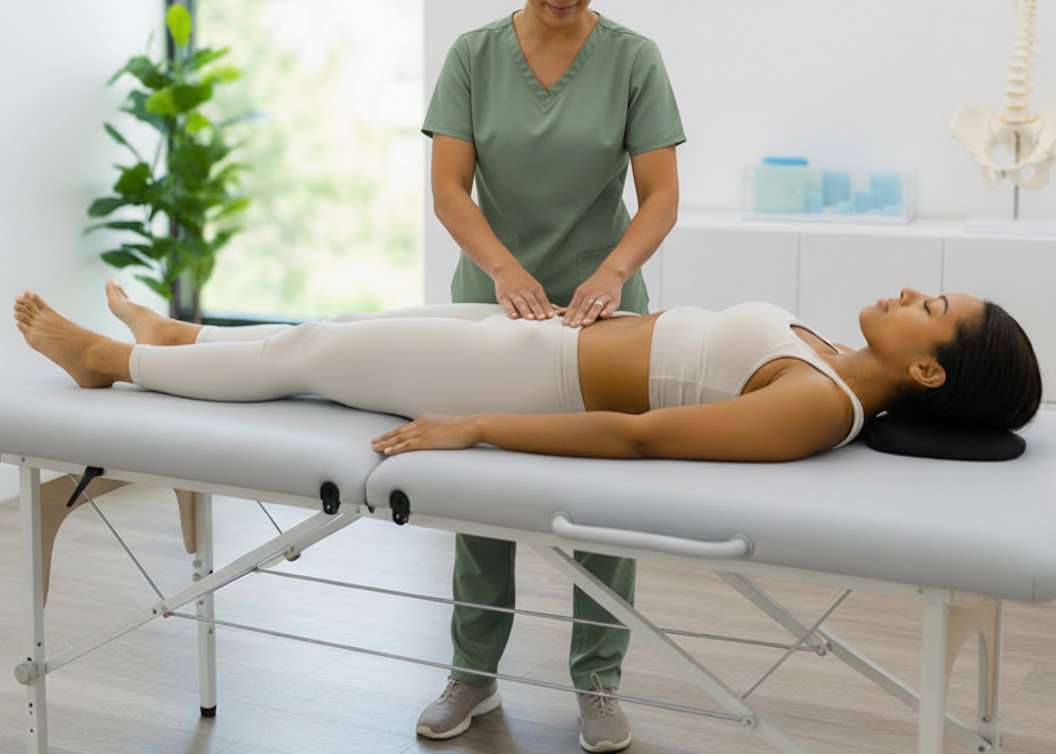
Six weeks postpartum, your doctor says you are cleared for exercise. But your body doesn’t feel ready.
Your core feels disconnected. You leak when you cough or sneeze. There is a visible bulge down the middle of your stomach when you sit up. Maybe your C-section scar is tight and numb. The six-week clearance means your tissues have healed enough, but not that your pelvic floor has recovered. Postpartum physiotherapy bridges that gap.
Private rooms. Expert care every visit. Babies always welcome. No referral needed.
Wellmax Physiotherapy provides expert postpartum physiotherapy in Oakville for pelvic floor recovery, diastasis recti, C-section scar rehabilitation, bladder leakage, and return to exercise after baby.
Six weeks postpartum, your doctor says you are cleared for exercise. But your body doesn’t feel ready. Your core feels disconnected, like the muscles have forgotten how to work together. You leak when you cough, sneeze, or pick up the baby. There is a visible bulge down the middle of your stomach when you sit up. Maybe your C-section scar is tight, numb, and pulling. And the idea of going back to running or the gym feels somewhere between unrealistic and terrifying.
Here is what the six-week clearance actually means: your tissues have healed enough to resume normal activities. It doesn’t mean your pelvic floor has recovered its strength. It doesn’t mean your core is functioning. It doesn’t mean your body is ready for running, lifting, or high-impact exercise. That part requires deliberate, progressive rehabilitation. This is the part that gets skipped for most women.
Postpartum physiotherapy bridges the gap between medical clearance and actual physical readiness. It is a thorough assessment of how your pelvic floor, core, and body are functioning after pregnancy and delivery, followed by a structured plan to restore what pregnancy changed. This isn’t about “bouncing back.” It is about making sure your body works properly so you can carry your baby, exercise, cough, laugh, and live your life without leaking, pain, or constantly worrying that something isn’t right.
At Wellmax Physiotherapy, postpartum assessments take place in a private treatment room. Every session is one-on-one care at Wellmax. We understand that you are recovering while also taking care of a baby, which is why babies are always welcome at appointments.
We are at 1148 Winston Churchill Blvd, Unit B3, Oakville, in the Winston Park area just south of the QEW. Serving new moms in Clarkson, Clearview, Sheridan Park, Maple Grove, and south Mississauga.
- What Pregnancy and Delivery Do to Your Body
- What Postpartum Physiotherapy Addresses
- Your Return-to-Exercise Roadmap
- What to Expect at Your First Postpartum Assessment
- What Results to Expect
- Why Choose Wellmax for Postpartum Physiotherapy
- Related Conditions and Services
- Book Your Postpartum Assessment in Oakville
- Frequently Asked Questions
What Pregnancy and Delivery Do to Your Body
Understanding why postpartum physiotherapy matters starts with understanding the scale of what your body just went through. This is not a single injury; it is a nine-month, system-wide adaptation followed by one of the most physically demanding events the body experiences.
The pelvic floor supports the growing weight of the baby, placenta, and amniotic fluid for nine months. During vaginal delivery, these muscles stretch up to three times their resting length. Even without tearing, this level of stretch causes temporary weakness and altered coordination. With tearing (first through fourth degree) or episiotomy, there is additional tissue trauma that needs to heal. C-section delivery bypasses vaginal trauma but still involves nine months of pelvic floor loading, plus surgical cutting through the abdominal wall and its effects on core function.
The abdominal wall stretches progressively throughout pregnancy. The rectus abdominis muscles (the “six-pack” muscles) separate along the midline, a condition called diastasis recti. This happens in virtually every pregnancy to some degree. In many women it resolves naturally in the first 8 weeks postpartum. In roughly one-third of women, it doesn’t fully resolve without intervention, leaving a gap that affects core stability, posture, and function.
The hormonal environment changes dramatically. Relaxin, a hormone that softens ligaments and connective tissue to prepare the pelvis for delivery, remains elevated for months postpartum (and longer if breastfeeding). This means joints are more lax and less stable than normal, which affects everything from the sacroiliac joints to the pubic symphysis to the arches of the feet.
Posture and loading patterns shift. Nursing, carrying the baby, car seat lifting, pushing the stroller. These new repetitive activities load the body in ways it wasn’t loaded before. Upper back and neck tension, wrist pain (de Quervain’s tenosynovitis), and lower back pain are extremely common in the early postpartum period, and they are compounded by a core and pelvic floor that aren’t yet functioning at full capacity. For back, neck and joint aches after birth, see our postpartum chiropractor page.
None of this is abnormal. All of it is treatable. But it doesn’t fix itself through rest alone, and the six-week medical check doesn’t assess any of it.
What Postpartum Physiotherapy Addresses
Diastasis Recti (Abdominal Separation)
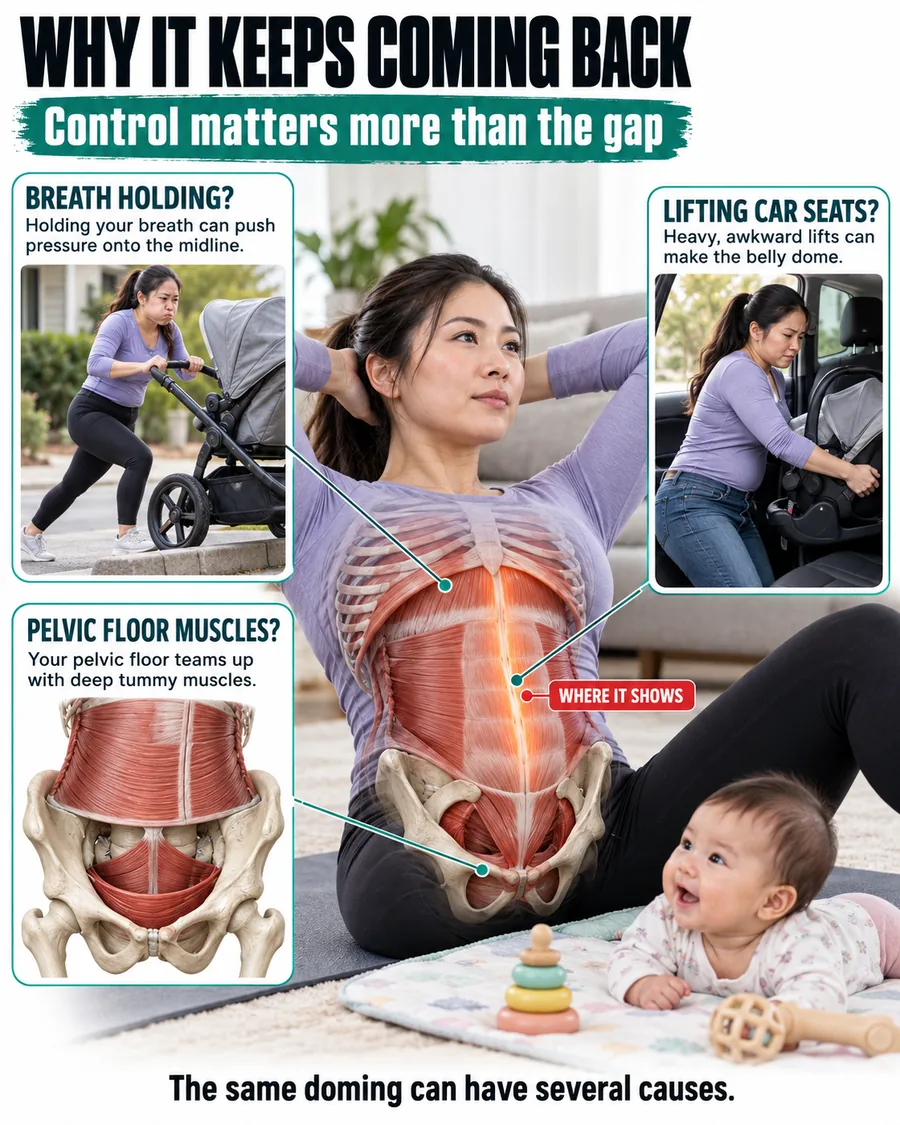
During pregnancy, the two halves of the rectus abdominis separate along the midline to make room for the growing baby. The connective tissue between them (the linea alba) stretches and thins. After delivery, this gap should gradually close. In roughly 30 to 40% of women, it doesn’t fully resolve on its own.
Signs of diastasis recti include a visible ridge, bulge, or “doming” along the midline when you sit up, crunch, or lift. A feeling that your core is weak, hollow, or disconnected. Difficulty generating abdominal tension for lifting or carrying. Lower back pain that worsens with sustained activity. And a sensation that your stomach muscles aren’t doing their job even though you are doing exercises.
Assessment involves measuring the width (how many fingers fit in the gap), the depth (how deep the fingers sink), and most importantly, the tension of the linea alba (can the tissue resist downward pressure). A 2-finger gap with good tension is often more functional than a 1-finger gap with poor tension. The number alone doesn’t tell the whole story.
Treatment focuses on specific core retraining exercises that restore the ability to generate tension across the midline. Traditional crunches and sit-ups are avoided, as they increase intra-abdominal pressure and can worsen the separation. Instead, exercises target the transversus abdominis (the deepest abdominal muscle) in coordination with the pelvic floor and diaphragm. The goal isn’t necessarily closing the gap to zero; the goal is restoring functional core stability. See our dedicated Diastasis Recti page for a deeper look at assessment and treatment.
Pelvic Floor Weakness and Incontinence
Leaking urine when you cough, sneeze, laugh, jump, or run is the most common postpartum pelvic floor symptom. It affects up to 30% of women in the first year after delivery. It is common, but it is not normal, and it is not something you should accept as your new baseline.
Postpartum pelvic floor weakness can also present as urgency (sudden need to urinate that is hard to control), frequency (needing the bathroom more than 6 to 8 times per day), a feeling of heaviness or pressure in the pelvis, reduced sensation during intercourse, and difficulty controlling gas. These symptoms can appear immediately after delivery or develop gradually over weeks and months.
Treatment involves proper pelvic floor muscle training, and “proper” is the key word. Research shows that up to 50% of women perform Kegels incorrectly when given verbal instruction alone. Some bear down instead of lifting. Some hold their breath. Some engage the wrong muscles entirely. Assessment (ideally including internal examination with consent) confirms that the muscles are activating correctly before a strengthening program begins. From there, training progresses from isolated contractions to functional integration with coughing, sneezing, lifting, and impact activities. See our pelvic floor physiotherapy in Oakville page for comprehensive detail on pelvic floor treatment. For bladder-specific concerns, see our Bladder Leakage and Incontinence page.
C-Section Scar Recovery
A Caesarean section cuts through skin, fat, fascia, and muscle layers to reach the uterus. It is a major abdominal surgery. As the incision heals, scar tissue forms, and that scar tissue can develop adhesions that bind layers of tissue together that should glide freely.
C-section scar issues include tightness or pulling sensation around the scar, numbness or hypersensitivity in the area (sometimes extending well beyond the scar itself), a visible “shelf” or indentation above the scar line, restricted mobility of the tissue when you bend, twist, or stretch, reduced core activation in the muscles adjacent to the incision, and pain with certain movements or clothing pressure on the scar.
Scar mobilization begins once the incision is fully closed (typically 6 to 8 weeks post-surgery). Treatment involves gentle massage techniques in multiple directions to break down adhesions, restore tissue glide, and normalize sensitivity. This is combined with core retraining to reactivate the abdominal muscles that were affected by the surgery. Many women are surprised how much difference scar work makes. A scar that feels tight and restrictive at 8 weeks can feel completely normal after 4 to 6 weeks of mobilization.
Pelvic Organ Prolapse
Some women develop early prolapse symptoms after delivery: a feeling of heaviness, pressure, or bulging in the vaginal area, particularly at the end of the day or after prolonged standing. Prolapse occurs when the pelvic floor muscles and supporting ligaments can’t adequately support the bladder, uterus, or rectum in their normal position.
Mild to moderate postpartum prolapse often improves significantly with pelvic floor strengthening, proper lifting mechanics, and management of intra-abdominal pressure. Early intervention produces better outcomes. If you are experiencing heaviness or pressure that wasn’t there before delivery, assessment sooner rather than later is worthwhile. See our Pelvic Organ Prolapse page for more on prolapse treatment.
Pelvic Girdle Pain and SI Joint Pain
Pain at the pubic bone (symphysis pubis dysfunction) or at the sacroiliac joints in the back of the pelvis is common during pregnancy and can persist postpartum. The combination of ligament laxity from relaxin, altered posture from pregnancy, and weakened core and pelvic floor muscles creates instability in the pelvic ring.
Treatment includes pelvic stabilization exercises targeting the deep core and gluteal muscles, manual therapy for joint mobilization and muscle release, activity modification for tasks that aggravate symptoms (one-legged activities like stairs, getting in and out of the car), and a support belt if needed in the short term while strength builds. For pregnancy-related pelvic pain that persists into the postpartum period, see our Pregnancy Pelvic Pain page.
Postpartum Back Pain
Lower back pain affects roughly 50% of women in the postpartum period. The combination of weakened core muscles, ligament laxity, altered posture from nursing and carrying, and the new physical demands of infant care creates the perfect storm for back pain. Treatment addresses the core stability deficit directly while managing the pain through manual therapy, exercise, and practical advice on nursing posture, carrying technique, and activity modification. See our Back Pain page for comprehensive detail.
Pain During Intercourse
Discomfort or pain during intercourse after delivery is common and can result from perineal scar tissue (from tearing or episiotomy), pelvic floor muscle tension (the muscles tighten protectively after trauma), hormonal changes (reduced estrogen while breastfeeding affects tissue lubrication and elasticity), or psychological factors (fear, anxiety, body image changes). Pelvic floor physiotherapy addresses the muscular and scar tissue components through relaxation training, scar mobilization, and gradual desensitization. This is treated with sensitivity and without judgment in a private treatment room.
Your Return-to-Exercise Roadmap
One of the most common questions we hear: “When can I start exercising again?” The answer depends on your individual recovery, but here is the general framework we use based on current evidence and clinical guidelines.
Stage 1: Foundation (Weeks 0 to 6 Postpartum)
Before medical clearance. Focus on gentle pelvic floor activation (if comfortable), diaphragmatic breathing, short walks as tolerated, and recovery. This is not a training phase. It is a healing phase. A prenatal or early postpartum consultation can provide guidance on what is safe during this window.
Stage 2: Rebuild (Weeks 6 to 12)
After medical clearance and ideally after a postpartum physiotherapy assessment. Pelvic floor strengthening progressing from isolated contractions to integration with functional movements. Core retraining targeting the deep stabilization system (transversus abdominis, pelvic floor, diaphragm coordination). Walking distance and pace gradually increasing. Low-impact strengthening (bodyweight squats, bridges, modified resistance exercises). Scar mobilization for C-section deliveries.
Stage 3: Load (Weeks 12 to 16)
Introduction of higher-demand activities based on assessment findings. Light jogging (only after pelvic floor function is assessed and cleared for impact). Moderate resistance training with progressive loading. Core exercises advancing beyond the foundational level. Continued pelvic floor training integrated with loading activities.
Stage 4: Return (Weeks 16 and Beyond)
Full return to pre-pregnancy exercise levels based on ongoing assessment. Running at pre-pregnancy distances and intensity. Full gym programming including compound lifts and higher-impact activities. Sport-specific training if applicable. Maintenance pelvic floor and core work becomes part of the ongoing routine.
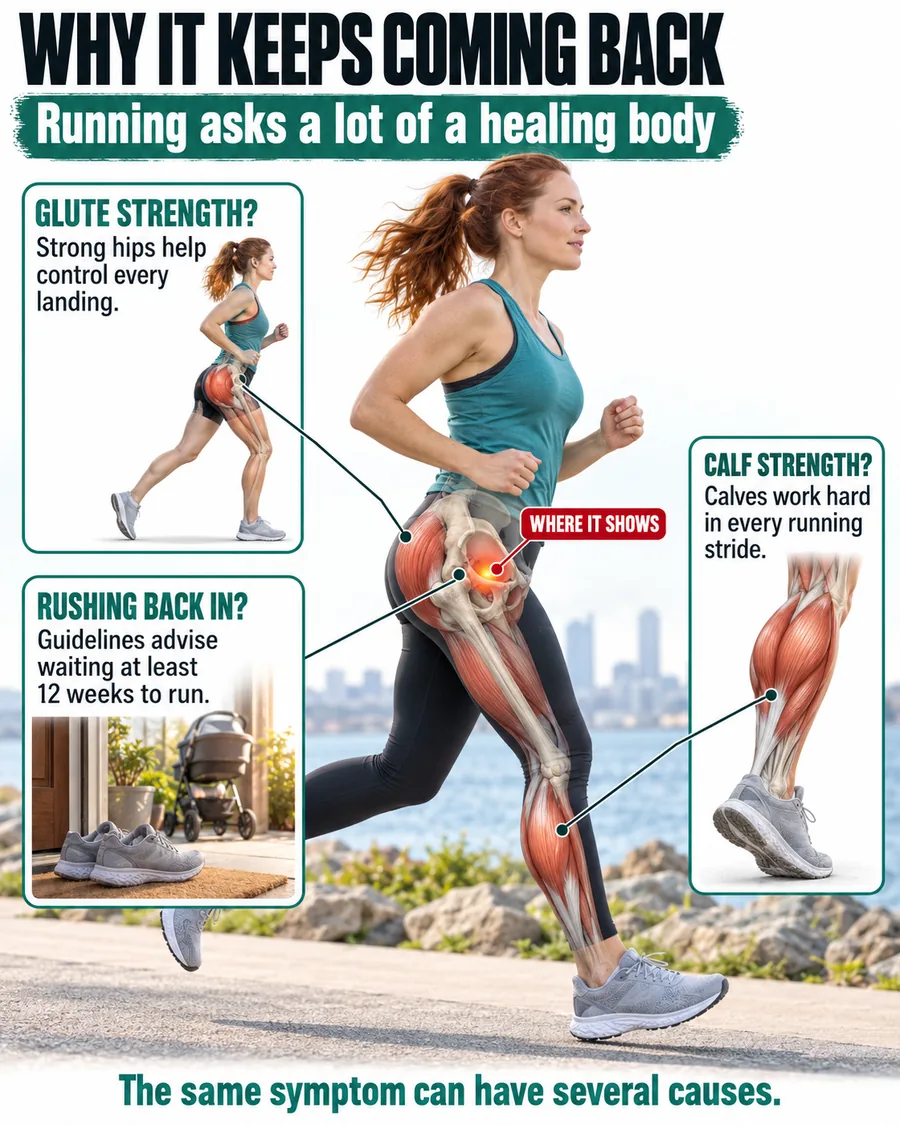
Important: These are guidelines, not rules. Some women progress faster. Some need longer, particularly after complicated deliveries, C-sections, or if symptoms persist. The progression is based on assessment findings and symptom response at each stage, not on arbitrary calendar dates. Returning to running before the pelvic floor can handle impact is how long-term incontinence and prolapse problems develop. Taking the time to rebuild properly protects you for years ahead.

Level 3 Pelvic Health Certified
 Advanced training with
Pelvic Health Solutions
After birth, recovery looks different for each person, whether you had a vaginal birth or a caesarean. Gurmeet checks your pelvic floor, abdominal wall, posture and how you lift and carry your baby, then talks through the results without rushing. Your postpartum plan builds from gentle basics toward the activities you want back, such as running, lifting or sport.
What to Expect at Your First Postpartum Assessment
Your appointment takes place in a private treatment room with the door closed, and your baby is welcome to come along.
Detailed history: Your physiotherapist will ask about your pregnancy, delivery type and any complications, current symptoms (leaking, pain, heaviness, weakness), breastfeeding status, sleep and energy levels, exercise history and goals, and what daily activities are currently challenging. This conversation is thorough because postpartum recovery is influenced by many factors beyond just the delivery itself.
Physical assessment includes:
- Diastasis recti measurement: width, depth, and tissue tension along the full length of the linea alba
- Pelvic floor assessment: internal examination (with your consent) to evaluate muscle strength, endurance, coordination, and tone. You can decline internal assessment at any time without it affecting your care.
- Core activation testing: can you generate abdominal tension? Is the pelvic floor coordinating with the deep core muscles?
- Posture and movement assessment: how pregnancy has changed your alignment and movement patterns
- C-section scar assessment (if applicable): tissue mobility, sensitivity, adhesions
- Lower back, pelvis, and hip assessment: checking for SI joint dysfunction, pelvic girdle pain, or compensatory patterns
You leave with: A clear picture of where you are in your recovery. Which areas need work and which are recovering well. A home exercise program to start immediately. A treatment plan with realistic timelines. And a follow-up appointment booked.
Babies are welcome. We understand childcare isn’t always available, and postpartum appointments are baby-friendly. Feed, change, settle: whatever your baby needs during the session is completely fine.
What Results to Expect
| Concern | Expected Outcome | Typical Timeline |
|---|---|---|
| Stress incontinence (leaking) | 60 to 70% resolved or significantly improved | 6 to 12 weeks |
| Diastasis recti | Functional tension restored, gap reduction | 6 to 12 weeks |
| C-section scar restriction | Improved mobility, reduced sensitivity | 4 to 8 weeks |
| Pelvic girdle and SI joint pain | Significant pain reduction | 4 to 8 weeks |
| Postpartum back pain | Major improvement with core rehab | 4 to 10 weeks |
| Return to running readiness | Cleared for progressive impact loading | 12 to 20 weeks postpartum |
| Full return to gym and sport | Pre-pregnancy activity levels | 16 to 24 weeks postpartum |
Most women notice meaningful improvement within the first 3 to 4 weeks of consistent treatment and home exercise. Complete restoration of core and pelvic floor function typically takes 3 to 6 months, depending on delivery type, complications, and starting point.
Why Choose Wellmax for Postpartum Physiotherapy
Private Treatment Room
All postpartum assessments and treatments take place in a fully private room with a closed door. Pelvic floor assessment, scar work, and the conversations that go with them require privacy, and you will always have it.
Expert Care, Every Visit
Postpartum recovery is personal. Your progress is tracked session to session so your care is precisely tailored and continuously adjusted, with honest guidance on where you are in your recovery.
Babies Are Always Welcome
We know that childcare isn’t always available, especially in the early postpartum months. Your baby is welcome at every appointment. Feed, change, settle: whatever they need during the session is completely fine.
Evidence-Based Return-to-Exercise Guidance
We don’t guess at when you are ready to run or return to the gym. We test pelvic floor strength, core function, and impact tolerance, and clear you based on assessment findings. This protects you from returning too early and developing problems that could have been prevented.
Naturopathic Support Under One Roof
For postpartum women dealing with hormonal changes, fatigue, mood concerns, or nutritional depletion, our naturopathic doctor can provide complementary support alongside your physiotherapy program, all at the same clinic, with direct communication between practitioners.
Convenient Oakville Location
1148 Winston Churchill Blvd, Unit B3, Oakville. Free parking directly in front. Ground-level entrance (no stairs with the stroller). Clarkson: 5 minutes. Clearview: 8 minutes. Sheridan Park: 10 minutes. South Mississauga: 7 minutes.
Direct Insurance Billing
Postpartum physiotherapy is covered under your physiotherapy benefit in most extended health plans. We direct bill to Sun Life, Manulife, Canada Life, Green Shield, Great-West Life, Blue Cross, Desjardins, and most other major providers. WSIB claims accepted. No referral needed.
What Our Patients Say
Verified Patient“After my second baby I was dealing with leakage every time I coughed, sneezed, or tried to exercise. I put off getting help for almost a year because I felt embarrassed and thought it was just something that happens after kids. The pelvic floor assessment at Wellmax was private, respectful, and way less uncomfortable than I expected. Gurmeet explained exactly what was happening with my pelvic floor muscles and gave me a program that was nothing like the generic Kegels my doctor had suggested. Four sessions in and the leakage had improved significantly. I can actually jump with my kids again without worrying.”
Emily C.“I can confidently say this is the best physiotherapy clinic in Oakville for postpartum care. After having my baby, I was experiencing pelvic floor discomfort and lower back pain that was making daily life very difficult. I booked an appointment with Gurmeet, and she made me feel completely comfortable and heard right from the start. She asked detailed questions about my daily routine and explained how pelvic health physiotherapy could help rebuild my core strength safely. The hands-on treatment and tailored home exercises made a massive difference in just a few weeks. The atmosphere is welcoming and professional, and they truly focus on long-term results rather than just a quick fix.”
Amara W.“I can’t recommend Gurmeet enough for post-partum recovery. She has been incredibly supportive, knowledgeable, and attentive throughout my healing journey. An incredible pelvic floor physio she is. From week 1 Postpartum I am seeing Gurmeet and thats the best decision I ever made!”
Verified Patient“I was referred to pelvic health physio after having bladder urgency issues for months. I was nervous about the internal assessment but the therapist at Wellmax explained every single step before doing anything and I never felt rushed or uncomfortable. The treatment room was completely private. By the end of my treatment plan I went from running to the bathroom every 30 minutes to being able to hold comfortably for hours. I wish I had done this sooner instead of just assuming I had to live with it.”
Jolean L.“Do not hesitate to book an appointment if you are pregnant and are experiencing any pelvic pain. The team was able to help me improve my ambulation quality of life in a very short time. Highly recommend!!”
Shamaila R.“Gurmeet Rai is not only an amazing physiotherapist, but also a truly wonderful person. Her smiling face and unique approach to treatment completely set her apart from other therapists. I first came to her with severe lower back and leg pain, and after her treatments, I experienced massive relief. When my younger sister visited from the UK suffering from pelvic floor issues, I immediately recommended Gurmeet. After just a few sessions, she is already feeling so much better! The clinic staff are also incredibly welcoming and helpful. Thank you, Gurmeet Rai, for your exceptional therapy and care!”
Marilyn’s E.“If you are looking for expert physiotherapy, look no further than Gurmeet Rai, who has just opened her own clinic, Wellmax Physiotherapy, in East Oakville. The space is freshly decorated and designed and the staff are welcoming. Treatment rooms are relaxing with calming colours and soft lighting. But the real bonus is the quality of the treatment and care you’ll receive. I began with pelvic floor therapy, but have continued on with Gurmeet to address some life-long postural issues. Gurmeet is a very experienced and highly skilled practitioner and I have no reservations in recommending her whatever your needs.”
Farrah S.“I saw Gurmeet for Pelvic Floor Therapy, before and after my Hysterectomy. She always made me feel comfortable and is very knowledgeable, helpful, and educated me during the whole process and at each visit. The front desk staff are always inviting and professional. I would recommend Wellmax to my friends and family.”
See all our Google reviewsRead more patient storiesLeave a review
Frequently Asked Questions
When can I start postpartum physiotherapy?+–
A formal assessment can begin at 6 weeks postpartum with medical clearance. If you have questions or concerns earlier, an initial consultation is fine for guidance. For C-section recovery, 6 to 8 weeks is typical depending on wound healing. There is no ‘too late’: women come for postpartum rehabilitation months or even years after delivery and still see significant improvement. Pelvic floor weakness and diastasis recti don’t have expiration dates on treatment.
Do I need an internal pelvic floor examination?+–
Internal examination provides the most accurate assessment of pelvic floor strength, coordination, and tone. It is the gold standard and is strongly recommended. But it is never required. Your physiotherapist will explain what it involves, why it is recommended, and ask for your informed consent. You can decline at any time without it affecting your care. External assessment techniques can still guide effective treatment.
Will my diastasis recti close completely?+–
Not always, and that is okay. The goal is functional recovery, restoring the ability to generate tension across the midline so your core can stabilize your spine and pelvis during daily activities and exercise. Many women achieve excellent function with a residual 1 to 2 finger-width gap. A gap with good tissue tension is more functional than a closed gap with poor tension. We measure both the gap and the quality of the tissue.
When can I start running after having a baby?+–
Current evidence-based guidelines recommend no running before 12 weeks postpartum at the earliest, and only after pelvic floor assessment confirms readiness for impact. Many women benefit from waiting until 16 to 20 weeks with a structured return-to-running program. Your physiotherapist will test pelvic floor strength, endurance, and response to impact loading before clearing you. Returning too early is how long-term incontinence and prolapse develop.
Is postpartum leaking normal? Will it go away on its own?+–
Leaking is common after delivery but it is not ‘normal’ in the sense that you should accept it permanently. Some women recover continence naturally in the first 3 to 6 months. Many don’t without intervention. Supervised pelvic floor muscle training resolves or significantly improves stress incontinence in 60 to 70% of women. If you are still leaking at 8 to 12 weeks postpartum, assessment is recommended rather than waiting and hoping.
Can I bring my baby to the appointment?+–
Absolutely. Babies are welcome at every appointment. We know childcare isn’t always available, especially in the early months. Feed, change, settle: whatever your baby needs during the session is completely fine. It doesn’t affect the quality of your assessment or treatment.
I had my baby years ago. Is it too late for postpartum physiotherapy?+–
No. Pelvic floor muscles respond to training at any age, regardless of how long ago you delivered. Women come to us 2, 5, even 10 years postpartum and still see significant improvement. If you have been leaking, feeling weak in your core, or dealing with pelvic heaviness since your last pregnancy, it is not too late. The muscles are still trainable.
Is postpartum physiotherapy different after a C-section versus vaginal delivery?+–
Yes, the emphasis differs. After vaginal delivery, the focus is primarily on pelvic floor recovery, particularly if there was tearing or instrumented delivery (forceps, vacuum). After C-section, scar mobilization and abdominal wall recovery take a larger role alongside pelvic floor rehabilitation, since the pelvic floor still carried the pregnancy for 9 months regardless of delivery type. Both require core retraining and staged return to exercise. The assessment determines which areas need the most attention.
Will my insurance cover postpartum physiotherapy?+–
Yes. Postpartum physiotherapy is billed as physiotherapy and is covered under your physiotherapy benefit in most extended health plans. Typical coverage ranges from $500 to $1,500 per year. We direct bill to most major insurance providers including Sun Life, Manulife, Canada Life, Green Shield, and Blue Cross. No referral is needed.
How many sessions will I need?+–
Most postpartum recovery programs involve 6 to 10 sessions over 8 to 16 weeks, depending on complexity. Straightforward cases (mild diastasis, mild pelvic floor weakness, no complications) may need 4 to 6 sessions. More complex presentations (significant diastasis, C-section scar issues, prolapse symptoms, persistent incontinence) may need 10 to 12 sessions. Your physiotherapist will give you a realistic estimate at your first assessment.
My pelvic floor feels heavy and like something is falling out. Is this normal postpartum?+–
A feeling of heaviness or pressure in the pelvis can indicate early pelvic organ prolapse, which is not uncommon after vaginal delivery. It is treatable, especially when caught early. Pelvic floor strengthening, proper lifting technique, and activity modification can significantly improve these symptoms. Assessment sooner rather than later is recommended: mild to moderate prolapse responds very well to physiotherapy.
Can postpartum physiotherapy help with pain during intercourse?+–
Yes. Pain during intercourse after delivery is common and can result from perineal scar tissue, pelvic floor muscle tension, hormonal changes from breastfeeding, or a combination of these factors. Pelvic floor physiotherapy addresses the muscular and scar tissue components through relaxation training, desensitization, and scar mobilization. This is treated with sensitivity and without judgment in a private room.
Related Conditions and Services
- Pelvic Floor Physiotherapy: Comprehensive pelvic floor assessment and treatment for incontinence, prolapse, pelvic pain, and more.
- Diastasis Recti: Abdominal separation assessment and core retraining to restore midline function.
- Bladder Leakage and Incontinence: Pelvic floor muscle training for stress and urge incontinence.
- Pelvic Organ Prolapse: Conservative management for bladder, uterine, and rectal prolapse.
- Pregnancy Pelvic Pain: SPD, SI joint pain, and pelvic girdle pain during and after pregnancy.
- Women’s Health Physiotherapy: The full range of women’s health services at Wellmax, from prenatal to menopause.
- Pelvic Pain and Painful Sex: Treatment for dyspareunia and pelvic floor tension after delivery.
- Back Pain and Sciatica: Postpartum back pain responds well to core rehabilitation combined with manual therapy.
- Naturopathic Medicine: Hormonal support, energy restoration, and nutritional optimization for postpartum recovery.
- Massage Therapy: Upper back, neck, and shoulder tension from nursing and carrying. See also pregnancy massage in Oakville, which covers postnatal massage.
- Physiotherapy: The full range of one-on-one, hands-on physiotherapy at Wellmax.
Book Your Postpartum Assessment in Oakville
Whether you are 6 weeks or 6 years postpartum, the first step is a thorough assessment in a private, comfortable setting. Babies are welcome at every appointment. Wellmax offers a free initial consultation if you want to talk through your situation before committing to an assessment.
Book a Postpartum Assessment Call (905) 829-1100
Wellmax Physiotherapy
1148 Winston Churchill Blvd, Unit B3, Oakville, ON L6J 0A3
Phone: (905) 829-1100
Email: info@wellmaxphysiotherapy.ca
Hours: Monday to Friday 9am to 7pm; Saturday 9am to 2pm; Sunday 9am to 2pm (by appointment only).
Proudly Serving Our Local Communities:
- East Oakville: Winston Park, Clearview, and the QEW/403 Corridor.
- South Oakville: Eastlake, Maple Grove, Lorne Park, and Old Oakville.
- North Oakville: Joshua Creek, Falgarwood, Iroquois Ridge, and Upper Middle Road.
- Mississauga Border: Clarkson, Sheridan Park, Sheridan Homelands, and Southdown.
Insurance: Direct billing to most major providers. WSIB and MVA claims accepted. No referral needed.
Find Us in Oakville
Registered & Regulated
Regulated & Recognized Across Every Discipline
Wellmax is in good standing with the regulatory colleges and leading associations for physiotherapy, chiropractic, massage therapy, and naturopathic medicine in Ontario.