Achilles Tendinopathy Treatment in Oakville
Midportion and insertional Achilles tendon pain treated with progressive loading, not rest.
Home > Conditions We Treat > Achilles Tendinopathy Treatment in Oakville
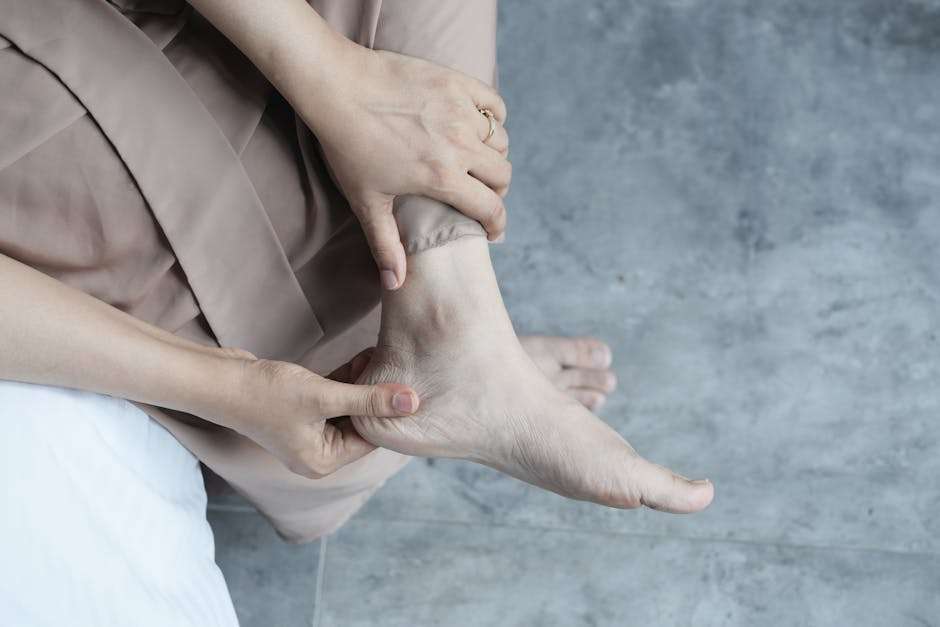
The first sign is usually morning stiffness. You swing your legs out of bed and the Achilles feels like a rusty hinge. It takes 5-10 minutes of walking before it loosens up. Then you go for a run and it’s stiff for the first kilometre before it warms up and feels manageable. The next morning it’s stiff again, maybe a bit worse than yesterday. You rest for a few days, it feels better, you run again, and the cycle repeats. Achilles tendinopathy treatment in Oakville at Wellmax loads the tendon at the right stage to rebuild it.
If that sounds familiar, you’re dealing with Achilles tendinopathy. And here’s the mistake that keeps people stuck in that cycle for months: resting it. The Achilles tendon is not inflamed (despite the old name “Achilles tendinitis”). In most cases that have lasted more than a few weeks, the tendon is degenerating. The collagen structure is breaking down. And degenerative tendons don’t heal with rest. They get worse with rest because the tissue loses its loading capacity even further. Every day you rest, the tendon can handle less.
The treatment that actually works is progressive loading. Gradually increasing the mechanical stress on the tendon to stimulate collagen remodeling and rebuild its tolerance. This is the same principle that treats rotator cuff tendinopathy, patellar tendinopathy, and tennis elbow. The specific protocols for the Achilles (heavy slow resistance calf raises, eccentric loading) are among the most well-researched treatments in all of physiotherapy.
At Wellmax Physiotherapy, we treat Achilles tendinopathy with a loading-first approach. The calf raise program is the foundation. Manual therapy, gait assessment, and for chronic cases that need more, shockwave therapy and deep tissue laser. Your physiotherapist tracks the tendon’s response and adjusts the load week to week.
We’re at 1148 Winston Churchill Blvd, Unit B3, Oakville, just south of the QEW. Runners, athletes, and active adults from Clarkson, Clearview, Sheridan Park, Maple Grove, and south Mississauga come to us for Achilles tendon treatment.
- Understanding Achilles Tendinopathy
- Achilles Tendinopathy Treatment at Wellmax
- Achilles Tendinopathy Recovery Timelines
- Why Oakville Patients Choose Wellmax for Achilles Tendon Treatment
- Achilles Tendon Treatment for South Mississauga Patients
- Related Conditions and Services
- Book Your Achilles Tendon Assessment
- Frequently Asked Questions
Understanding Achilles Tendinopathy
The Anatomy
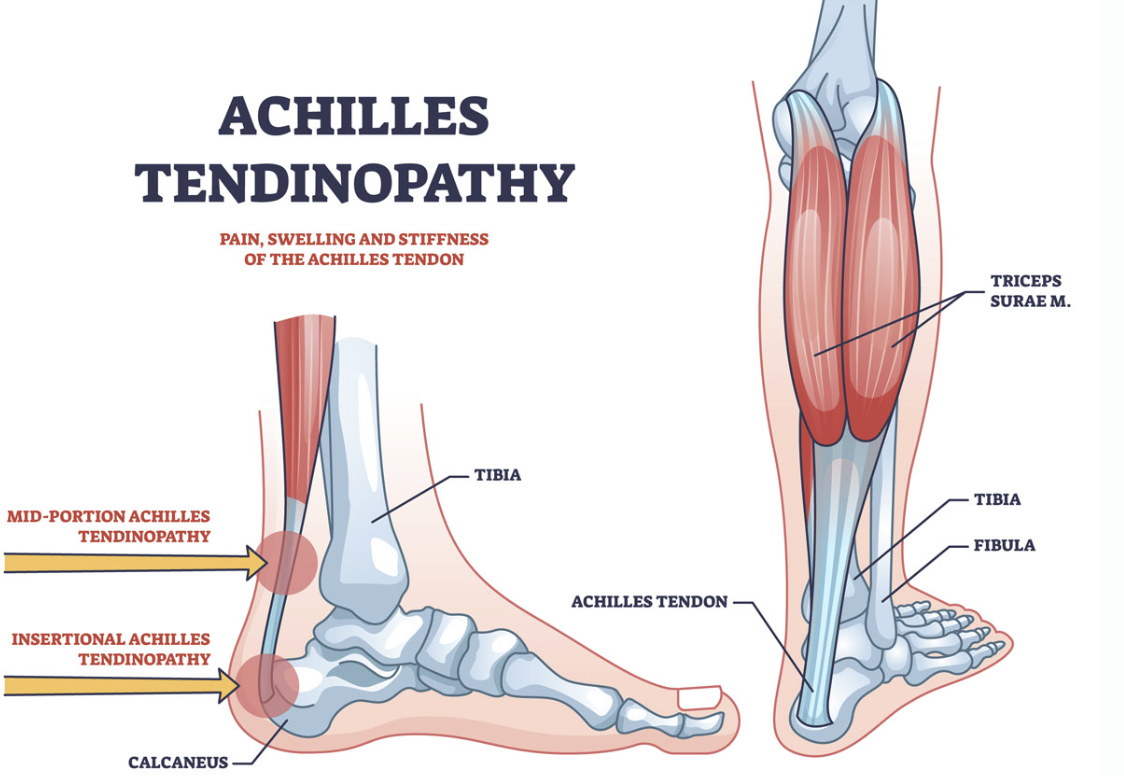
The Achilles tendon is the thickest and strongest tendon in the body. It connects the two calf muscles (gastrocnemius and soleus) to the heel bone (calcaneus). Every time you walk, the Achilles absorbs 3-4 times your body weight. Every time you run, that jumps to 6-8 times body weight. Every time you push off a step, jump, or sprint, the Achilles is the primary force transmitter between your calf and the ground. It handles enormous loads, thousands of times per day.
What Goes Wrong
Achilles tendinopathy develops when the cumulative loading on the tendon exceeds its capacity to repair and adapt. The tendon’s collagen structure starts to break down. Rather than the organized, parallel collagen fibers of a healthy tendon, the tissue becomes disorganized, thickened, and less resilient. Blood supply changes. Nerve ingrowth increases (which is why it hurts). The tendon gets thicker but weaker, not thicker and stronger.
The old term “tendinitis” (implying inflammation) has been largely replaced by “tendinopathy” (implying degeneration) because tissue studies consistently show that chronic Achilles tendon pain involves degenerative changes rather than an active inflammatory process. This distinction matters for treatment: anti-inflammatory strategies (ice, NSAIDs, cortisone) don’t address the underlying problem. Progressive mechanical loading does.
Two Types: Midportion vs. Insertional
This distinction is clinically important because the two conditions behave differently and the treatment approach varies.
Midportion Achilles tendinopathy. Pain and thickening in the middle of the tendon, 2-6 cm above the heel bone. This is the most common type. It responds well to the Alfredson eccentric loading protocol and heavy slow resistance exercises. Compressive loads (stretching the tendon over the edge of a step) are generally tolerated well.
Insertional Achilles tendinopathy. Pain right where the tendon attaches to the heel bone. This type is trickier because the tendon is compressed against the bone at its insertion point, and exercises that increase that compression (like heel drops off a step) can make it worse. The loading program needs to be modified: calf raises are done on flat ground initially, avoiding the dorsiflexed (stretched) position that compresses the insertion. Hill running and uphill walking tend to aggravate insertional tendinopathy more than midportion.
Getting this distinction right at the initial assessment changes the exercise prescription significantly. A loading program designed for midportion tendinopathy can actually worsen an insertional problem.
Who Gets Achilles Tendinopathy
Runners are the most commonly affected group, particularly distance runners who’ve increased their mileage too quickly. But Achilles tendinopathy is also common in court sport athletes (basketball, volleyball, tennis, badminton), recreational walkers who’ve ramped up activity, people in their 40s-60s whose tendon quality has naturally decreased with age, and people with certain systemic factors (diabetes, high cholesterol, and some medications like fluoroquinolone antibiotics are associated with increased risk).
Locally, we see Achilles issues in runners from the Waterfront Trail and Sixteen Mile Creek paths who built their spring mileage too fast. Court sport athletes from community leagues who play on hard surfaces, where sports injury rehab keeps them in the game. Gym athletes doing box jumps and calf-heavy workouts at CrossFit Radix, Orangetheory, and local fitness studios. And people in their 50s who simply increased their walking when they moved to a hillier neighbourhood or started using stairs more regularly.
Achilles Tendinopathy Treatment at Wellmax
The Foundation: Progressive Tendon Loading
Heavy slow resistance calf raises are the cornerstone of Achilles tendinopathy treatment. The tendon needs mechanical loading to stimulate collagen remodeling and rebuild its structural integrity. The program starts at a level the tendon can tolerate (often isometric calf holds or light bilateral calf raises) and progresses systematically toward heavy single-leg loading.
For midportion tendinopathy, the Alfredson eccentric protocol (heel drops off a step with a slow, controlled lowering phase) is well-established. More recent research (the Silbernagel protocol) shows that a combination of concentric and eccentric loading, progressed through heavy slow resistance, produces outcomes at least as good as pure eccentrics and is better tolerated by most patients.
For insertional tendinopathy, the loading program is modified. Calf raises are done on flat ground initially, avoiding the dorsiflexed position that compresses the tendon against the heel bone. As the tendon adapts, range is gradually increased. This modification is the detail most generic exercise programs miss, and it’s why some patients with insertional Achilles tendinopathy get worse with standard protocols.
Manual Therapy
Hands-on treatment for the calf complex (gastrocnemius and soleus, which are frequently tight and restrict ankle dorsiflexion), the ankle joint (stiff ankles change loading mechanics), and the foot joints. We also assess the hip and pelvis because weakness in the gluteal muscles changes running and walking mechanics in ways that increase Achilles loading. Manual therapy provides symptom relief and improves the tissue’s ability to tolerate the loading program.
Load Management for Runners
For runners, the goal is to keep running when the tendon allows it. Complete rest deconditions the tendon further. We modify the training: reduce mileage to a level below the symptom threshold, avoid hills (especially uphill for insertional tendinopathy), slow the pace, and run on softer surfaces when possible. The loading program builds the tendon’s capacity while the running modifications reduce the demand. As the tendon strengthens, the running volume is gradually increased. See our Running Injuries page for more on training modification during Achilles rehab.
Shockwave Therapy for Chronic Cases
When Achilles tendinopathy has persisted for 3+ months and hasn’t responded adequately to loading alone, shockwave therapy is strongly supported by the evidence. It delivers acoustic energy into the degenerative tendon tissue, stimulating neovascularization (new blood vessel formation), promoting collagen remodeling, and reducing pain. We typically combine 3-6 shockwave sessions with the ongoing loading program. The two together produce better outcomes than either alone.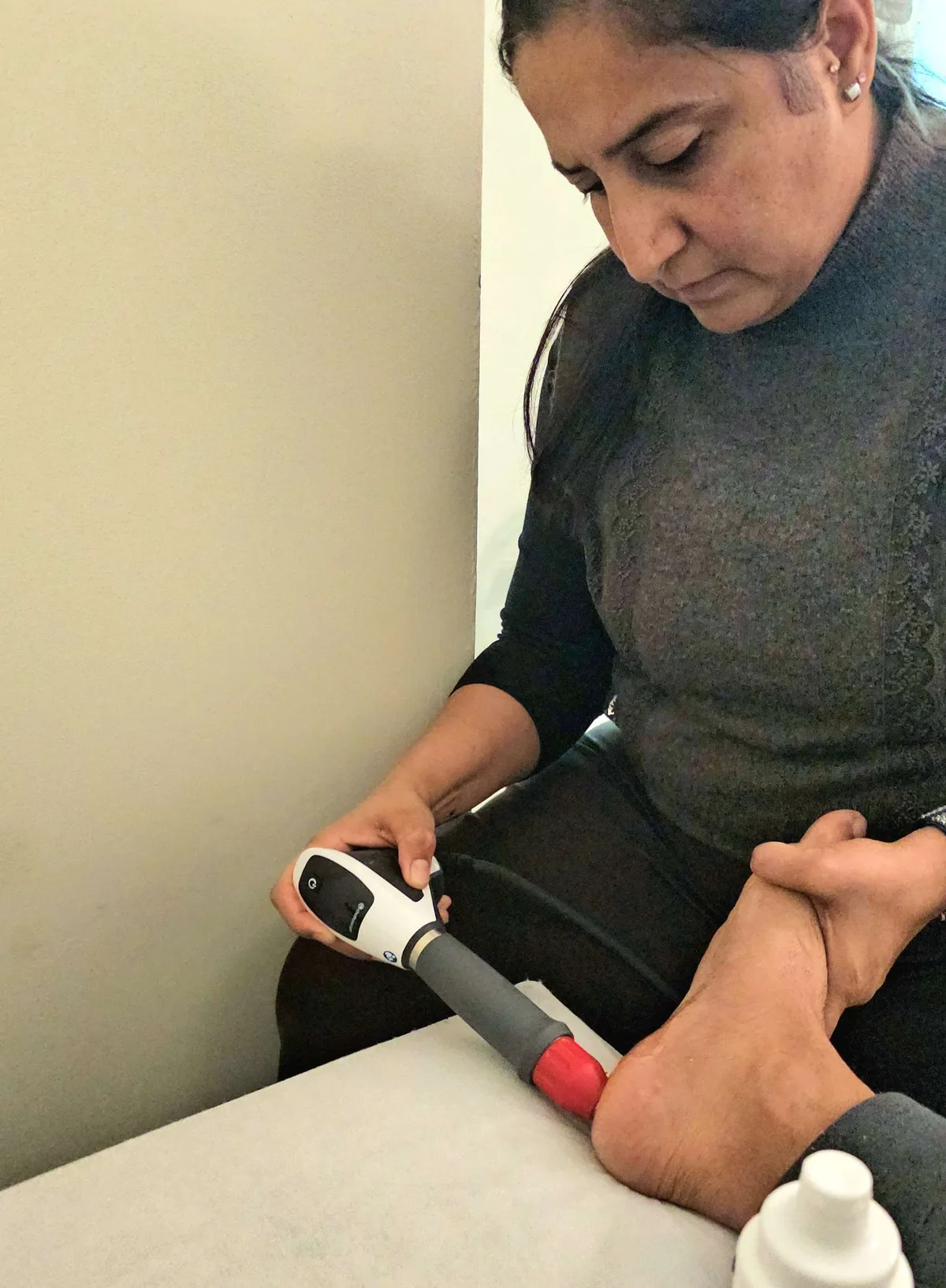
Deep Tissue Laser for Pain Flare-Ups
Deep tissue laser therapy is used for acute pain flare-ups and for tendon irritability that limits the patient’s ability to do the loading exercises. The laser reduces pain and inflammation at the cellular level, improving the window of tolerance for the strengthening program. It’s particularly useful in the first 2-3 weeks of treatment when the tendon is at its most reactive.
Footwear and Orthotics
Shoes with a moderate heel-to-toe drop (10-12mm for daily wear, sport-specific for running) reduce the stretch on the Achilles compared to flat shoes. Orthotics can help if overpronation is contributing to medial Achilles loading. We assess footwear as part of every Achilles treatment plan and provide specific recommendations. See our Orthotics & Braces page for custom orthotic assessment.
What Doesn’t Work (and Why We Avoid It)
Complete rest. Makes the tendon weaker and more vulnerable when loading resumes.
Cortisone injections around the Achilles. Corticosteroids weaken tendon tissue and are associated with increased risk of Achilles rupture. Most orthopaedic guidelines advise against cortisone for Achilles tendinopathy.
Stretching as the primary treatment. Gentle calf stretching has a place, but aggressive stretching of an irritable Achilles tendon (particularly insertional) can compress and aggravate the condition. Loading is the priority, not stretching.
Achilles Tendinopathy Recovery Timelines
| Presentation | Typical Recovery | Can You Keep Running? |
|---|---|---|
| Reactive Achilles tendinopathy (acute, <4 weeks) | 4-8 weeks | Often yes, with reduced volume and intensity |
| Midportion tendinopathy (chronic, 3+ months) | 8-12 weeks | Usually yes, below symptom threshold |
| Insertional tendinopathy (chronic) | 10-16 weeks | Often, with modified loading (avoid hills) |
| Chronic with prior failed treatment | 12-20 weeks | Depends on irritability level |
| Runner returning to full mileage | 8-14 weeks to return to pre-injury volume | Modified running throughout, graduated return |
These timelines depend on how long the problem has been present, the type (midportion vs insertional), your activity level, and consistency with the loading program. The earlier treatment starts, the faster recovery goes. An Achilles tendon that’s been symptomatic for 6 months takes significantly longer to resolve than one caught at 3 weeks. Gurmeet provides a specific timeline at your initial assessment.
Why Oakville Patients Choose Wellmax for Achilles Tendon Treatment
Loading-First Approach, Not Passive Treatment
Most clinics treat Achilles tendinopathy with ultrasound, massage, and stretching. Those provide temporary relief but don’t address the tendon degeneration. At Wellmax, progressive calf loading is the foundation because that’s what the evidence supports. Everything else (manual therapy, shockwave, laser) supports the loading program, not the other way around.
Midportion vs. Insertional: We Get the Distinction Right
The exercise program for midportion and insertional Achilles tendinopathy is different. A loading protocol designed for midportion can actually worsen insertional tendinopathy because of the compressive forces at the heel insertion. Gurmeet identifies which type you have at the first assessment and tailors the loading program accordingly. Getting this detail wrong is one of the most common reasons Achilles tendinopathy treatment fails.
Shockwave + Laser for Chronic Cases
Having both shockwave therapy and deep tissue laser available means we can match the modality to the tendon’s stage. Laser for acute pain management. Shockwave for chronic degeneration. Combined with loading. Most Oakville clinics have one or the other, not both.
Runners Who Understand Runners
Most Achilles tendinopathy patients at Wellmax are runners. They want to keep running. At Wellmax, the default is to modify training, not stop it. We keep you running within the tendon’s tolerance while the loading program builds capacity. That’s a fundamentally different approach from “rest for 6 weeks and come back.”
Oakville’s Running and Active Community
We treat Achilles problems in Waterfront Trail and Sixteen Mile Creek runners who ramped their spring mileage too fast. Court sport athletes from basketball and tennis leagues whose Achilles can’t keep up with the stop-start demands. CrossFit and gym athletes from local studios doing box jumps and heavy calf work. Weekend walkers from Clearview and Maple Grove who increased their step count and the Achilles protested. And people in their 50s and 60s across Oakville whose tendon quality has naturally declined and needs progressive loading to build back up.
We’re at 1148 Winston Churchill Blvd, Unit B3, Oakville. Just south of the QEW. Free parking, ground-level access, private treatment rooms. Patients come from Clarkson, Clearview, Sheridan Park, Maple Grove, River Oaks, and south Mississauga.
Achilles Tendon Treatment for South Mississauga Patients
A large share of our Achilles caseload comes from South Mississauga, and the geography explains why. Our clinic sits at 1148 Winston Churchill Blvd, directly on the Oakville and Mississauga boundary. From Clarkson and Sheridan Park that is usually under ten minutes. From Lorne Park allow ten to fifteen, and from Port Credit or south Erin Mills closer to fifteen to twenty. For most of South Mississauga we are one of the nearest clinics rather than a drive out of town.
Why Achilles Problems Are Common in This Part of Mississauga
The Waterfront Trail, the Credit River paths and the Lakeshore Road loops are busy with runners and walkers year round. Achilles tendons dislike two things in particular, and both are easy to run into here: a sudden jump in weekly distance, and repeated hill or bridge work after a flat winter of treadmill running. Add a switch to flatter shoes or a return to spring racing, and the load on the tendon climbs faster than the tendon adapts.
The pattern people describe is fairly consistent. The heel or the back of the ankle is stiff and sore for the first steps in the morning, it eases once you are warm, and then it bites again a few hours after the run rather than during it. That said, the same symptoms can come from several different sources, and each one needs different treatment. That is what an assessment is for.
What Treatment Looks Like
Achilles tendons respond to load, not rest, but the load has to be the right kind and introduced in the right order. Your first visit is a full sixty minutes, one-on-one, and includes hands-on treatment the same day. From there we build a progressive loading programme and check how the calf, ankle and hip are sharing the work, because a tendon that keeps flaring is often being asked to cover for something further up the chain. For cases that have already been stubborn for months, shockwave therapy is available in the same building. If running is the goal, our running injury page covers how we handle return to mileage.
You get expert care every visit, we direct bill most major insurers, and parking is free at the door. If you are not sure whether this is worth an appointment, book a free 15-minute consult and a registered physiotherapist will tell you honestly whether we can help.
What Our Patients Say
Michael R.“If you are dealing with sports injuries, this is easily the best physiotherapy clinic in Oakville. I was struggling with Achilles tendinopathy from running, and the pain in my heel was getting worse every week. Dhrushi was my physiotherapist and she was absolutely fantastic. She did not just look at my ankle but assessed my entire walking and running mechanics. She explained exactly why the tendon was inflamed and built a personalized treatment plan with manual therapy and specific eccentric exercises for me to do at home. The clinic always runs on time and the entire team is so friendly. I am finally back to running pain-free and I will not hesitate to return if I ever need care again.”
Zakaria S.“I came in with a locked and sore ankle and Gurmeet was able to identify the root cause very quickly. The soft tissue release, electrical therapy, manual manipulation and assigned stretches have all been beneficial for my situation. They’ve got a customer for life. Gurmeet and her team are friendly and knowledgeable.”
Hazel V.“I was suffering from plantar fasciitis. I went to other physio, shockwave nothing helped. Until I found Wellmax Physiotherapy. This is a great place!”
Christopher N.“Gurmeet and her team are awesome 🙂 They really helped me to recover from my ankle sprain. Thanks team Wellmax. Highly Recommended!”
Tia D.“My experience with Gurmeet and her team was truly wonderful. I arrived with a painful ankle sprain and a lot of uncertainty about how well I would heal. After just a few sessions with her, I already felt more hopeful and confident again. I was able to walk more comfortably, the swelling went down significantly, and they helped me manage the pain so much better. Gurmeet and her team are incredibly caring, supportive, and knowledgeable. They made sure I felt looked after not only during my visits but also gave me everything I needed to continue healing well at home. I trusted them completely, and I still feel so grateful that I did. I would wholeheartedly recommend them to anyone.”
Pamela V.“10/10!! I came to this physio after spraining my ankle with a grade 3 ankle sprain in late August 2025. I was on crutches, couldn’t walk and could barely move my ligaments in my foot to do an ankle circle. I came to this clinic and was so impressed with the new team and new physiotherapist, Gurmeet. She does her work exceptionally well. She explains things so easily and told me she wants patients to understand what’s going on so it can help them. …”
Sunil R.“Gurmeet figured out the cause of my knee pain and is working hard on fixing it. Already feel much more pain relief and better walking ability. Thanks to you and your team! Not only are you all very professional and knowledgeable, but also very kind and caring! As an update, Gurmeet’s techniques have significantly improved the mobility in my foot/ankle, and the recommended stretches and modalities have all helped so much too! Thankful to Nav and Cynthia too. Everyone is so skilled and polite and friendly! Cynthia is the best massage therapist I’ve had in years! She really works on the tight muscles and listens to feedback well if you ask for less or more pressure. …”
Ghanshyam S.“I had an excellent experience at Wellmax Physiotherapy for my ankle pain. Gurmeet, the physiotherapist, was very knowledgeable and took the time to understand my condition and create an effective treatment plan. She recommended shockwave therapy, which helped reduce my pain and improve my mobility significantly. Janvi and Manahil the Physiotherapy Assistant were also very friendly, professional, and supportive throughout my treatment sessions. The entire team made me feel comfortable and welcomed every time I visited. The clinic is clean, well-organized, and provides outstanding patient care. I highly recommend Wellmax Physiotherapy to anyone looking for effective treatment for physio and massage.”
See all our Google reviewsRead more patient storiesLeave a review
Frequently Asked Questions
What's the difference between Achilles tendinitis and Achilles tendinopathy?+–
The terms are often used interchangeably, but they describe different things. Tendinitis implies inflammation. Tendinopathy implies degeneration. Research shows that most chronic Achilles tendon pain involves degenerative changes in the tendon’s collagen structure, not an active inflammatory process. This matters because anti-inflammatory treatments (ice, NSAIDs, cortisone) don’t fix degeneration. Progressive loading does. The correct term for most cases is tendinopathy, even though many people (and some clinicians) still say tendinitis.
Should I rest my Achilles tendon if it hurts?+–
Not completely. Complete rest makes the tendon weaker and more vulnerable when you try to load it again. The correct approach is modifying activities to keep pain at a manageable level (under 4 out of 10 during and after activity) while starting a progressive loading program. The loading program is what stimulates the tendon to repair and rebuild. Without it, the tendon doesn’t improve.
Can I keep running with Achilles tendinopathy?+–
In most cases, yes, with modifications. Reduce mileage, slow the pace, avoid hills, and choose softer surfaces. The key rule: if pain during or after the run is under 3-4 out of 10 and doesn’t progressively worsen over subsequent runs, you can continue. If it’s above that threshold or getting worse each run, the volume needs to come down further. Your physiotherapist will help determine the right level.
How long does Achilles tendinopathy take to heal?+–
Reactive (acute) cases caught early can improve in 4-8 weeks. Chronic midportion tendinopathy typically takes 8-12 weeks. Chronic insertional tendinopathy often takes 10-16 weeks. Cases that have persisted for 6+ months with prior failed treatment may take 12-20 weeks. The earlier you start evidence-based treatment (loading, not rest), the faster recovery goes.
Is shockwave therapy effective for Achilles tendinopathy?+–
Yes. Shockwave therapy has strong evidence for chronic Achilles tendinopathy that hasn’t responded to loading alone. It stimulates tendon remodeling, promotes new blood vessel formation, and reduces pain. At Wellmax, we combine shockwave with the loading program for chronic cases. Shockwave alone without loading produces inferior results.
Are cortisone injections safe for the Achilles tendon?+–
Most orthopaedic guidelines advise against cortisone injections for Achilles tendinopathy. Corticosteroids weaken tendon tissue and are associated with an increased risk of tendon rupture. While injection might provide short-term pain relief, the long-term risks outweigh the benefits for this specific tendon. Progressive loading, shockwave therapy, and manual therapy are safer and more effective long-term strategies.
What's the difference between midportion and insertional Achilles tendinopathy?+–
Midportion tendinopathy causes pain in the middle of the tendon, 2-6 cm above the heel. Insertional tendinopathy causes pain right where the tendon attaches to the heel bone. The distinction matters because the loading program is different. Midportion responds well to heel drops off a step (eccentric loading in a stretched position). Insertional gets worse with that same exercise because it compresses the tendon against the bone. Insertional loading starts on flat ground and avoids the dorsiflexed position. Getting this right is the difference between the program helping and the program making things worse.
Will the Achilles tendon thickening go away?+–
Partially. With proper loading, the tendon’s pain and function typically normalize. The thickening (visible and palpable enlargement of the tendon) may reduce somewhat but often remains to some degree even after symptoms resolve. A thickened tendon that is pain-free and functional is a treated tendon. The goal is restoring function and eliminating pain, not returning the tendon to its pre-injury MRI appearance.
Do I need an MRI or ultrasound for Achilles tendinopathy?+–
Not usually for initial diagnosis. Achilles tendinopathy is primarily a clinical diagnosis based on location of pain, symptom pattern (morning stiffness, warmup phenomenon, pain with loading), and physical examination. Imaging is useful when the diagnosis is uncertain, when a partial or complete tear needs to be ruled out, or when the tendon isn’t responding as expected to treatment. Gurmeet will advise if imaging is warranted based on your clinical presentation.
Is Achilles tendinopathy physiotherapy covered by insurance?+–
Yes. Treatment at Wellmax is billed as physiotherapy and covered by most extended health plans. Shockwave and laser are included in your physiotherapy session at no extra charge. We direct bill to Sun Life, Manulife, Canada Life, Green Shield, Great-West Life, Blue Cross, Desjardins, and most other major providers. No referral needed. See our insurance page for details.
Why does my Achilles feel worse first thing in the morning?+–
Morning stiffness is one of the most characteristic features of Achilles tendinopathy. While you sleep, the tendon settles into a shortened position and the degenerative tissue stiffens up. The first steps out of bed load that stiff tendon before it has warmed up, which is why it feels like a rusty hinge for the first 5-10 minutes. As the tendon warms with gentle movement, the stiffness eases. Tracking how long that morning stiffness lasts is actually a useful way to monitor whether the tendon is improving week to week.
Can tight calf muscles cause Achilles tendinopathy?+–
They can contribute. The gastrocnemius and soleus muscles attach directly into the Achilles tendon, so a tight, restricted calf increases the tension and load passing through the tendon, especially during the push-off phase of walking and running. Limited ankle dorsiflexion from calf tightness also changes movement mechanics further up the chain. That is why treatment at Wellmax addresses calf flexibility and ankle mobility alongside the progressive loading program, rather than focusing on the tendon in isolation.
What is the heel drop exercise and why is it so important for Achilles tendinopathy?+–
Heel drops (eccentric calf lowering) are the most evidence-based exercise for Achilles tendinopathy. You rise onto the ball of the foot using both legs, then lower slowly on the affected leg alone over three to five seconds. Done with the knee straight they target the gastrocnemius; with the knee bent they target the soleus. This loading stimulates tendon repair and builds tissue tolerance. A physiotherapist will guide the correct load, sets, and progression to avoid aggravating symptoms.
Can I swim or cycle instead of running while my Achilles heals?+–
Swimming is generally well tolerated as it places minimal load through the Achilles tendon. Stationary cycling is also a good option provided it is pain-free. The elliptical trainer can aggravate the Achilles and is better avoided. The key principle is to maintain cardiovascular fitness through activities that do not overload the tendon while the loading program progressively rebuilds tendon strength. Confirm your chosen alternative is pain-free before committing to it regularly.
How do I know if my Achilles is getting better or worse with loading?+–
A mild ache of up to 3 out of 10 during exercise that settles within 24 hours is considered acceptable during tendon rehabilitation. Worsening pain during activity, pain that exceeds 4 out of 10, or pain that lingers into the next day are signs you have loaded the tendon too much. A physiotherapist uses these pain monitoring rules to guide your progressive loading program so you are always within a safe and productive range.
Can Achilles tendinopathy lead to a tendon rupture?+–
Most ruptures occur during sudden explosive loading rather than as a direct progression from tendinopathy. Proper rehabilitation, avoiding cortisone injections into the tendon body, and building load tolerance gradually all reduce risk. If you notice a sudden sharp pain at the back of the heel and are unable to stand on tiptoe, seek urgent assessment as this may indicate a rupture rather than tendinopathy. A degenerated tendon does have altered structure, which is why evidence-based loading and not guessing at home management is important.
Related Conditions and Services
- Ankle & Foot Pain: Comprehensive ankle and foot treatment including sprains, tendinopathy, and structural issues.
- Plantar Fasciitis: The Achilles and plantar fascia are connected through the calf complex. Both conditions frequently co-exist.
- Ankle Sprain: Ankle instability can alter Achilles loading patterns.
- Running Injuries: Achilles tendinopathy is one of the most common running injuries. Training modification and return-to-run programming.
- Shockwave Therapy: Evidence-based treatment for chronic Achilles tendinopathy.
- Deep Tissue Laser Therapy: Deep tissue laser for acute pain flare-ups and tendon irritability.
- Sports Injury Rehabilitation: Full spectrum sports injury treatment including tendon injuries.
- Orthotics & Braces: Footwear assessment and custom orthotics for biomechanical correction.
- Chronic Pain: When Achilles tendon pain has persisted for months and involves central sensitization.
Book Your Achilles Tendon Assessment
Wellmax Physiotherapy 1148 Winston Churchill Blvd, Unit B3 Oakville, ON L6J 0A3
Phone: (905) 829-1100
Email: info@wellmaxphysiotherapy.ca
Proudly Serving Our Local Communities:
- East Oakville: Winston Park, Clearview, and the QEW/403 Corridor.
- South Oakville: Eastlake, Maple Grove, Lorne Park, and Old Oakville.
- North Oakville: Joshua Creek, Falgarwood, Iroquois Ridge, and Upper Middle Road.
- Mississauga Border: Clarkson, Sheridan Park, Sheridan Homelands, and Southdown.
Insurance: Direct billing to most major providers. WSIB and MVA claims accepted. No referral needed.
Hours: Monday to Friday: 9am – 7pm; Saturday: 9am – 2pm Sunday: 9am – 2pm (by appt. only)
Convenient Location + Free Parking – Simple, stress-free access for busy professionals and families.
Registered & Regulated
Regulated & Recognized Across Every Discipline
Wellmax is in good standing with the regulatory colleges and leading associations for physiotherapy, chiropractic, massage therapy, and naturopathic medicine in Ontario.