Sports Physiotherapy in Oakville
For recreational athletes, competitive players, and everyone who needs to get back to doing what they love.
Home > Our Services > Sports Physiotherapy in Oakville
Searching for the best sports physiotherapist near you in Oakville? Your plan is built around your sport, with hands-on treatment, shockwave or laser where they fit, and loading that steps up as you handle it.
Sports injury physiotherapy in Oakville, in one paragraph: at Wellmax your first visit is a full 60-minute assessment of the injury and the movement pattern behind it, treatment starts the same day, and your plan is built around a tested return to your sport rather than rest alone. We treat ACL and knee injuries, ankle sprains, running injuries and concussion, with direct billing and no referral needed.
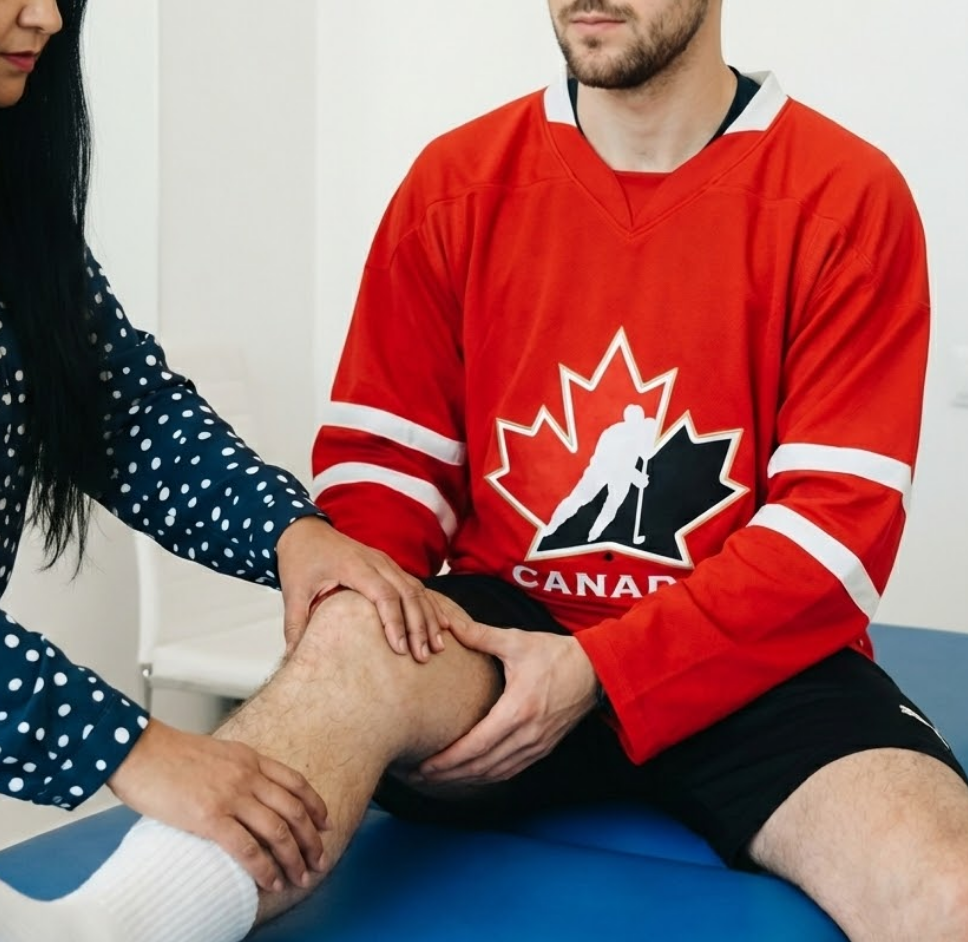
The pain is mostly gone. The doctor said you can ease back in. The surgeon is happy with how things look. But nobody has actually tested whether your leg is strong enough, whether your movement patterns are ready, or whether your body can handle what your sport actually demands. That gap between feeling better and being ready is where re-injuries happen. And it’s exactly what sports physiotherapy in Oakville is designed to close.
Getting you out of pain is step one. Every physio clinic does that. Sports physiotherapy goes further. It means understanding the specific forces and movement patterns your sport demands, building a program that actually prepares you for those demands, using objective testing to measure readiness, and managing the return-to-play process so you get back to full participation, not just full daily function.
A knee that feels fine walking to the car is not the same knee that can cut at full speed on a soccer pitch. A shoulder that can reach overhead without pain is not the same shoulder that can throw 50 pitches or serve 30 tennis balls. A runner who can jog 2km pain-free is not the same runner whose body can handle a half-marathon training block. Return to sport is a progression. Not a date on the calendar. Not a gut feeling. A progression with measurable milestones.
At Wellmax Physiotherapy, we work with recreational and competitive athletes across Oakville’s sports community: hockey players from Joshua’s Creek Arenas and Sixteen Mile Sports Complex, runners from the Waterfront Trail and Sixteen Mile Creek trails, tennis players from Ontario Racquet Club and Joshua Creek Tennis, and gym athletes from CrossFit Radix, Vive Fitness, and Anytime Fitness. We know the activities. We know the injuries they produce. And we know what it actually takes to get back.
We’re at 1148 Winston Churchill Blvd, Unit B3, Oakville, just south of the QEW. Clarkson, Clearview, Sheridan Park, Maple Grove, and south Mississauga are all under 10 minutes away.
- What Makes Sports Physiotherapy Different from General Physiotherapy
- Sports and Activities We Treat in Oakville
- Sports Injury Rehabilitation: Our Four-Phase Approach
- Typical Return-to-Sport Timelines
- Why Athletes in Oakville Choose Wellmax for Sports Physiotherapy
- Related Conditions and Services
- Book Your Sports Physiotherapy Assessment in Oakville
- Frequently Asked Questions
What Makes Sports Physiotherapy Different from General Physiotherapy
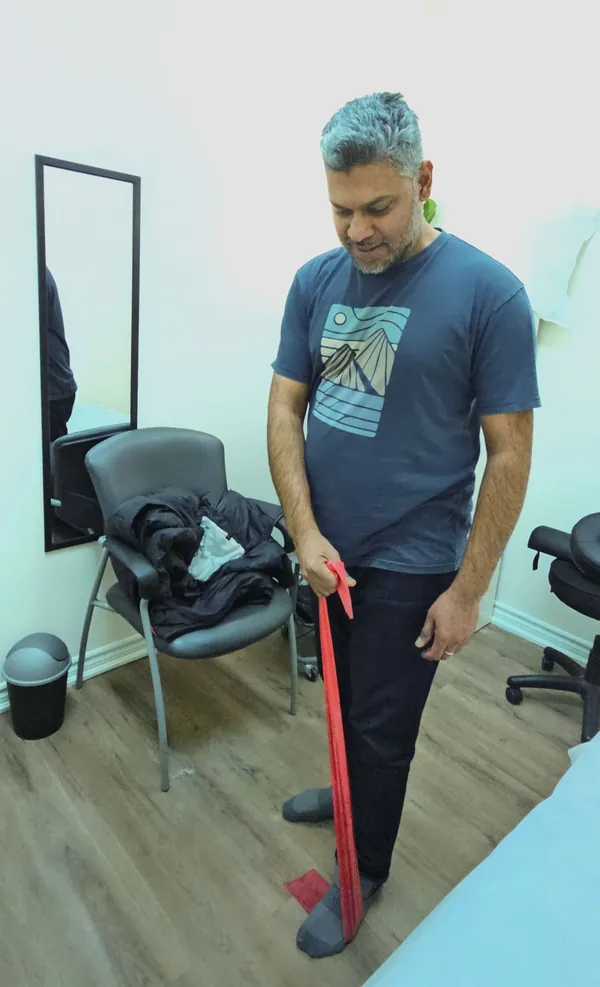
The Goal Is Return to Sport, Not Just Pain Relief
General physiotherapy gets you back to walking, stairs, and daily activities without pain. That’s a legitimate goal. Sports physiotherapy starts there and goes further. The real question isn’t “does it hurt?” It is “can this body handle the speeds, loads, and movement patterns that the sport demands?” That’s a different standard. It needs a different approach.
Sport-Specific Demands Drive the Program
Hockey means rapid acceleration and deceleration, single-leg stability on an unstable surface, absorbing and delivering contact, and rotational power through the hips and core. Running means absorbing two to three times your body weight with every single stride, thousands of times per session. Tennis means overhead shoulder stability, rapid lateral movement, rotational trunk power, and full-speed deceleration. A rehab program that doesn’t account for those specific demands isn’t a return-to-sport program. It’s general strengthening with a sports label on it.
Measurable Criteria, Not Calendar Dates
Time-based return to sport, waiting a set number of weeks, produces higher re-injury rates than criteria-based return. The research on this is consistent. At Wellmax, we use objective testing: limb symmetry index (strength comparisons between sides), single-leg hop tests, movement quality assessments, and sport-specific functional tests. An ACL patient doesn’t return to cutting and pivoting at 9 months because the calendar says so. They return when they’ve hit the quadriceps strength, hamstring strength, hop distance symmetry, and movement quality benchmarks the evidence says predict safe return.
Load Management Is Part of Treatment
Most sports injuries aren’t caused by a single moment. They’re caused by training loads that exceeded the body’s capacity to recover. Tendinopathies, stress fractures, IT band syndrome, patellofemoral pain: these are all load-related injuries. Treating the tissue without addressing the training load that caused the problem means the injury comes back the moment you return to sport. Load management (adjusting volume, intensity, frequency, and recovery) is a core part of what we do.
Sports and Activities We Treat in Oakville
 Hockey
 Hockey
Oakville’s hockey community is one of the largest in the GTA, with year-round programs at Joshua’s Creek Arenas, Sixteen Mile Sports Complex, Maple Grove Arena, and Kinoak Arena. We treat groin and hip flexor strains, the most common hockey injury, along with shoulder separations, rotator cuff injuries from contact, MCL and ACL injuries from falls on the ice, concussions, and lower back pain from the skating posture. Hockey rehab includes return-to-skating progressions, not just off-ice exercises that don’t transfer.
Running Injury Rehabilitation
 Running Injury Rehabilitation
Runners from the Waterfront Trail, Sixteen Mile Creek trails, and Lions Valley Park are among our most frequent patients. Running injuries are almost always load-related. The body was asked to handle more than it was ready for. We treat runner’s knee, IT band syndrome, Achilles and patellar tendinopathy, shin splints, plantar fasciitis, hip flexor and hamstring strains, and stress reactions. Treatment always includes a structured return-to-running program with specific distance and pace progressions. Not “start running when it feels okay,” but an actual plan. Read more about Running Injuries Physiotherapy at Wellmax.
Tennis & Racquet Sports
 Tennis & Racquet Sports
Players from Joshua Creek Tennis, Wallace Park Tennis Club, Ontario Racquet Club, and Iroquois Ridge courts come in with lateral epicondylalgia (tennis elbow), rotator cuff and shoulder impingement, wrist injuries, ankle sprains from lateral movement, and lower back pain from repetitive rotation. Rehab includes racquet-specific strengthening, serving mechanics review, and a graduated return to match play, because rallying at half pace and competing are not the same thing. See our Tennis Elbow page for more on lateral elbow pain.
Soccer & Field Sports
 Soccer & Field Sports
ACL tears, hamstring strains, ankle sprains, and groin injuries are the most common presentations from soccer, rugby, and field sport athletes at Clarkson Park, Toronto Rock Athletic Centre, and Churchill Meadows Community Centre & Sports Park. These sports demand rapid direction changes, acceleration and deceleration, single-leg stability, and contact tolerance. Return to field sport requires progressive agility and change-of-direction training, not just straight-line running. See our Knee Pain page for detailed ACL and ligament information.
Gym & CrossFit
 Gym & CrossFit
Athletes from CrossFit Radix, Element Movement, Vive Fitness, CORTEN, Iron 24, Conker Fitness, and Anytime Fitness come in with shoulder impingement and rotator cuff issues from overhead pressing and pulling, lower back injuries from deadlifts and squats, wrist and elbow pain from Olympic lifting, and knee pain from squatting and jumping. Gym rehab includes technique review and loading progressions specific to the lifts that caused the injury, because you need to get back under the bar, not just back to daily life.
Swimming
 Swimming
Swimmers from Oakville Trafalgar Community Centre pool, Iroquois Ridge pool, and Ontario Racquet Club deal primarily with shoulder injuries: subacromial impingement, rotator cuff tendinopathy, and biceps tendinopathy from the repetitive overhead demands of freestyle and butterfly. Rehab addresses scapular stability, rotator cuff strength-endurance, thoracic spine mobility, and stroke modification to reduce the loading pattern that caused the problem.
Golf
 Golf
Golfers from Oakville Golf Club, Deerfield Golf Club, Credit Valley Golf & Country Club, and Glen Abbey present with lower back pain (the most common golf injury), golfer’s elbow, rotator cuff issues, and wrist injuries. The golf swing generates enormous rotational forces through the spine and hips. Rehabilitation focuses on hip and thoracic rotation mobility, core rotational strength, and gradual return to full swing, starting with short game before working back to full driver swings. See our Back Pain page for more on rotational lower back injuries.
Yoga & Pilates
 Yoga & Pilates
Practitioners from iGita Yoga & Pilates, Hot Yoga & Pilates, and Goji Yoga & Wellness present with hamstring insertional tendinopathy from deep forward folds, hip labral irritation from deep external rotation positions, wrist pain from sustained weight-bearing, and neck and shoulder strain. Treatment addresses the specific positions causing symptoms while preserving the flexibility and body awareness these disciplines develop.
Basketball & Court Sports
 Basketball & Court Sports
Athletes from the Oakville Basketball Club (Venom), local high school teams, and adult leagues at the Glen Abbey and Iroquois Ridge community centres frequently present with ankle sprains, jumper’s knee (patellar tendinopathy), Achilles issues, and finger sprains. The constant jumping, hard landings, and explosive lateral movements take a massive toll on the lower body. Rehabilitation focuses on landing mechanics, lower chain power development, and specific plyometric progressions to get you back on the court safely. See our Ankle & Foot Pain page for more on sprains and Achilles rehab.
Sports Injury Rehabilitation: Our Four-Phase Approach
Phase 1: Accurate Diagnosis and Pain Management
- What we’re doing: A thorough assessment to identify the specific tissue injured, the mechanism, and any biomechanical or training factors that contributed. Hands-on manual therapy, modalities for acute inflammation when appropriate, and early protected loading to keep the tissue moving without stressing the healing structure.
- What you’ll notice: Pain decreasing, swelling resolving, basic movement coming back.
- Your homework: Early-phase exercises to maintain muscle activation and range of motion, with activity modifications that protect the tissue while keeping you as active as safely possible.
Phase 2: Rebuild Strength and Movement Quality
- What we’re doing: Progressive strengthening of the injured area and the supporting structures around it. Addressing the biomechanical contributors, like hip weakness driving knee pain, scapular instability feeding into a shoulder problem, and core deficits affecting spinal loading. Restoring full range of motion and beginning functional movement patterns.
- What you’ll notice: Strength returning, confidence in the injured area building, ability to do more without symptoms.
- Your homework: A structured strengthening program three to four times per week, with loads that actually progress week to week, not the same band exercises every session.
Phase 3: Return-to-Sport Progressions and Objective Testing
- What we’re doing: This is where most clinics stop short, and where Wellmax doesn’t. Sport-specific exercises and drills that replicate the demands of the activity at progressively higher intensities. Objective testing, like strength symmetry, hop tests, and movement quality, to determine readiness at each stage before advancing. A graduated return-to-sport protocol built specifically for the sport.
- What you’ll notice: The ability to perform sport-specific movements at full speed and intensity without symptoms or hesitation. This is not just the absence of pain, but the presence of confidence.
- Your homework: Sport-specific progressions (return-to-running program, return-to-skating protocol, graduated return to match play) alongside maintenance strengthening to reduce re-injury risk. Read more about Running Injuries Physiotherapy at Wellmax.
Phase 4: Re-Injury Prevention
- What we’re doing: Identifying the factors that led to the injury, such as training load errors, biomechanical weaknesses, mobility deficits, and equipment issues, and building a maintenance program that addresses them long-term. This is how recurring injuries get broken.
- What you’ll notice: Sustained return to sport without recurrence.
- Your homework: Ongoing maintenance exercises two to three times per week, typically 15 to 20 minutes, to protect the gains that keep you on the field.
Typical Return-to-Sport Timelines
| Injury | Expected Outcome | Return-to-Sport Timeline |
|---|---|---|
| Muscle strain (Grade I-II) | Full return to sport | 2-6 weeks |
| Ankle sprain (Grade I-II) | Full return with improved stability | 2-6 weeks |
| Patellofemoral pain (runner’s knee) | Return to running pain-free | 6-10 weeks |
| Tennis elbow (lateral epicondylalgia) | Return to racquet sport | 6-12 weeks |
| Rotator cuff tendinopathy | Return to overhead sport or gym | 8-12 weeks |
| ACL reconstruction (post-surgical) | Return-to-sport clearance | 9-12 months |
| Concussion (sport-related) | Return to play clearance | 2-8 weeks |
| Achilles / patellar tendinopathy | Return to running or jumping sport | 8-16 weeks |
These timelines are criteria-based, not calendar-based. Actual return to sport depends on meeting specific strength, movement, and functional benchmarks at each stage. Your physiotherapist will outline the specific criteria for your injury and sport at your first assessment.
Why Athletes in Oakville Choose Wellmax for Sports Physiotherapy
We Know the Local Sports Community
We treat athletes from Oakville’s arenas, trails, courts, gyms, and fields. We know the surfaces, the training volumes, the competitive schedules, and the specific demands that local sports place on the body. When a hockey parent comes in with a teenager’s groin strain in November, we understand what a rep hockey schedule looks like. When a runner shows up with IT band pain six weeks before a race, we know the load management conversation that needs to happen. Context matters in sports rehab, and we have it.
Return-to-Sport Is Built Into Every Plan
We don’t discharge athletes when the pain is gone. We discharge them when they’ve met the objective criteria for return to their specific sport using strength testing, functional testing, sport-specific loading, and graduated return-to-play progressions. This is the standard in professional sports medicine. It should be the standard in community sports physio too.
Expert Care, Every Visit
Significant injury rehab takes months. Your therapist needs to know your baseline strength numbers from week two, how you responded to the last loading progression, and exactly where you are in the return-to-sport protocol. At Wellmax, that is tracked and reassessed at every visit, with honest guidance on when you are ready to progress.
Hands-On Treatment in Every Session
Manual therapy is part of every sports physio session. This includes joint mobilization, soft tissue release, and nerve mobilization when indicated. It works alongside your exercise program, not instead of it. A lot of clinics go heavy on exercise-only or modality-only approaches for sports injuries. We use both because that’s what the evidence supports.
Access to Shockwave and Deep Laser
Chronic tendinopathies that haven’t responded to 6-8 weeks of progressive loading can benefit from shockwave therapy. Acute injuries with significant swelling and inflammation benefit from deep tissue laser. Both are available in-clinic as part of an integrated treatment plan, not as standalone treatments that skip the rehab work.
What Our Patients Say
Jeff B.“I’m a new client suffering from a sports-related injury. Gurmeet was quick to diagnose the issue and, along with her colleagues, Nav and Janvi, has me back on the road to recovery. Coupled with a very friendly environment and loads of free parking, my experience has been top-notch!”
Gurjit M.“Great Practice, I have seen Gurmeet a number of times for various injuries and sports related issues over the years. She is a great Physiotherapist and took great care and attention to treating me. Definitely recommend Wellmax!”
Steven S.“I have been to many different physiotherapists for various sport related, I wish I would have found her sooner! She and her staff are always warm and welcoming. Very knowledgeable in what she does and always goes above and beyond with her treatment. You can tell she really cares about her patients and not just the paycheque like other physiotherapists. I highly recommend going to see her!”
Michael R.“If you are dealing with sports injuries, this is easily the best physiotherapy clinic in Oakville. I was struggling with Achilles tendinopathy from running, and the pain in my heel was getting worse every week. Dhrushi was my physiotherapist and she was absolutely fantastic. She did not just look at my ankle but assessed my entire walking and running mechanics. She explained exactly why the tendon was inflamed and built a personalized treatment plan with manual therapy and specific eccentric exercises for me to do at home. The clinic always runs on time and the entire team is so friendly. I am finally back to running pain-free and I will not hesitate to return if I ever need care again.”
Verified Patient“Tore my meniscus playing soccer at Sixteen Mile Sports Complex and needed a physio who understood returning to sport, not just getting out of pain. Gurmeet built a rehab program that started with reducing the swelling and restoring range of motion and progressed all the way to cutting, pivoting, and sport-specific drills before she cleared me to play again. Most physios would have discharged me when the pain stopped. She made sure I was actually ready to compete. Back on the pitch now with full confidence in the knee.”
Bella J.“I would highly recommend Wellmax Physiotherapy, staff is so professional and helpful, also atmosphere is so clean.”
See all our Google reviewsRead more patient storiesLeave a review
Frequently Asked Questions
How is sports physiotherapy different from regular physiotherapy?+–
Sports physiotherapy goes beyond pain relief to prepare the body for the specific demands of the sport. It includes sport-specific strength and conditioning, objective return-to-sport testing like strength symmetry, hop tests, and movement quality, as well as graduated return-to-play protocols, and load management to prevent re-injury. General physiotherapy aims for pain-free daily function. Sports physiotherapy aims for full athletic function at the intensity and speed the sport actually demands.
How soon should I see a physiotherapist after a sports injury?+–
As soon as possible. Early assessment leads to faster recovery for most sports injuries. For acute injuries like sprains, strains, and ligament tears, early management reduces swelling, protects healing tissue, and begins safe loading sooner. For overuse injuries like tendinopathy, stress reactions, and IT band syndrome, early intervention prevents a manageable problem from becoming a chronic one. No referral needed. Physiotherapy is direct-access in Ontario.
Do I need imaging (X-ray, MRI, ultrasound) before starting physiotherapy?+–
In most cases, no. A thorough clinical assessment can diagnose the majority of sports injuries without imaging. We will refer for imaging when the findings suggest a fracture, complete ligament tear, or internal joint pathology that would actually change the treatment plan. Starting physiotherapy early while waiting for imaging, if needed, is better than waiting weeks to begin treatment.
Can I keep training while receiving physiotherapy?+–
Usually yes, with modifications. Complete rest is rarely the right answer. We identify what is safe to continue, what needs modification, and what needs to be temporarily avoided. The goal is to maintain as much fitness and sport-specific capacity as possible while the injury heals. Complete detraining makes the return-to-sport process significantly longer and harder.
What sports injuries do you treat most often?+–
Our most common presentations are knee ligament injuries and meniscus tears from hockey and soccer, runner’s knee and IT band syndrome, shoulder impingement and rotator cuff injuries from swimming, tennis, and gym training, ankle sprains from court and field sports, tennis and golfer’s elbow, hamstring and groin strains, and sport-related concussions. See our Sports Injury page for detailed information on specific injuries.
How long until I can return to my sport?+–
It depends on the injury, the sport’s demands, and how rehabilitation progresses. Minor muscle strains may return in 2-4 weeks. Moderate ligament sprains take 4-8 weeks. ACL reconstruction takes 9-12 months. The critical point is that return to sport should be based on meeting objective criteria like strength testing, functional testing, and sport-specific drills, not on time alone. Returning too early because it feels fine is the most common cause of re-injury.
Do you work with youth athletes?+–
Yes. We treat youth athletes from Oakville’s minor hockey, soccer, basketball, and swimming programs. Youth sports injuries require different considerations than adult injuries, including growth plates, developing musculoskeletal systems, training load relative to maturation, and the psychological aspects of injury in a young athlete. We communicate with parents, coaches, and trainers throughout the return-to-sport process.
My injury keeps coming back. Can sports physiotherapy help?+–
Recurring injuries are one of the most common reasons athletes come to us. The injury keeps returning because the underlying cause was never addressed. These include strength deficits, biomechanical issues, training load errors, or incomplete rehab from the previous episode. A proper assessment identifies what is driving the recurrence. Treatment targets the cause, not just the current episode.
Is sports physiotherapy covered by insurance?+–
Yes. Sports physiotherapy is billed under physiotherapy and covered by most extended health plans that include a physiotherapy benefit. We direct bill to most major insurance providers including Sun Life, Manulife, Canada Life, Green Shield, Blue Cross, and Desjardins. No referral is needed.
Do you provide custom braces for sports?+–
Yes. We provide custom-measured knee braces for ACL protection and post-surgical return to sport, ankle braces for athletes with recurrent sprains, and wrist supports for contact and racquet sports. Custom braces are measured and ordered in-clinic, with fitting and adjustment included.
What is a return-to-sport criteria-based clearance?+–
Criteria-based clearance means an athlete returns to their sport only after passing objective benchmarks, not after a fixed number of weeks. At Wellmax, these include limb symmetry index scores (strength comparison between the injured and uninjured side), single-leg hop test performance, movement quality assessments, and sport-specific functional drills. This approach reduces re-injury rates compared to time-based return and is the standard used in professional sports medicine.
Can sports physiotherapy help with injury prevention, not just rehab?+–
Absolutely. Many athletes come to Wellmax during the off-season or between seasons to identify and address asymmetries, weaknesses, and movement faults before they become injuries. A movement screen and strength assessment can flag the biomechanical factors most likely to cause trouble when training loads increase. This is especially valuable for youth athletes entering higher-intensity programs and for athletes returning from a previous injury.
Can a sports physio near me get me back to my sport?
Getting you back to your sport is the point of the plan. We test how you move, treat the area by hand, add shockwave or laser when they suit the problem, then load you back up in stages. Progress is measured against the demands of your sport, not against a calendar. Once you can meet those demands without trouble, you are ready for discharge, and we tell you so.
Who near me treats sports injuries and bills my extended health plan directly?+–
Wellmax Physiotherapy at 1148 Winston Churchill Blvd in Oakville treats sports injuries and direct bills most major insurers, so you do not have to front the money every visit. No doctor’s referral is needed. Your first visit is a 60-minute assessment and treatment starts the same day.
Where can I get sports physiotherapy near me without a doctor’s note?+–
In Ontario you can book physiotherapy without a referral. At Wellmax you can book online or call (905) 829-1100, and a free 15-minute consult is available if you would like to meet us first.
Related Conditions and Services
- Sports Injury Physiotherapy: Detailed information on specific sports injuries including ACL tears, concussions, muscle strains, tendinopathies, and ankle sprains.
- Running Injuries Physiotherapy: IT band syndrome, shin splints, runner’s knee, Achilles tendinopathy, and structured return-to-running programs.
- ACL Injury Treatment: Pre-surgical prehab, post-surgical rehabilitation, and criteria-based return-to-sport clearance.
- Knee Pain Physiotherapy: ACL, MCL, meniscus, runner’s knee, patellar tendinopathy, and post-surgical knee rehabilitation.
- Shoulder Pain Physiotherapy: Rotator cuff injuries, impingement, instability, and return to overhead sport.
- Shockwave Therapy: Treatment for chronic tendinopathies that haven’t responded to exercise alone.
- Concussion Rehabilitation: Sport-related concussion assessment, return-to-play protocols, and vestibular rehabilitation.
- Ankle Sprain Physiotherapy: Ankle sprains, Achilles tendinopathy, plantar fasciitis, and return to running and court sport.
- Tennis Elbow: Lateral epicondylalgia treatment and return to racquet sport.
- Hip Pain Physiotherapy: Groin strains, hip labral injuries, hip flexor issues, and return to skating and running.
- Custom Braces & Orthotics: Custom knee, ankle, and wrist braces for sport protection and return to play.
Book Your Sports Physiotherapy Assessment in Oakville
Whether it’s a fresh injury, something that keeps coming back, or a post-surgical program that needs to get you back on the ice, the field, the court, or the trail, the first step is a thorough assessment. One that looks at the injury, the demands of your sport, and what actually needs to happen to get you back safely. Not just back. Back ready.
Book a free initial consult at Wellmax Physiotherapy. No referral needed. Direct billing to most major insurers. Same-day appointments available.
Wellmax Physiotherapy
1148 Winston Churchill Blvd, Unit B3, Oakville, ON L6J 0A3
Phone: (905) 829-1100
Email: info@wellmaxphysiotherapy.ca
Proudly Serving Our Local Communities:
- East Oakville: Winston Park, Clearview, and the QEW/403 Corridor.
- South Oakville: Eastlake, Maple Grove, and Old Oakville.
- North Oakville: Joshua Creek, Falgarwood, and Upper Middle Road.
- Mississauga Border: Clarkson, Sheridan Park, and Sheridan Homelands.
Insurance: Direct billing to most major providers. WSIB and MVA claims accepted. No referral needed. See our insurance and direct billing page for details.
Hours: Monday to Friday: 9am to 7pm | Saturday: 9am to 2pm | Sunday: 9am to 2pm (by appointment only)
Registered & Regulated
Regulated & Recognized Across Every Discipline
Wellmax is in good standing with the regulatory colleges and leading associations for physiotherapy, chiropractic, massage therapy, and naturopathic medicine in Ontario.