Frozen Shoulder Treatment in Oakville
Stage-specific treatment for adhesive capsulitis: pain management, mobility restoration and full recovery.
Home > Conditions We Treat > Frozen Shoulder Treatment in Oakville

It started with a dull ache in the shoulder that you figured would go away on its own. Then you noticed you couldn’t reach the top shelf in the kitchen anymore. Putting on a coat became awkward. Fastening a bra or tucking in a shirt behind your back became impossible. Sleeping on that side woke you up at 2am every night. And now the shoulder is so stiff that you can barely lift your arm to shoulder height. This is the kind of stiffness that frozen shoulder physiotherapy in Oakville is built to unlock, stage by stage. Frozen shoulder treatment in Oakville at Wellmax matches treatment to your stage so you regain motion.
If this sounds familiar, you’re probably dealing with a frozen shoulder. Medically called adhesive capsulitis, this condition involves the capsule surrounding the shoulder joint thickening, tightening, and developing adhesions that progressively restrict movement. It’s one of the most frustrating conditions we treat because it develops slowly, can last 18-24 months without treatment, and the pain during certain phases is genuinely awful. This is exactly why frozen shoulder physiotherapy in Oakville works best when the treatment is matched to the stage you are in, rather than a generic set of exercises.
Here’s what makes frozen shoulder different from other shoulder problems: the treatment approach changes depending on which stage you’re in. There are three distinct stages and each one requires a different intensity, a different type of exercise, and a different expectation for progress. Push too hard during the freezing phase and you’ll make the shoulder angrier. Don’t push hard enough during the thawing phase and the stiffness persists longer than it needs to. Getting the timing and intensity right is the skill.
At Wellmax Physiotherapy, we treat frozen shoulder patients through all three stages, from the first assessment through full recovery. Your physiotherapist calibrates the treatment intensity visit by visit based on how the shoulder is responding. That kind of nuanced, week-to-week adjustment is what produces the best outcomes with frozen shoulder. It’s not a condition where you can hand someone a sheet of exercises and send them on their way.
We’re at 1148 Winston Churchill Blvd, Unit B3, Oakville, just south of the QEW. Patients come to us from Clarkson, Clearview, Sheridan Park, Maple Grove, and south Mississauga.
- Understanding Frozen Shoulder (Adhesive Capsulitis)
- Frozen Shoulder Treatment in Oakville: Treatment Matched to Your Stage
- Frozen Shoulder Recovery Timelines
- Why Patients Choose Wellmax for Frozen Shoulder Treatment in Oakville
- Frozen Shoulder Treatment for Oakville's Community
- Related Conditions and Services
- Book Your Frozen Shoulder Assessment
- Frequently Asked Questions
Understanding Frozen Shoulder (Adhesive Capsulitis)
What’s Happening Inside the Shoulder
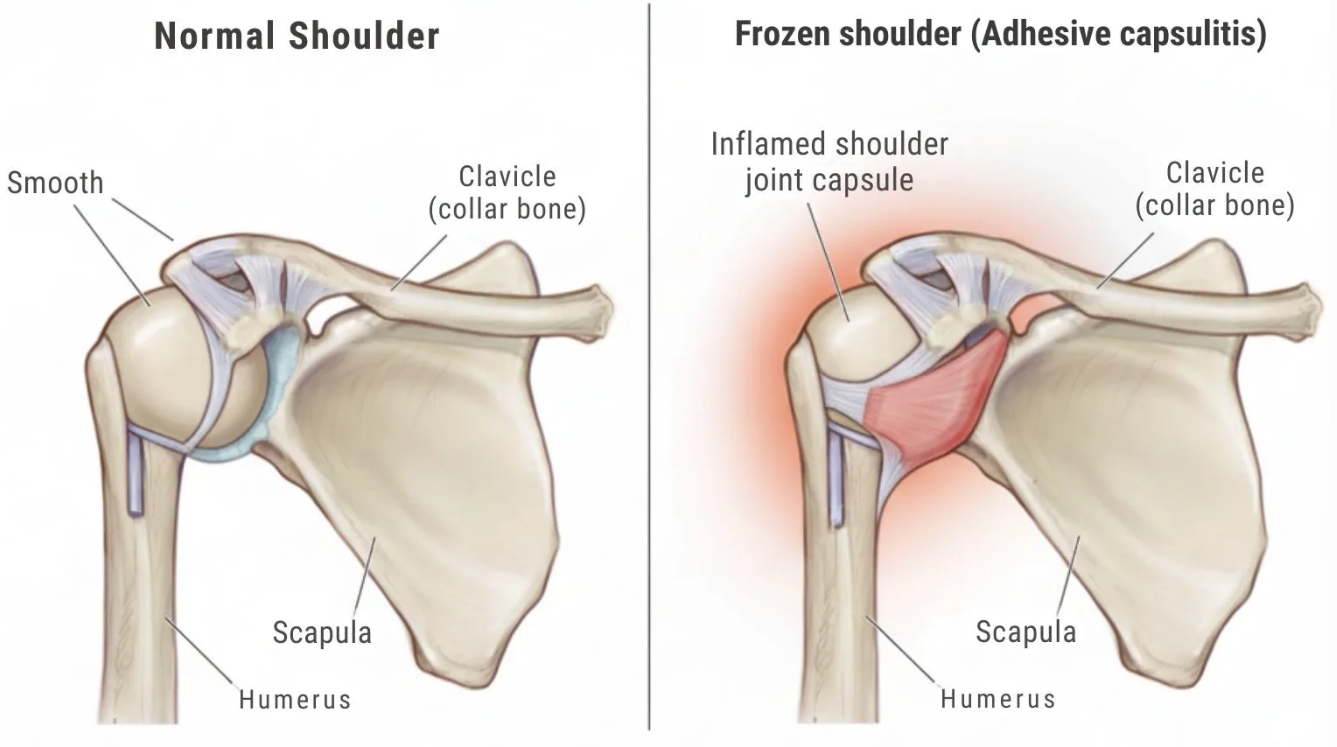
The shoulder joint is surrounded by a capsule made of connective tissue. This capsule is normally loose and flexible, allowing the shoulder its full range of motion. In frozen shoulder, this capsule becomes inflamed, then gradually thickens, tightens, and contracts. Adhesions (bands of scar-like tissue) form within the capsule. The result is a joint that’s mechanically locked down. The ball of the upper arm bone can’t move freely within the socket because the capsule won’t let it.
This is different from other shoulder conditions. A rotator cuff tear causes weakness and pain but the joint itself can usually be moved passively (when someone else moves the arm). With frozen shoulder, the restriction is structural. Even when the muscles are completely relaxed, the joint won’t move past a certain point. That’s the capsule holding it. For broader shoulder problems beyond the capsule, see our Shoulder Pain page.
The Three Stages of Frozen Shoulder
Stage 1: Freezing (2-9 months). This is the pain-dominant stage. The shoulder aches constantly. Night pain is severe and disrupts sleep regularly. Movement starts to decrease gradually, but the primary complaint is pain, not stiffness. During this stage, the capsule is actively inflaming. Aggressive stretching or forcing range of motion can actually make the inflammation worse. Treatment focuses on pain management and gentle, controlled movement within the pain-free range.
Stage 2: Frozen (4-12 months). The pain starts to ease somewhat, but the stiffness becomes the main problem. The shoulder is significantly restricted in multiple directions, particularly external rotation (turning the arm outward), abduction (lifting the arm to the side), and reaching behind the back. Daily activities become genuinely difficult. Getting dressed, washing your hair, reaching for a seatbelt, putting dishes away. Treatment during this stage shifts toward more assertive stretching and joint mobilization because the acute inflammation has settled and the capsule can tolerate more mechanical input.
Stage 3: Thawing (6-24 months). Range of motion gradually returns. The capsule starts to loosen and the adhesions soften. Pain is minimal. This is the stage where physiotherapy makes the biggest difference in shortening the total recovery timeline. Progressive stretching, strengthening (the muscles have weakened significantly during months of restricted use), and functional retraining accelerate the return to normal shoulder function.
Without treatment, frozen shoulder is self-limiting. It eventually resolves on its own. But “eventually” can mean 18 months to 3 years. With proper physiotherapy, the timeline can be shortened significantly and the stiffness and functional loss during the process are much less severe.
Who Gets Frozen Shoulder
Frozen shoulder most commonly affects people between 40 and 65 years old. Women are affected more than men. Several factors increase risk:
Diabetes. People with diabetes are 2-4 times more likely to develop frozen shoulder, and when they do, it tends to be more severe and take longer to resolve. If you’re diabetic and develop shoulder stiffness, early assessment is especially important. The diabetes connection is thought to relate to how elevated blood sugar affects collagen quality in the joint capsule.
Thyroid disorders. Both hypothyroidism and hyperthyroidism are associated with increased frozen shoulder risk.
Shoulder immobilization. After surgery (rotator cuff repair, breast surgery, cardiac surgery), after a fracture, or after any period of prolonged reduced shoulder movement, frozen shoulder can develop as a secondary complication. This is why post-surgical rehab protocols include early range of motion exercises. See our Pre and Post-Surgical Rehab page for prevention and management.
Previous frozen shoulder. If you’ve had frozen shoulder on one side, there’s approximately a 20-30% chance of developing it on the other side at some point.
Other conditions. Parkinson’s disease, cardiac disease, and stroke are all associated with increased risk.
Frozen Shoulder Treatment in Oakville: Treatment Matched to Your Stage
This is where most frozen shoulder treatment goes wrong. The treatment that helps in Stage 3 can actually harm in Stage 1. A physiotherapist who doesn’t assess which stage the shoulder is in will either under-treat or over-treat, and both produce poor outcomes. At Wellmax, we assess the stage at every visit and adjust the approach accordingly.
Treatment During the Freezing Stage (Stage 1)

The goal is pain management, not range of motion gains. The capsule is actively inflaming and aggressive stretching at this point triggers more inflammation and more pain. Treatment includes:
Gentle pendulum exercises and active-assisted range of motion within comfortable limits. Manual therapy focused on the cervical spine, thoracic spine, and scapular muscles (these areas stiffen in response to the frozen shoulder and cause secondary pain). Deep tissue laser therapy to reduce capsular inflammation and manage pain. Education on sleeping positions (pillow support), activity modification, and what to expect from the condition’s natural progression. Pain management strategies that don’t rely solely on medication.
This stage requires patience. Patients often come in expecting aggressive stretching and are surprised when we tell them the best approach right now is controlled, gentle movement. Being too aggressive during the freezing stage is one of the most common mistakes in frozen shoulder management.
Treatment During the Frozen Stage (Stage 2)
As the acute inflammation settles and pain becomes less dominant, the treatment intensity increases. The capsule can now tolerate more mechanical input. Treatment includes:
Progressive joint mobilization techniques targeting the specific capsular restrictions (anterior capsule, inferior capsule, posterior capsule). Stretching exercises with increasing hold duration and frequency. Scapular mobilization and thoracic spine mobility work (the upper back stiffens significantly during months of limited shoulder movement and needs to be freed up for the shoulder to recover). Active-assisted exercises progressing toward full active range of motion. Strengthening begins for the muscles that have weakened during the restricted phase.
Treatment During the Thawing Stage (Stage 3)
This is where physiotherapy has the biggest impact on shortening the overall timeline. The capsule is loosening and the shoulder is ready for more intensive work. Treatment includes:
More intensive stretching and end-range mobilization to push through the remaining restrictions. Progressive strengthening of the rotator cuff, deltoid, and scapular stabilizers (these muscles atrophy significantly during months of disuse). Functional retraining: overhead reaching, dressing, driving, work tasks, and sport-specific movements. Shockwave therapy can be useful during this stage for residual capsular tightness. Full return-to-activity programming.
Frozen Shoulder Recovery Timelines
Frozen shoulder is a slow condition. There are no quick fixes. But with consistent physiotherapy matched to the correct stage, the overall duration is shorter, the pain during the process is more manageable, and the functional impact on daily life is significantly reduced. Gurmeet provides realistic timeline expectations at your first assessment based on which stage the shoulder is in.
| Stage / Presentation | Without Treatment | With Physiotherapy |
|---|---|---|
| Stage 1: Freezing (pain dominant) | 2-9 months | Pain managed, progression minimized with early intervention |
| Stage 2: Frozen (stiffness dominant) | 4-12 months | Stiffness reduced, functional capacity maintained better |
| Stage 3: Thawing (recovery) | 6-24 months | Significantly shortened with progressive mobilization and strengthening |
| Total (freezing through full recovery) | 12-36 months | 8-18 months with consistent physiotherapy |
| Frozen shoulder with diabetes | Often longer, more severe | Responds to treatment but may take longer than non-diabetic cases |
| Post-surgical frozen shoulder | Variable | Early intervention critical to prevent full progression |
Why Patients Choose Wellmax for Frozen Shoulder Treatment in Oakville
Stage-Specific Treatment, Not One-Size-Fits-All
The biggest mistake in frozen shoulder management is treating every stage the same way. Aggressive stretching during the freezing phase makes the capsule more inflamed. Gentle stretching during the thawing phase wastes time. At Wellmax, your physiotherapist reassesses which stage the shoulder is in at every visit and calibrates the treatment intensity to match. That precision matters over a condition that lasts months.
Expert Care for the Entire Journey
Frozen shoulder rehab spans months. The person managing your care needs to know your shoulder intimately: how it responded to last week’s mobilization, whether pain is trending up or down, when to push the progression and when to hold. At Wellmax, frozen shoulder cases are managed from first assessment through full recovery with a reassessment at every visit and honest guidance on where the shoulder stands.
Laser Therapy for Pain Management During the Worst Phase
The freezing stage is genuinely painful. Night pain alone makes the condition miserable. Deep tissue laser therapy reduces capsular inflammation and provides pain relief that helps patients cope during the most difficult months. Not every clinic has this option. At Wellmax, it’s available as part of your physiotherapy session at no extra cost.
Experience with Diabetic Frozen Shoulder
Diabetic patients develop frozen shoulder more frequently, more severely, and recover more slowly than non-diabetic patients. The treatment approach needs to account for this. Gurmeet has experience managing diabetic frozen shoulder cases and understands the adjusted timelines and treatment considerations that diabetes introduces.
Honest Timelines, No False Promises
We don’t tell patients their frozen shoulder will be fixed in 6 weeks. It won’t. We give you an honest, evidence-based timeline for what to expect and then we work to beat that timeline. Setting realistic expectations from day one reduces frustration and improves treatment compliance over the months ahead.
Frozen Shoulder Treatment for Oakville’s Community
Frozen shoulder doesn’t discriminate by activity level or occupation. We see it in desk workers in the Winston Park business district whose shoulder started aching months ago and is now too stiff to reach their car’s sun visor. In active people from Clearview and Maple Grove who can’t swing a golf club or do a lap in the pool anymore.
In postpartum women whose shoulder stiffened after months of altered sleep positions and reduced arm use. In diabetic patients from across Oakville and south Mississauga who develop the condition more frequently and more severely. In people recovering from heart surgery, breast surgery, or a shoulder injury where the arm was immobilized too long.
The common thread: the shoulder is stiff, it’s affecting daily life, and it’s not getting better on its own at an acceptable rate. That’s when physiotherapy makes the difference.
We’re at 1148 Winston Churchill Blvd, Unit B3, Oakville. Just south of the QEW in the Winston Park plaza. Free parking, ground-level access, private treatment rooms. Patients come from Clarkson, Clearview, Sheridan Park, Maple Grove, River Oaks, and south Mississauga.
What Our Patients Say
Sarah J.“Without a doubt, this is the best physiotherapy clinic in Oakville. My experience here with frozen shoulder is too good not to share. I came in with persistent shoulder pain and stiffness that was not fading away. I was having difficulties lifting my arm, getting dressed, and even sleeping was extremely uncomfortable. Before coming to Wellmax, nothing I tried gave me lasting relief. From the very first visit, the staff made me feel welcomed and genuinely cared for. What stood out most was how thorough the assessment was. Gurmeet took her time and explained everything without rushing. Within a few sessions, the improvement was incredible. The sharp pain faded and my range of motion improved drastically. …”
George X.“Ms Rai is doing a fabulous job of managing the rehab of my rotator cuff, both in her treatment and in her guiding of my own exercise regimen.”
Abeer A.“The Magician, that’s the only way I can describe Dr. Gurmeet. After six months of constant shoulder and neck pain that took over my life…”
Helen O.“I began seeing Gurmeet as I was struggling with a painful shoulder and limited range of motion. Her knowledge and experience were evident from the start and within a short period of time I not only got relief from the pain but begin to see a change in how I was able to use my shoulder. Gurmeet and her staff employ a hands on approach which I appreciate and have found great success with. She was provided a recovery plan and exercises, which have been very effective. I have also began seeing her for sciatic/SI joint pain and already I am seeing a difference. I also appreciate that they are always able to accommodate my appointments!”
Neha T.“Great experience with Gurmeet and Jhanvi for a rotator cuff injury. They were knowledgeable, patient, and explained everything clearly throughout my recovery. The treatment plan was effective and tailored to my needs, and I noticed steady improvement in my shoulder pain and mobility. Highly recommend for anyone dealing with shoulder issues.”
Nilson A.“Physio therapy on my left shoulder, amazing. Felt relief right away. Gurmeet is excellent and I recommend Wellmax to everyone. The staff are friendly and courteous and professional. Genuinely care about the patients.”
Zafar H.“Extraordinary relief from my shoulder pain in few minutes. Gurmeet magically brought my arm back to work instantly. It’s more than three hours after my appointment and I have no pain at all.”
N.A. T.“I recently had physiotherapy sessions here for my neck and shoulder pain. After just 6 sessions, I’m feeling much, much better. The whole team is amazing, very supportive, friendly, and professional. I truly appreciate all the effort and care they put into my treatment. Highly recommended”
See all our Google reviewsRead more patient storiesLeave a review
Frequently Asked Questions
How long does frozen shoulder last?+–
Without treatment, frozen shoulder typically runs its course over 12-36 months through three stages: freezing (2-9 months), frozen (4-12 months), and thawing (6-24 months). With consistent physiotherapy matched to the correct stage, the total timeline can be shortened to 8-18 months, and the severity of symptoms during the process is significantly reduced.
Will frozen shoulder go away on its own?+–
Frozen shoulder is self-limiting, meaning it will eventually resolve without treatment for most people. However, ‘eventually’ can mean 2-3 years, and some patients are left with residual stiffness even after the condition resolves. Physiotherapy shortens the timeline and improves the final outcome. It’s also worth noting that the months of pain and functional limitation during the untreated course significantly affect quality of life.
What causes frozen shoulder?+–
The exact cause isn’t fully understood. The capsule surrounding the shoulder joint becomes inflamed, then thickens and contracts. Risk factors include diabetes (2-4 times higher risk), thyroid disorders, previous shoulder surgery or immobilization, age 40-65, and being female. It can also develop after heart surgery, breast surgery, or any period of prolonged shoulder inactivity.
Is frozen shoulder the same as a rotator cuff injury?+–
No. They’re different conditions that can feel similar. A rotator cuff injury affects the tendons and muscles around the shoulder, causing pain and weakness but the joint itself can usually be moved passively. Frozen shoulder involves the joint capsule tightening, restricting movement even when the muscles are relaxed. Both cause shoulder pain and limited movement, but the treatment approach differs. Sometimes they co-exist. See our Rotator Cuff page for more on tendon injuries.
Should I force my shoulder to move if it's frozen?+–
It depends on the stage. During the freezing stage (when pain is dominant), forcing movement makes the inflammation worse and can delay recovery. During the frozen and thawing stages, progressively challenging the shoulder’s range of motion is appropriate and beneficial. This is why stage-specific treatment from a physiotherapist who understands the condition is so important. The line between helpful stretching and harmful forcing requires clinical judgment.
Why does frozen shoulder hurt so much at night?+–
Several factors contribute. The inflamed capsule swells slightly when you’re lying down due to changes in blood flow. Lying on the affected side compresses the shoulder. And without daytime distractions, the brain focuses more on the pain signals. Sleeping with a pillow supporting the arm in front of you (like hugging a pillow) helps. Avoiding lying on the affected side is important. During the freezing stage, night pain is often the worst symptom and is one of the hallmarks that helps distinguish frozen shoulder from other conditions.
Does diabetes make frozen shoulder worse?+–
Yes. Diabetic patients develop frozen shoulder more frequently, experience more severe stiffness, and typically take longer to recover. Poorly controlled blood sugar affects collagen quality in the joint capsule, making it more prone to thickening and adhesion formation. Physiotherapy is still effective for diabetic frozen shoulder, but the treatment timeline is generally longer. Good blood sugar management alongside physiotherapy produces the best outcomes.
Can frozen shoulder come back after it resolves?+–
It’s uncommon on the same side, but there’s approximately a 20-30% chance of developing frozen shoulder on the opposite shoulder at some point. If you’ve had frozen shoulder on one side and start noticing symptoms on the other, early physiotherapy can potentially prevent or minimize the progression.
Do I need surgery for frozen shoulder?+–
Surgery (manipulation under anesthesia or arthroscopic capsular release) is typically reserved for cases that haven’t responded to 6+ months of consistent physiotherapy. The vast majority of frozen shoulder cases, about 90%, resolve with conservative treatment alone. If surgery is needed, it’s followed by intensive physiotherapy to maintain the range of motion gained during the procedure.
Is frozen shoulder physiotherapy covered by insurance?+–
Yes. Treatment at Wellmax is billed as physiotherapy and covered by most extended health plans. We direct bill to Sun Life, Manulife, Canada Life, Green Shield, Great-West Life, Blue Cross, Desjardins, and most other major providers. No referral needed. See our insurance page for details.
What are the best exercises for a frozen shoulder?+–
The right exercises depend on the stage. In the freezing stage, gentle pendulum swings and active-assisted range of motion within a pain-free range are best, since aggressive stretching aggravates the inflamed capsule. In the frozen and thawing stages, cross-body stretches, external rotation stretches with a stick or towel, wall walks, and posterior capsule stretches become appropriate, progressing into rotator cuff and scapular strengthening. A physiotherapist should match the exercises to your current stage so you do not push too hard too early or too gently too late.
How do I know if I have a frozen shoulder or just a stiff shoulder?+–
A general stiff shoulder usually loosens up with movement through the day and can still be moved fully when someone else passively moves your arm. A true frozen shoulder progressively loses range of motion in multiple directions, particularly turning the arm outward and reaching behind the back, and that restriction stays even when the muscles are fully relaxed because the joint capsule itself is tight. Severe night pain and the inability to passively reach full range are strong signs of adhesive capsulitis rather than simple stiffness. A physiotherapy assessment can confirm which one you are dealing with rather than guessing.
What are the three stages of frozen shoulder and how do they affect treatment?+–
The freezing stage lasts roughly two to nine months and is characterised by increasing pain and stiffening. The frozen stage lasts four to twelve months with less pain but significant movement restriction. The thawing stage brings gradual return of range over five to twenty-six months. Treatment differs by stage: the freezing phase prioritises pain management and gentle movement; the frozen phase uses mobilisation and stretching; the thawing phase emphasises strengthening. Knowing your stage allows your physiotherapist to tailor the right approach and avoid treatments that would make things worse.
Can physiotherapy speed up recovery from frozen shoulder?+–
Yes. Without treatment, frozen shoulder can last two to three years. Consistent physiotherapy, particularly hands-on joint mobilisation combined with structured movement exercises, has been shown to shorten recovery time and restore function sooner. Mobilisation with movement techniques appear particularly effective. Early intervention tends to produce better outcomes, so seeking assessment as soon as you notice significant stiffness is recommended rather than waiting for it to resolve on its own.
Can the other shoulder develop frozen shoulder too?+–
Bilateral frozen shoulder is possible. Research suggests it develops in the opposite shoulder in approximately five to seventeen percent of cases, often within five years of the first. People with diabetes, thyroid conditions, or other systemic risk factors appear more susceptible. If you notice stiffness beginning in the other shoulder after recovering from the first, early physiotherapy assessment can address it before it progresses through the full cycle.
Related Conditions and Services
- Shoulder Pain Physiotherapy: Comprehensive shoulder treatment including impingement, rotator cuff issues, and post-surgical recovery.
- Rotator Cuff Injury: Tendinopathy, tears, and post-surgical rotator cuff rehabilitation. A rotator cuff injury can feel similar to frozen shoulder and the two sometimes co-exist.
- Deep Tissue Laser Therapy: Deep tissue laser for capsular inflammation and pain management during the freezing phase.
- Shockwave Therapy: Can assist with residual capsular restrictions during the thawing phase.
- Pre and Post-Surgical Rehab: Post-surgical frozen shoulder prevention and management.
- Chronic Pain: When frozen shoulder pain has led to broader pain sensitization.
- Arthritis: Shoulder arthritis can co-exist with or mimic frozen shoulder.
- Sports Physiotherapy: Return to overhead sport after frozen shoulder recovery.
- Sports Injury Rehabilitation: Shoulder injuries and immobilization that can precede a frozen shoulder.
Book Your Frozen Shoulder Assessment
If your shoulder has been getting progressively stiffer and more painful over weeks or months, or if you’ve been told you have frozen shoulder and aren’t sure what treatment actually helps, start with an assessment. Gurmeet will determine which stage the shoulder is in and build a treatment plan that matches where the condition is right now, not where it was a month ago or where it might be in three months. Every frozen shoulder is managed individually at Wellmax because the treatment that helps in one stage can harm in another.
Wellmax Physiotherapy
1148 Winston Churchill Blvd, Unit B3, Oakville, ON L6J 0A3
Phone: (905) 829-1100
Email: info@wellmaxphysiotherapy.ca
Proudly Serving Our Local Communities:
- East Oakville: Winston Park, Clearview, and the QEW/403 Corridor.
- South Oakville: Eastlake, Maple Grove, Lorne Park, and Old Oakville.
- North Oakville: Joshua Creek, Falgarwood, Iroquois Ridge, and Upper Middle Road.
- Mississauga Border: Clarkson, Sheridan Park, Sheridan Homelands, and Southdown.
Insurance: Direct billing to most major providers. WSIB and MVA claims accepted. No referral needed. See our insurance and direct billing page for details.
Hours: Monday to Friday: 9am to 7pm | Saturday: 9am to 2pm | Sunday: 9am to 2pm (by appointment only)
Registered & Regulated
Regulated & Recognized Across Every Discipline
Wellmax is in good standing with the regulatory colleges and leading associations for physiotherapy, chiropractic, massage therapy, and naturopathic medicine in Ontario.