
Hip Pain Treatment in Oakville
Hip flexor, gluteal, SI joint and trochanteric pain treated at the source. Non-surgical, direct billing.
Home > Conditions We Treat > Hip Pain Treatment in Oakville
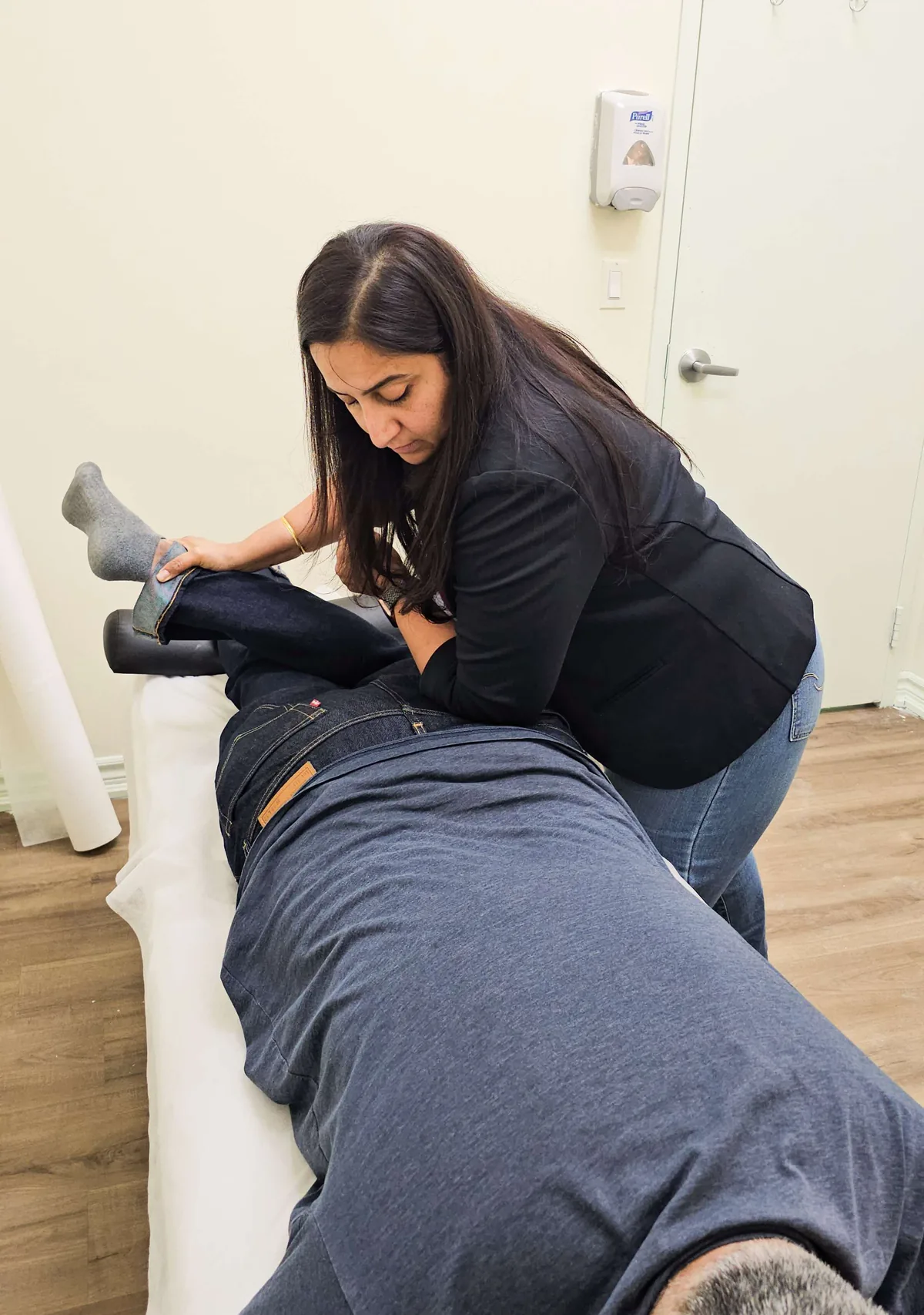
If you are looking for hip pain treatment in Oakville, the most important first step is finding out exactly what is causing it. The hip joint, the surrounding tendons and bursae, the lumbar spine, and the sacroiliac joint all refer pain into overlapping areas. Treating the wrong source, no matter how well-executed, will not get you better. At Wellmax Physiotherapy, every hip assessment systematically tests both the hip and lumbar spine so we target the right structure from the first visit.
Hip pain is deceptive. It develops slowly, often over months, and by the time it is limiting your activities it has been compensating for a while. It started with stiffness getting out of the car. Then a pinch in the front of the hip when sitting too long. Now it is catching when you walk, aching at night when you lie on that side, and you may be starting to limp without realizing it. Hip pain affects your ability to walk, sit, sleep, exercise, and even put on your shoes, rippling through everything.
We are at 1148 Winston Churchill Blvd, Unit B3, Oakville, in the Winston Park area just south of the QEW. Clarkson, Clearview, Sheridan Park, Maple Grove, and south Mississauga are all under 10 minutes away.
- Understanding the Hip Joint
- Hip Conditions We Treat
- How We Deliver Hip Pain Treatment in Oakville
- Your Recovery Timeline for Hip Pain Treatment
- Hip Pain Treatment in Oakville: Typical Recovery by Condition
- What Results to Expect Based on Scientific Evidence
- Why Choose Wellmax for Hip Pain Treatment in Oakville
- Related Conditions and Services
- Book Your Hip Pain Assessment in Oakville
- Frequently Asked Questions
Understanding the Hip Joint
The hip is a ball-and-socket joint, the deepest, most inherently stable joint in the body. It is designed to handle enormous loads (3-5 times body weight during walking, 8-10 times during running) while providing the mobility needed for everything from crossing your legs to kicking a ball. When something goes wrong in this system, the effects are far-reaching because the hip is the mechanical link between the trunk and the leg.
The Joint
The ball (femoral head) sits inside a deep socket (acetabulum) in the pelvis. Unlike the shoulder, which sacrifices stability for mobility, the hip socket is deep enough to cover most of the ball, making dislocation rare. The joint surfaces are lined with articular cartilage that allows smooth, frictionless movement. A ring of fibrocartilage called the labrum lines the rim of the socket, deepening it further and creating a suction seal that helps hold the ball securely in place. When the labrum tears, that seal is disrupted, which can cause clicking, catching, and a feeling of instability.
Femoroacetabular Impingement (FAI)
The shape of the ball and socket determines how they fit together during movement. In some people, extra bone develops on the ball (cam morphology), the socket (pincer morphology), or both (mixed). This extra bone causes the ball and socket to pinch against each other during deep bending, squatting, or crossing the legs, that pinching is femoroacetabular impingement, and over time it can irritate or tear the labrum. Importantly, many people have cam or pincer morphology on imaging with zero symptoms. The bone shape alone does not determine whether you will have pain, muscle strength, movement patterns, and activity demands matter just as much.
The Muscles
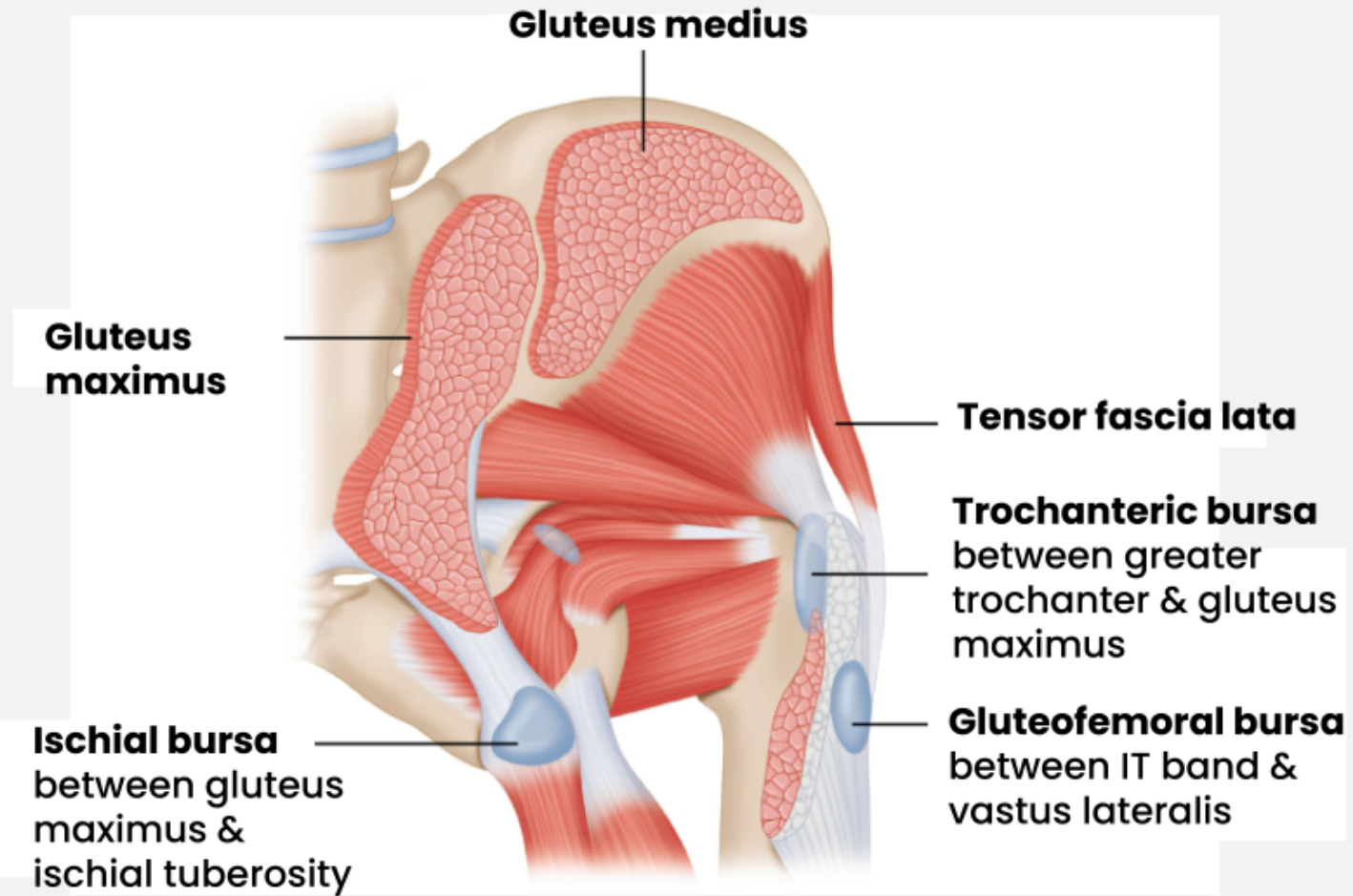
The hip has the largest, most powerful muscles in the body, organized in layers. The gluteus maximus is the primary hip extensor, driving you forward during walking, running, and stair climbing. The gluteus medius sits on the side of the hip and is arguably the most clinically important hip muscle, it stabilizes the pelvis during single-leg stance (which is what walking and running essentially are). When the gluteus medius is weak, the pelvis drops on the opposite side during walking, the knee collapses inward, and the entire lower limb chain compensates. Gluteus medius weakness is a factor in hip bursitis, gluteal tendinopathy, IT band syndrome, patellofemoral knee pain, and even ankle injuries.
The hip flexors (iliopsoas and rectus femoris) lift the thigh toward the chest and are essential for walking, stair climbing, and running. They tend to become tight and overactive in people who sit for long periods, which can change how forces are distributed in the hip joint. The adductors (inner thigh muscles) pull the leg inward and provide rotational stability. The deep hip rotators (including piriformis) control rotation and stabilize the ball in the socket.
The Bursae and Tendons
Several bursae (fluid-filled cushions) sit around the hip to reduce friction between tendons and bone. The most clinically relevant is the trochanteric bursa on the outside of the hip, over the bony point you can feel when you press on the side. When this area hurts, it was traditionally called “trochanteric bursitis.” We now understand that the bursa is rarely the primary problem, the gluteal tendons that cross over this area are usually the main source of pain. This is why the condition is now more accurately called greater trochanteric pain syndrome or gluteal tendinopathy, and why treatment focuses on tendon loading and strengthening rather than just anti-inflammatory approaches. See our bursitis treatment page for the full explanation of this distinction.
The Hip-Back Connection
The lower back and hip share nerve pathways, muscle attachments, and movement patterns. The lumbar spine can refer pain into the buttock, groin, and outer hip. A hip problem can alter walking mechanics and create secondary back pain. SI joint dysfunction causes buttock pain that overlaps with both. This is why differentiating the source is the first step in any effective hip treatment plan, and why assessing both the hip and the lumbar spine is standard at every Wellmax initial assessment.
Hip Conditions We Treat
Hip Impingement (Femoroacetabular Impingement / FAI)
A mismatch in the shape of the ball-and-socket hip joint that causes the bones to pinch during certain movements, particularly deep bending, squatting, sitting for prolonged periods, or crossing the legs. The two types are cam impingement (extra bone on the ball), pincer impingement (extra bone on the socket), and mixed (both).
Hip impingement typically feels like a deep pinching or catching in the front of the hip during squatting or bending, groin pain that is worse with prolonged sitting, stiffness after sitting in a car or at a desk, pain during or after exercise (particularly squats, lunges, or running), difficulty crossing one leg over the other, and clicking or catching with hip rotation.
Physiotherapy focuses on improving hip mobility within comfortable ranges, strengthening the muscles that control hip movement (particularly the gluteals and deep rotators), modifying activities and movement patterns that aggravate the impingement, and building the muscular support that protects the joint during demanding activities. Many people with significant structural FAI on imaging live completely symptom-free with proper muscle strength and movement control. The bone shape does not change, but the system around it can be trained to compensate effectively.
Greater Trochanteric Pain Syndrome (Hip Bursitis)
Pain on the outside of the hip, right over the bony prominence you can feel when you press on the side. This used to be called trochanteric bursitis, but current research shows the primary problem is usually the gluteal tendons, not the bursa. The condition is now more accurately called greater trochanteric pain syndrome (GTPS) or lateral hip pain.
Symptoms include pain on the outside of the hip over the bony point, significant worsening when lying on that side at night (this is often the most disruptive symptom), pain walking upstairs or uphill, aching after prolonged standing or walking, tenderness to press on the side of the hip, and a pattern of being more common in women over 40 and in runners.
Treatment focuses on gluteal tendon loading and strengthening, crucially, not stretching. Stretching the gluteal tendons by crossing the leg over or pulling the knee across the body compresses the tendons against the bone and typically makes the condition worse. Progressive isometric and then isotonic loading of the gluteals, activity modification (avoiding leg crossing, side-lying adjustments for sleep), and addressing biomechanical contributors produces the best outcomes. Shockwave therapy is effective for cases that have not responded to 6-8 weeks of exercise. See our dedicated bursitis treatment page for the full explanation of why stretching makes GTPS worse.
Hip Labral Tears
The labrum is a ring of cartilage that lines the rim of the hip socket, deepening it and creating a suction seal that improves joint stability. Labral tears cause deep hip or groin pain, clicking, catching, and sometimes a feeling of the hip giving way during weight-bearing activities.
Labral tears typically present as deep groin pain or front-of-hip pain that is hard to pinpoint, clicking, catching, or locking sensations in the hip, a sharp catch with pivoting or twisting movements, pain that has been present for months and does not fully resolve with rest, and stiffness after prolonged sitting that takes several steps to ease.
Labral tears can be managed conservatively with physiotherapy in many cases, particularly when symptoms are manageable and function is adequate. Treatment focuses on hip stability through gluteal and deep rotator strengthening, core control, and load management to reduce the demands on the labrum. Surgical labral repair (arthroscopic) is considered when conservative treatment has not provided adequate improvement after 3-6 months, when mechanical symptoms (catching, locking) are persistent, or when the tear is large and in a location that will not heal with conservative management.
Hip Arthritis (Osteoarthritis)
Gradual wear of the articular cartilage in the hip joint. The most common cause of hip pain in people over 55. It typically develops slowly over years, starting with stiffness and progressing to activity-limiting pain. Hip arthritis commonly presents as morning stiffness that eases within 30 minutes of moving, groin pain or deep front-of-hip pain, reduced range of motion (particularly rotation and flexion), pain after prolonged activity, a feeling that the hip is stiff or locked up, and a gradually increasing limp.
Physiotherapy is the recommended first-line treatment for hip arthritis. Progressive strengthening of the gluteals and hip muscles reduces joint loading, improves shock absorption, and often dramatically reduces pain, even with significant structural changes on imaging. Manual therapy improves range of motion and reduces stiffness. Many patients with significant arthritis on X-ray manage well for years with regular exercise. See our Arthritis Treatment in Oakville page for comprehensive arthritis management.
Hip Flexor Strain and Tendinopathy
The hip flexors (iliopsoas and rectus femoris) can become strained with sudden overload or develop tendinopathy with repetitive overuse. Hip flexor problems are common in runners, cyclists, dancers, and people who do a lot of kicking or stair climbing. They present as pain in the front of the hip or groin that is worse when lifting the knee, particularly at the beginning and end of activity. A “snapping” of the hip flexor tendon over the front of the hip is common and usually painless, but if it becomes painful it should be assessed.
Treatment focuses on graduated loading of the hip flexor tendon (not complete rest), activity modification to reduce the specific repetitive overload, and strengthening of the hip stabilizers that reduce the demands on the hip flexors.
Sacroiliac (SI) Joint Dysfunction
The SI joint connects the pelvis to the base of the spine. When it becomes stiff or moves asymmetrically, it causes buttock pain that can radiate into the hip and outer thigh, a pattern that overlaps heavily with both hip and sciatica presentations. SI joint dysfunction is common following pregnancy, prolonged sitting, or asymmetrical loading activities. It is often misidentified as either hip pain or lower back pain, making accurate physical examination important. Treatment involves specific SI joint mobilization, core and pelvic stabilizer strengthening, and movement pattern retraining.
Gluteal Tendinopathy (Lateral Hip Pain)
Degeneration of the gluteus medius and minimus tendons where they attach to the greater trochanter. This is one of the most under-recognized causes of persistent hip pain. The tendons become painful when they are repeatedly compressed against bone, during positions like leg crossing, side sleeping, prolonged hip adduction, or certain exercise positions. Unlike muscle strains, this is a tendon problem that requires progressive loading to repair, not rest, not stretching, and not cortisone injections as a stand-alone treatment.
Gluteal tendinopathy is particularly common in women between 40-60, runners, and people who have recently increased their training volume. The treatment programme is specific and differs significantly from general hip pain advice, getting it right matters. We use evidence-based tendon loading protocols starting with isometric exercises before progressing to isotonic loading.
Piriformis Syndrome and Deep Gluteal Pain
The piriformis muscle is one of the deep hip rotators. When it becomes tight or overloaded, it can cause deep buttock pain and in some cases compress the sciatic nerve, producing sciatica-like symptoms radiating down the leg. This is distinct from true sciatica caused by lumbar disc herniation or nerve root compression, though the two can be difficult to distinguish without careful examination. Treatment involves manual therapy to the piriformis, graduated strengthening of the hip external rotators, and activity modification.
Snapping Hip Syndrome (Coxa Saltans)
A snapping or clicking sensation in the hip, often audible, caused by a tendon snapping over a bony prominence. The most common locations are the hip flexor tendon at the front of the hip (internal snapping) and the IT band on the outside (external snapping). Painless snapping does not need treatment. Painful snapping should be assessed, particularly external snapping, which can be associated with IT band syndrome and gluteal tendinopathy. Treatment focuses on reducing the load on the snapping tendon and building strength and control in the surrounding muscles.
How We Deliver Hip Pain Treatment in Oakville
Assessment: Hip, Back, or Both?
This is the critical first step and the one that gets skipped most often. Hip pain and lower back pain overlap significantly in their symptom patterns. The lumbar spine can refer pain into the buttock, groin, and outer hip. A hip problem can alter walking mechanics and create secondary back pain. SI joint dysfunction causes buttock pain that could be either. We test both the hip joint and the lumbar spine systematically at every initial assessment to determine where the pain is actually coming from. If both are contributing (which is common), we treat both. Getting this right at the start is worth more than weeks of treatment aimed at the wrong target.
Hands-On Manual Therapy
Manual therapy for hip conditions includes hip joint mobilization to restore rotation and flexion range (internal rotation is often the first movement restricted in hip arthritis and impingement), lumbar spine mobilization when the back is contributing, soft tissue release for the hip flexors, gluteals, piriformis, adductors, and IT band, SI joint mobilization for sacroiliac dysfunction, and traction for hip joint decompression. Manual therapy creates immediate improvements in pain and mobility that open a window for the strengthening work to take effect.
Progressive Strengthening
Hip rehabilitation is fundamentally about strengthening. The gluteal muscles are the primary stabilizers of the hip, pelvis, and lower limb. When they are weak, the hip joint absorbs excessive load, the IT band tightens as it compensates, the knee starts compensating below, and pain develops. Gluteus medius strength specifically is the single most important factor in hip function and is deficient in the majority of hip pain patients we see.
We build strength progressively: from simple activation exercises (getting the muscle firing again), through supported strengthening (side-lying, seated), to loaded functional movements (single-leg squats, step-ups, lunges), and eventually to sport-specific or work-specific demands. The progression is based on your response, not a calendar.
Shockwave Therapy for Chronic Hip Pain
Particularly effective for greater trochanteric pain syndrome and gluteal tendinopathy that has not responded to 6-8 weeks of progressive exercise. Shockwave promotes tendon remodeling, stimulates blood flow, and reduces chronic pain. Used alongside the exercise programme, not as a replacement. See our Shockwave Therapy page for how this fits into hip tendon management.
Deep Tissue Laser Therapy
Used for acute inflammatory presentations, hip bursitis flare-ups, post-surgical inflammation, acute strain recovery, to reduce swelling and accelerate healing. Also used for hip arthritis flare-ups where inflammation is the primary driver of the current pain episode. See our Laser Therapy page for details.
Your Recovery Timeline for Hip Pain Treatment
Recovery timelines depend on the specific condition, its severity, and how long it has been present. Here is the general framework we use for most hip conditions.
Phase 1: Pain Reduction and Early Mobility (Weeks 1-3)
What we are doing: Joint mobilization, soft tissue work, pain-free movement exercises, activity modification guidance, and sleep positioning strategies (lateral hip pain at night is often the most disruptive symptom).
What you will notice: Sitting becomes more comfortable, walking stiffness reduces, sleeping on the affected side starts to improve, and getting in and out of the car becomes easier.
Your homework: Gentle hip mobility exercises daily, activity modifications (we tell you exactly what to change and what to avoid), specific positioning tips for sleeping.
Phase 2: Strengthening and Loading (Weeks 4-8)
What we are doing: Progressive gluteal strengthening (the most important component), core stability training, functional movement retraining including squats, stairs, and walking endurance.
What you will notice: Walking distance increases, getting in and out of the car is noticeably easier, stairs improve, the hip feels more stable and reliable, and you start returning to activities you had been avoiding.
Your homework: Strengthening exercises 3-4 times per week, walking programme with gradually increasing distance, gradual return to exercise.
Phase 3: Return to Full Function (Weeks 8-12+)
What we are doing: Advanced strengthening to full capacity, sport-specific or work-specific training, maintenance programme design for long-term hip health.
What you will notice: Full function restored, confidence in the hip during demanding activities, self-management skills and knowledge in place.
Your homework: Maintenance exercises 2-3 times per week, permanently. For most hip conditions, 15 minutes of targeted gluteal and hip work 2-3 times per week is the long-term investment that prevents recurrence.
These timelines represent typical ranges. Individual results depend on how long the condition has been present, injury severity, adherence to the home exercise programme, and overall health. Your physiotherapist will provide a specific estimate at your first assessment.
Hip Pain Treatment in Oakville: Typical Recovery by Condition
| Condition | Typical Recovery | Primary Treatment |
|---|---|---|
| Greater trochanteric pain syndrome (gluteal tendinopathy) | 8-14 weeks | Gluteal tendon loading, avoid compressive positions, shockwave for chronic cases |
| Hip impingement (FAI) | 8-12 weeks | Hip mobility work, gluteal and deep rotator strengthening, activity modification |
| Hip labral tear (conservative management) | 12-24 weeks | Hip stability training, load management, graduated return to sport |
| Hip osteoarthritis | Ongoing management | Progressive strengthening, joint mobility, activity modification |
| Hip flexor tendinopathy | 6-12 weeks | Graduated tendon loading, activity modification, hip stabilizer strengthening |
| SI joint dysfunction | 4-8 weeks | SI joint mobilization, core and pelvic stabilizer strengthening |
| Post-hip replacement rehab | 12-20 weeks | Progressive loading, gait retraining, return to full function |
What Results to Expect Based on Scientific Evidence
The evidence for physiotherapy in hip conditions is strong. For gluteal tendinopathy and greater trochanteric pain syndrome, a 2018 randomized controlled trial (Mellor et al., JAMA) found that education and exercise produced significantly better outcomes at 8 weeks than cortisone injection alone, and better long-term results at 52 weeks. For hip osteoarthritis, exercise-based physiotherapy consistently reduces pain and improves function, with evidence supporting a delay or avoidance of surgery in a meaningful proportion of patients. For hip impingement, physiotherapy produces outcomes comparable to surgery in many patients with FAI, a finding from the UK Fashionista trial.
What this means for you: structured, progressive physiotherapy is not a consolation prize while waiting for something else. For most hip conditions, it is the appropriate primary treatment, and the outcomes it produces are genuinely good when applied correctly.
Why Choose Wellmax for Hip Pain Treatment in Oakville
We Differentiate Hip From Back
Many patients come to us after being treated for hip pain that turned out to be their lower back, or for back pain that was actually coming from the hip. We assess both the hip joint and the lumbar spine systematically at every initial assessment. If both are contributing, we treat both. Getting the source right at the start prevents weeks of misdirected treatment.
Expert Care, Every Visit
Hip rehab is a progression that requires nuanced tracking of how your mobility, strength, and function are responding week over week. At Wellmax, your care is tracked from visit to visit, so your team knows which movements were restricted last week, how the gluteal loading was tolerated, and exactly where to progress this week. That precision comes from reassessing at every visit, from start to finish, with honest guidance on where you stand.
We Understand Tendon Loading
Gluteal tendinopathy and greater trochanteric pain syndrome are among the most commonly mistreated hip conditions. Standard advice to “stretch the hip” and “strengthen the glutes” often makes things worse because the stretching compresses the already irritated tendon. We use evidence-based tendon loading protocols that start with the right type of exercise (isometric before isotonic), avoid the specific positions that aggravate the tendon, and progress at a pace the tendon can tolerate. Getting this wrong is why many GTPS patients have been stuck for months.
Shockwave and Laser Available
For chronic gluteal tendinopathy and trochanteric pain that has not responded to exercise alone, shockwave therapy is available as part of the treatment plan. Deep tissue laser is available for acute inflammatory presentations and post-surgical recovery. These are used when clinically indicated, not as filler.
Convenient Oakville Location
1148 Winston Churchill Blvd, Unit B3, Oakville. Free parking directly in front. Ground-level entrance (no stairs). Clarkson: 5 minutes. Clearview: 8 minutes. Sheridan Park: 10 minutes. South Mississauga: 7 minutes.
Direct Insurance Billing
Hip physiotherapy is covered under your physiotherapy benefit in most extended health plans. We direct bill to Sun Life, Manulife, Canada Life, Green Shield, Great-West Life, Blue Cross, Desjardins, and most other major providers. WSIB and MVA hip injuries billed directly. No referral needed. See our insurance and direct billing page for details.
What Our Patients Say
Keith T.“Gurmeet Rai, Owner and Registered Physiotherapist, at Wellmax Physiotherapy in Oakville, has been treating my wife Claudia for spinal curvature conditions, Scoliosis and Kyphosis. Gurmeet has also treated me for hip and side pain issues. Gurmeet Rai is a very caring, well trained and knowledgeable professional, and she carefully addresses all related health issues. Gurmeet also recommends personal exercises, which can be done at home to make sure that her patient is getting the maximum recovery in-between visits. We have the fullest confidence in Gurmeet’s capabilities and we are very happy to have her looking after us. We recommend her highly.”
Sukhleen B.“I had been suffering from severe chronic back and hip pain for a long time and had tried physical therapy at many different places. Most of them relied on machines, massage guns, and heat or cold therapy, but no one was ever able to truly pinpoint the real problem. Meeting Gurmeet changed everything for me. She took the time to do a very detailed analysis of my gait and pain points and focused on hands-on manual therapy. She truly has magic in her hands. The relief and improvement I felt were something I hadn’t experienced in years. In addition to her manual therapy, she gave me exercises that were simple, practical, and extremely helpful in supporting my recovery. …”
Palkin K.“I have been seeing Gurmeet Rai for physiotherapy for the past few months following my surgery. When I started, I was dealing with significant pain and limitations, but her treatment and guidance truly changed my recovery journey. She is incredibly skilled, patient, and compassionate, and she always took the time to understand my condition and tailored the therapy accordingly. Because of her support, my pain reduced. I highly recommend to anyone looking for effective and genuine physiotherapy care.”
Verified Patient“Tore my meniscus playing soccer at Sixteen Mile Sports Complex and needed a physio who understood returning to sport, not just getting out of pain. Gurmeet built a rehab program that started with reducing the swelling and restoring range of motion and progressed all the way to cutting, pivoting, and sport-specific drills before she cleared me to play again. Most physios would have discharged me when the pain stopped. She made sure I was actually ready to compete. Back on the pitch now with full confidence in the knee.”
Joan B.“The team is wonderful and they did amazing job to fix my knee injury. I highly recommend them for any physio needs”
Sam S.“Dr. Gurmeet is absolutely amazing! I have been suffering from knee and hamstring pain for 10 months. I tried physical therapy before seeing her, but nothing worked. Incredible as it sounds, I felt a noticeable improvement after my very first session with Dr. Gurmeet. She understood exactly where the pain was coming from right after our first conversation. On top of her expertise, she is cheerful, patient, and truly wonderful in every way. I highly recommend anyone experiencing bodily pain to visit her immediately. I will definitely be completing the rest of my sessions with her. Thank you so much, Dr. Gurmeet! 🙏”
Maria G.“My experience here with knee osteoarthritis was too good not to share, making it the best physiotherapy clinic in Oakville in my opinion. I was having a lot of difficulty climbing stairs and my knee felt very unstable. Gurmeet was so patient and encouraging. Instead of just telling me to rest, she explained how strengthening the muscles around my knee would reduce the joint pain. The manual therapy provided instant relief, and the exercise program she designed was very easy to follow at home. My knee feels much stronger now and the sharp pain is gone. The entire staff is wonderful.”
Puja D.“I went to Gurmeet for knee tendinitis when I was struggling with climbing stairs and jogging. With her knowledge and techniques, she helped me recover and get back to feeling normal again. She is extremely helpful, friendly, and professional, and she never once made the sessions feel awkward. She explains things clearly and genuinely cares about your progress. I’m very grateful for her support and would highly recommend her.”
See all our Google reviewsRead more patient storiesLeave a review
Frequently Asked Questions
How do I know if my pain is from my hip or my back?+–
This is one of the most common diagnostic challenges in physiotherapy, and it is the reason so many hip patients end up in the wrong treatment. General patterns: hip joint problems tend to cause groin or front-of-hip pain that is worse with weight-bearing, deep bending, and rotation. Back problems tend to cause buttock or outer hip pain that may radiate down the leg. But there is significant overlap, and many patients have both contributing. A thorough physical examination testing both areas usually provides a clear answer, which is why we assess both the hip and lumbar spine at every initial appointment.
Can I avoid hip replacement with physiotherapy?+–
For many people, yes, or at least delay it significantly. Every major clinical guideline recommends trying exercise-based physiotherapy before considering hip replacement. Research shows that structured hip strengthening reduces pain and improves function in hip arthritis. Some patients manage well for years with regular exercise and activity modification. Others eventually need the surgery, but being stronger beforehand leads to faster recovery and better outcomes after the procedure.
Why does my hip hurt at night?+–
Lying on the affected side compresses the structures on the outside of the hip, particularly the gluteal tendons and bursae. This is a hallmark of greater trochanteric pain syndrome. Hip arthritis can cause night pain due to inflammation, often worse after a particularly active day. Front-of-hip pain at night may indicate hip impingement aggravated by sleeping position. We provide specific positioning strategies based on your assessment findings, and night pain typically improves quickly once the underlying tendon or joint issue is treated.
Is clicking in my hip something to worry about?+–
Painless clicking is usually harmless. It is commonly caused by a tendon snapping over bone (snapping hip syndrome), either the hip flexor tendon at the front or the IT band on the outside. This does not cause damage and does not need treatment unless it is bothersome. Clicking accompanied by pain, catching, a feeling of instability, or locking may indicate a labral tear or other structural issue and should be assessed.
Should I stretch my hip if it feels tight?+–
It depends on what is causing the tightness. For hip impingement and labral tears, aggressive stretching (particularly into deep flexion or rotation) can worsen symptoms by jamming the ball into the socket. For gluteal tendinopathy, crossing the leg for IT band or glute stretches compresses the tender tendon against bone and makes it worse. Sometimes what feels like tightness is actually the muscles guarding a painful joint, and stretching increases the irritation. We assess what is actually happening and tell you exactly which movements are safe and which to avoid.
Does sitting too much cause hip pain?+–
Prolonged sitting can contribute to hip flexor tightness, gluteal deactivation (the glutes essentially switch off when sitting for hours), hip stiffness, and compression of the front of the hip joint. For desk workers, addressing sitting habits (regular movement breaks, desk setup) and building a targeted hip exercise routine is usually part of the treatment plan. The hip needs regular movement and loading to stay healthy.
How often should I come for hip physiotherapy?+–
Typically twice per week for the first 2-3 weeks to establish the exercise programme and manage acute symptoms, then once weekly as you become more independent with home exercises, then every other week for monitoring and progression. Total course is usually 8-16 sessions depending on the condition. Hip replacement rehab may run longer. Your physiotherapist will give you a specific estimate at the first assessment.
My hip X-ray shows arthritis. Does that mean I need surgery?+–
No. X-ray findings do not determine your treatment. Many people with significant arthritis on imaging have minimal pain and excellent function. Many people with mild changes on imaging are significantly limited. The modifiable factors, muscle strength, activity levels, weight, movement patterns, matter more than the imaging findings. Physiotherapy is the recommended first-line treatment before surgery is considered, and it works well for the majority of patients.
Can physiotherapy help after a hip replacement?+–
Absolutely. Post-surgical rehabilitation is essential after hip replacement. The surgery replaces the worn joint surfaces. Physiotherapy restores the strength, mobility, balance, and confidence you need to walk normally, use stairs, return to exercise, and live without restrictions. Most people start physiotherapy within days of surgery and continue for 12-20 weeks. Patients who complete the rehab consistently have significantly better outcomes.
Will my insurance cover hip physiotherapy?+–
Most extended health benefit plans include physiotherapy coverage, typically $500-$1,500 per year. We direct bill to most major providers so you do not pay upfront. MVA and WSIB hip injuries are billed directly to the respective insurer. No referral is needed to start treatment in Ontario. Contact us to confirm your specific coverage before your first visit.
What is a hip labral tear and can physiotherapy treat it without surgery?+–
The hip labrum is a ring of cartilage that lines the socket of the hip joint, providing stability and cushioning. Labral tears typically cause deep groin pain, a catching sensation in the hip, and pain with prolonged sitting or hip flexion. Most hip labral tears can be successfully managed without surgery using physiotherapy focused on hip stability, movement control, and reducing impingement. Surgery is generally reserved for high-grade tears that fail to improve after three to six months of appropriate conservative treatment.
Why do I feel a snapping or clicking sensation in my hip when I walk?+–
Snapping hip has three main causes. Internal snapping at the front of the hip is usually the iliopsoas tendon flicking over a bony prominence. External snapping on the outer hip is the IT band sliding over the greater trochanter. Intra-articular snapping inside the joint may indicate a labral tear or loose body. Most cases are painless and benign, but when snapping is painful or persistent, physiotherapy can address the underlying muscle imbalances and mechanics driving it.
Is groin pain the same as hip pain, and should I see a physiotherapist for it?+–
Not always, but they often overlap. Hip joint problems frequently cause deep groin pain, particularly with deep hip flexion, rotation, and weight-bearing. Other causes of groin pain include adductor strains, sports hernias, iliopsoas tendinopathy, and referred pain from the lumbar spine or sacroiliac joint. A physiotherapist can examine the hip, groin, and lumbar spine together to identify the source accurately, since treatments differ significantly depending on the cause.
What is greater trochanteric pain syndrome and how is it treated?+–
Greater trochanteric pain syndrome is pain on the outer hip over the bony prominence caused by gluteal tendinopathy and bursitis. It is common in women over 40 and runners. Key symptoms include point tenderness on the outer hip, pain lying on the affected side, and pain walking up stairs. Physiotherapy focuses on load management, avoiding compressive postures like crossing your legs, and progressive gluteal strengthening. Shockwave therapy is effective for persistent cases. Avoid stretching the IT band – it compresses the tendon and makes symptoms worse.
Can sitting for long hours at a desk cause hip pain?+–
Yes. Prolonged sitting shortens and tightens the hip flexors, particularly the iliopsoas, reduces blood flow to hip structures, and creates sustained compressive load on the hip joint. Over time this contributes to anterior hip pain, hip flexor tendinopathy, and hip impingement symptoms. Taking regular breaks every 30-45 minutes, adjusting your seat height so your hips are at 90 degrees or slightly open, and targeted hip mobility and strengthening exercises address the desk-related contributors.
How do I know if my hip pain is serious enough to need imaging or an X-ray?+–
Red flags that warrant imaging include: pain after a fall or trauma, inability to bear weight, severe pain at rest or at night, unexplained weight loss, history of cancer, fever with joint pain, or pain that has not improved with any treatment after three to four weeks. Most hip pain from muscle, tendon, or soft tissue causes does not require imaging to begin effective treatment. Your physiotherapist will refer you for imaging if clinical examination findings warrant it.
Can physiotherapy help with hip pain caused by a labral tear?+–
Yes. Physiotherapy for hip labral tears focuses on reducing the impingement forces that stress the labrum, strengthening the hip stabilizers including the glutes and deep rotators, improving lumbopelvic control, and modifying movement patterns that load the labrum. Many patients with confirmed labral tears on MRI achieve full return to activity with physiotherapy alone. The goal is to make the labrum’s job easier by optimizing hip mechanics, not just to manage pain.
Related Conditions and Services
- Bursitis Treatment in Oakville: Hip bursitis, trochanteric bursitis, and greater trochanteric pain syndrome, the full explanation of why stretching makes it worse.
- Arthritis Treatment in Oakville: Hip osteoarthritis management including progressive loading to delay or avoid surgery.
- Back Pain and Sciatica Treatment: Lower back conditions that frequently refer pain into the hip and buttock area.
- Sciatica Treatment in Oakville: Nerve pain radiating from the lower back through the buttock and leg, often confused with hip conditions.
- IT Band Syndrome Treatment: Lateral hip and knee pain from IT band overload, closely related to gluteal weakness.
- Knee Pain Treatment in Oakville: Knee conditions secondary to hip weakness and altered movement mechanics.
- Shockwave Therapy in Oakville: Evidence-based treatment for chronic gluteal tendinopathy and trochanteric pain syndrome.
- Deep Tissue Laser Therapy: Deep tissue laser for acute hip bursitis flare-ups and inflammatory presentations.
- Sports Injury Rehabilitation: Hip injuries in runners, cyclists, and athletes.
- Running Injuries Physiotherapy: Hip flexor, gluteal, and IT band issues in runners specifically.
- Pre and Post-Surgical Rehabilitation: Hip replacement and hip arthroscopy rehabilitation.
Book Your Hip Pain Assessment in Oakville
Whether it is lateral hip pain keeping you up at night, a groin catch that has not settled, stiffness building up with every flight of stairs, or an arthritis diagnosis you want to manage without surgery, get it properly assessed so treatment targets the right source. Wellmax offers a free 15-minute consultation to discuss your situation before your first visit.
Wellmax Physiotherapy
1148 Winston Churchill Blvd, Unit B3, Oakville, ON L6J 0A3
Phone: (905) 829-1100
Email: info@wellmaxphysiotherapy.ca
Proudly Serving Our Local Communities:
- East Oakville: Winston Park, Clearview, and the QEW/403 Corridor.
- South Oakville: Eastlake, Maple Grove, Lorne Park, and Old Oakville.
- North Oakville: Joshua Creek, Falgarwood, Iroquois Ridge, and Upper Middle Road.
- Mississauga Border: Clarkson, Sheridan Park, Sheridan Homelands, and Southdown.
Insurance: Direct billing to most major providers. WSIB and MVA claims accepted. No referral needed. See our insurance and direct billing page for details.
Hours: Monday to Friday: 9am to 7pm | Saturday: 9am to 2pm | Sunday: 9am to 2pm (by appointment only)
Registered & Regulated
Regulated & Recognized Across Every Discipline
Wellmax is in good standing with the regulatory colleges and leading associations for physiotherapy, chiropractic, massage therapy, and naturopathic medicine in Ontario.