Neck Pain Treatment in Oakville
Cervicogenic headaches, tech neck, whiplash, and disc herniations treated at the source.
Home > Conditions We Treat > Neck Pain Treatment in Oakville
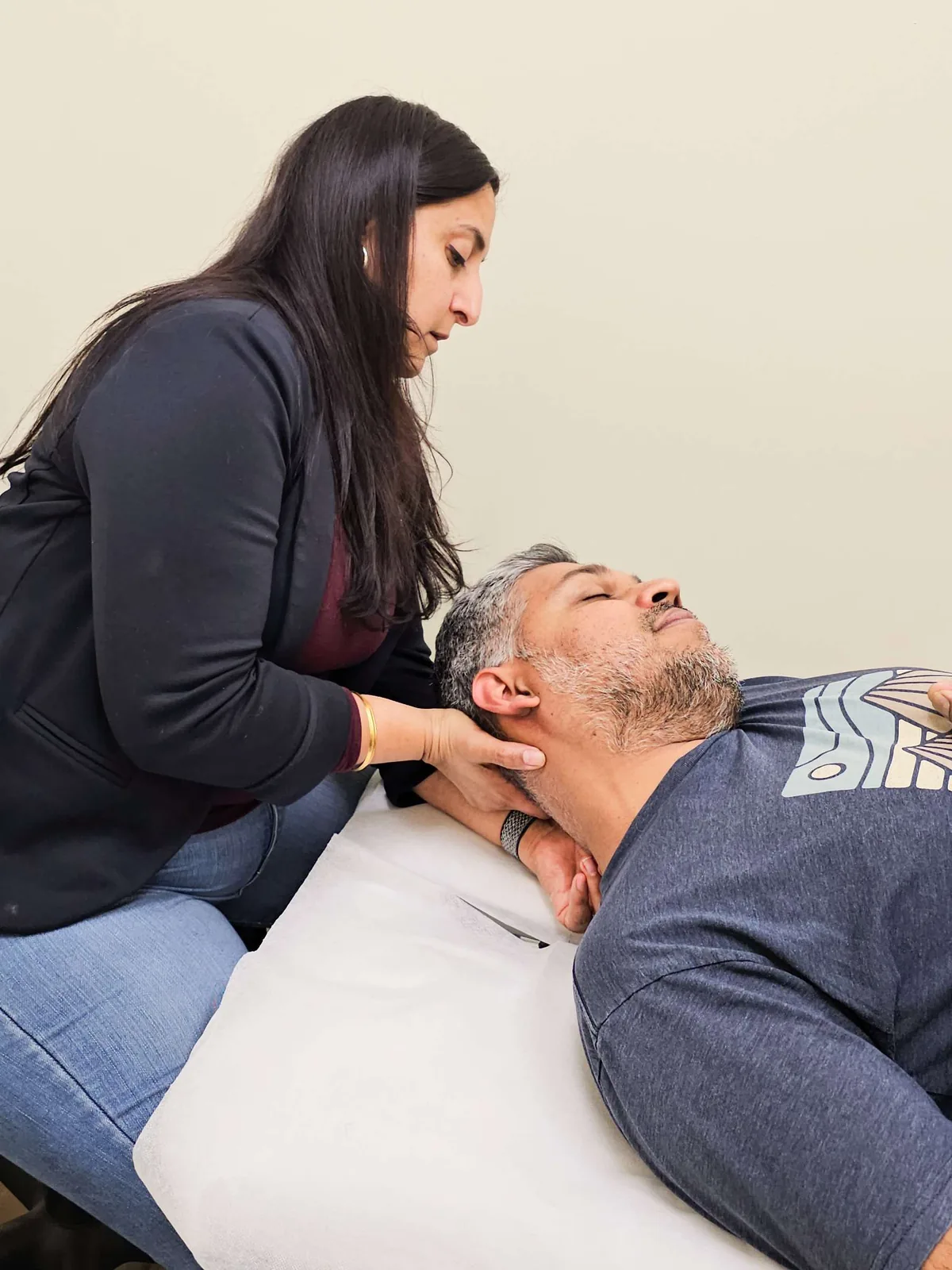
You can’t turn your head to check your blind spot. Your neck is stiff by 10am every single day. Maybe the pain wraps up into your skull and now you’ve got a headache that won’t go away with Advil. You’ve been stretching, you’ve been rolling on a tennis ball, you’ve adjusted your office chair three times this month, and it’s still there.
Neck pain is the second most common reason people come to see us at Wellmax, right behind back pain. And headaches? A surprising number of recurring headaches actually start in the neck, not the head. Stiff joints and tight muscles in the top of the cervical spine can send pain straight up into the skull, behind the eyes, across the forehead, and along the temples. These are called cervicogenic headaches, and they’re one of the most under-diagnosed conditions in physiotherapy.
Neck pain treatment in Oakville at Wellmax starts with finding the specific joints and muscles that are contributing to the problem. If someone has told you “it’s just stress” or “you need to work on your posture” and left it at that, that’s not treatment. That’s a suggestion. Treatment means finding the specific joints and muscles that are contributing, working on them with your hands, building strength in the areas that need it, and giving you a clear plan so this doesn’t keep coming back every few weeks.
We’re at 1148 Winston Churchill Blvd, Unit B3, Oakville, in the Winston Park area just south of the QEW. If you’re in Clarkson, Clearview, Sheridan Park, or south Mississauga, you can be here in under 10 minutes.
- Understanding Neck Pain
- The Neck-Headache Connection
- Conditions We Treat: Neck Pain and Headaches
- How We Treat Neck Pain and Headaches
- What to Expect: Recovery Timelines
- Your Treatment Plan: Phase by Phase
- Why Oakville Patients Choose Wellmax for Neck Pain and Headache Treatment
- What to Do Before, During, and After Your First Visit
- Helpful Tips for Neck Pain and Headache Relief Between Sessions
- When to Seek Emergency Care
- Related Conditions and Services
- Book Your Neck Pain Assessment
- Frequently Asked Questions
Understanding Neck Pain
Your neck is seven vertebrae (C1 through C7) stacked between your skull and your upper back. Between each vertebra sits a disc, and behind each disc are facet joints that guide movement. Muscles layer over the entire structure, some deep and small, some large and superficial. Ligaments hold the bones together, and nerves branch out at every level, traveling into the shoulders, arms, and hands.
Your neck has the job of holding up a head that weighs about 10 to 12 pounds. That’s manageable when it’s sitting directly over the spine. But tilt that head forward even a few inches, say, to look at a phone or a laptop that’s too low, and the load on your neck muscles can triple or even quadruple. Do that for 8 hours a day, 5 days a week, and something’s eventually going to protest.
This is why neck pain treatment in Oakville is so commonly sought by people who work at desks, use phones heavily, or drive long distances. The structures weren’t designed for sustained forward-head positions. When they’re overloaded, they get stiff, irritated, and painful.

The Neck-Headache Connection
This is the part most people don’t realize: the top three vertebrae of your neck (C1, C2, and C3) share a nerve pathway with the nerves that supply sensation to your head and face. This is called the trigeminocervical nucleus. In plain language, it means that a problem at the top of your neck can create pain you feel in your head.
This isn’t rare; studies suggest that up to 20% of all chronic headaches are cervicogenic, meaning they come from the neck, not from inside the skull. For people who’ve had whiplash injuries, that number is much higher. Here’s how you can tell the difference between a cervicogenic headache and a regular tension headache or migraine:
- Cervicogenic headaches usually start on one side.
- The pain often begins at the base of the skull and wraps forward.
- Moving your neck can trigger or change the headache.
- Pressing on certain spots at the top of the neck reproduces the head pain.
- Pain medication helps less than you’d expect.
If any of that sounds familiar, your headaches might not be a “head problem” at all. They might be a neck problem that’s referring pain upward. That changes the treatment entirely, and it’s something we assess for in every neck pain patient at Wellmax.
Conditions We Treat: Neck Pain and Headaches
Cervicogenic Headaches
The most under-diagnosed headache type. Stiff or irritated joints at C1-C3 send pain signals up into the head through shared nerve pathways. People with cervicogenic headaches often spend years being told they have migraines or tension headaches, taking medication that only partly works, because nobody assessed their neck properly.
What cervicogenic headaches feel like:
- One-sided headache that starts at the base of the skull
- Pain wrapping around to the forehead, temple, or behind the eye
- Headache triggered or worsened by certain neck positions
- Stiffness at the top of the neck, especially in the morning
- Neck pain that comes along with or just before the headache
- Reduced response to typical headache medications
Treatment: Manual therapy targeting the upper cervical joints and suboccipital muscles, combined with deep neck flexor strengthening. Research by Jull et al. showed this combination reduces headache frequency by 50% or more in most patients within 8 to 12 weeks. Also see our Headache and Migraine Chiropractor page for chiropractic management of headaches.
Tension Headaches
The most common type of headache. Feels like a band of pressure around the head or across the forehead. Usually both sides, mild to moderate intensity. Often related to muscle tension in the neck, upper traps, and jaw, especially in people who clench when they’re stressed.
Typical symptoms:
- Dull, pressing pain on both sides of the head
- Tightness across the forehead or around the temples
- Neck and shoulder tension that builds through the day
- Worse with stress, fatigue, or long desk sessions
- Usually doesn’t cause nausea or light sensitivity (unlike migraine)
Physiotherapy reduces tension headache frequency by addressing the muscle tension and joint stiffness that feed the cycle. For people in Oakville who spend most of their day at a desk, postural correction is a major part of the solution.
Tech Neck (Text Neck)
Not a formal medical diagnosis, but a very real pattern. Head forward, shoulders rounded, chin poking out. Hours of this daily, usually from working on a laptop, scrolling a phone, or looking down at a tablet. Over time, the muscles at the front of the neck shorten, the muscles at the back overwork to hold the head up, and the joints in the mid-cervical spine start stiffening.
Signs of tech neck:
- Dull ache at the base of the neck and across the upper shoulders
- Stiffness that builds through the work day and eases on weekends
- Headaches that come on in the afternoon or evening
- Noticeable forward head posture when you see yourself in a mirror
- Neck feels “old” despite being in your 30s or 40s
Tech neck is extremely common in our patient population. Between the corporate offices along Winston Churchill, the work-from-home crowd throughout Clarkson and Sheridan Park, and Sheridan College students nearby, we treat this pattern constantly. The good news: it responds well to treatment and corrects faster than most people expect.
Whiplash
A sudden acceleration-deceleration force that snaps the neck forward and back. Most often from car accidents but also from sports collisions, falls, or any sudden impact. Whiplash can damage muscles, ligaments, discs, facet joints, and nerves in the cervical spine, and symptoms can show up anywhere from immediately to several days after the injury.
What whiplash causes:
- Neck pain and stiffness (sometimes severe)
- Headaches starting at the base of the skull
- Pain between the shoulder blades
- Dizziness or feeling “off balance”
- Difficulty concentrating, brain fog
- Jaw pain or clicking (TMJ involvement)
- Arm pain, numbness, or tingling if nerves are involved
Important: whiplash symptoms don’t always match injury severity. A low-speed fender bender can cause more problems than you’d expect. If you’ve been in a car accident, don’t wait weeks to see how you feel. Early treatment leads to better outcomes. We accept MVA claims and bill your auto insurer directly. See our Motor Vehicle Accident page for details. For a full breakdown of whiplash grades, treatment timelines, and what to expect, see our dedicated Whiplash Treatment in Oakville page.
Cervical Disc Herniation
Same concept as a lumbar disc herniation, but in the neck. A disc bulges or herniates and presses on a nerve root. Instead of leg pain, you get arm pain, shooting down the shoulder, arm, and sometimes into the hand and fingers.
Symptoms:
- Sharp neck pain with pain radiating into one arm
- Numbness or tingling in specific fingers (which fingers depends on which nerve is affected)
- Weakness in the arm or hand
- Pain that’s worse looking up or tilting the head toward the painful side
- Some people feel better with their hand on top of their head (takes tension off the nerve)
Most cervical disc herniations improve with conservative treatment. Traction can be particularly effective here, gently separating the vertebrae to reduce pressure on the nerve. We use our traction table regularly for cervical disc problems. See our Herniated Disc Treatment in Oakville page for the full management approach.
Cervical Arthritis (Spondylosis)
Wear-and-tear changes in the neck joints and discs that happen with age. Shows up on imaging in most people over 50, and often in people much younger. Can cause stiffness, aching, grinding sensations, and sometimes nerve symptoms if the spaces where nerves exit become narrowed.
What it feels like:
- Gradual stiffness and aching in the neck
- Grinding or crunching sounds with neck movement
- Pain that’s worse in the morning and eases with gentle movement
- Occasional sharp catches with certain positions
- May cause headaches if the upper cervical levels are involved
Having arthritis on your scan doesn’t mean you’re stuck with pain. Most people with cervical arthritis on imaging have no symptoms at all. Physiotherapy improves how the joints move, builds supporting muscle strength, and reduces the frequency of flare-ups. See our Arthritis Treatment in Oakville page for the detailed approach to cervical spondylosis and joint degeneration.
How We Treat Neck Pain and Headaches
Assessment Comes First, and We Don’t Rush It
Your first visit is a full session of one-on-one care at Wellmax. We take the time to understand your complete picture: when the pain started, what you’ve tried, what your daily routine looks like, how the headaches pattern with the neck symptoms, and what your goals are.
The physical exam covers everything that matters: cervical range of motion, specific joint mobility testing at each level (especially C1-C3 for headaches), muscle strength and endurance testing, nerve tension tests if arm symptoms are present, and a thorough check of the thoracic spine and shoulder blades, both of which feed into neck problems more often than people realize.
Neck conditions change week to week, sometimes session to session. That is why your therapist reassesses at every visit: feeling how your joints are responding, tracking subtle changes in range of motion, and adjusting treatment based on real-time feedback.
Hands-On Manual Therapy
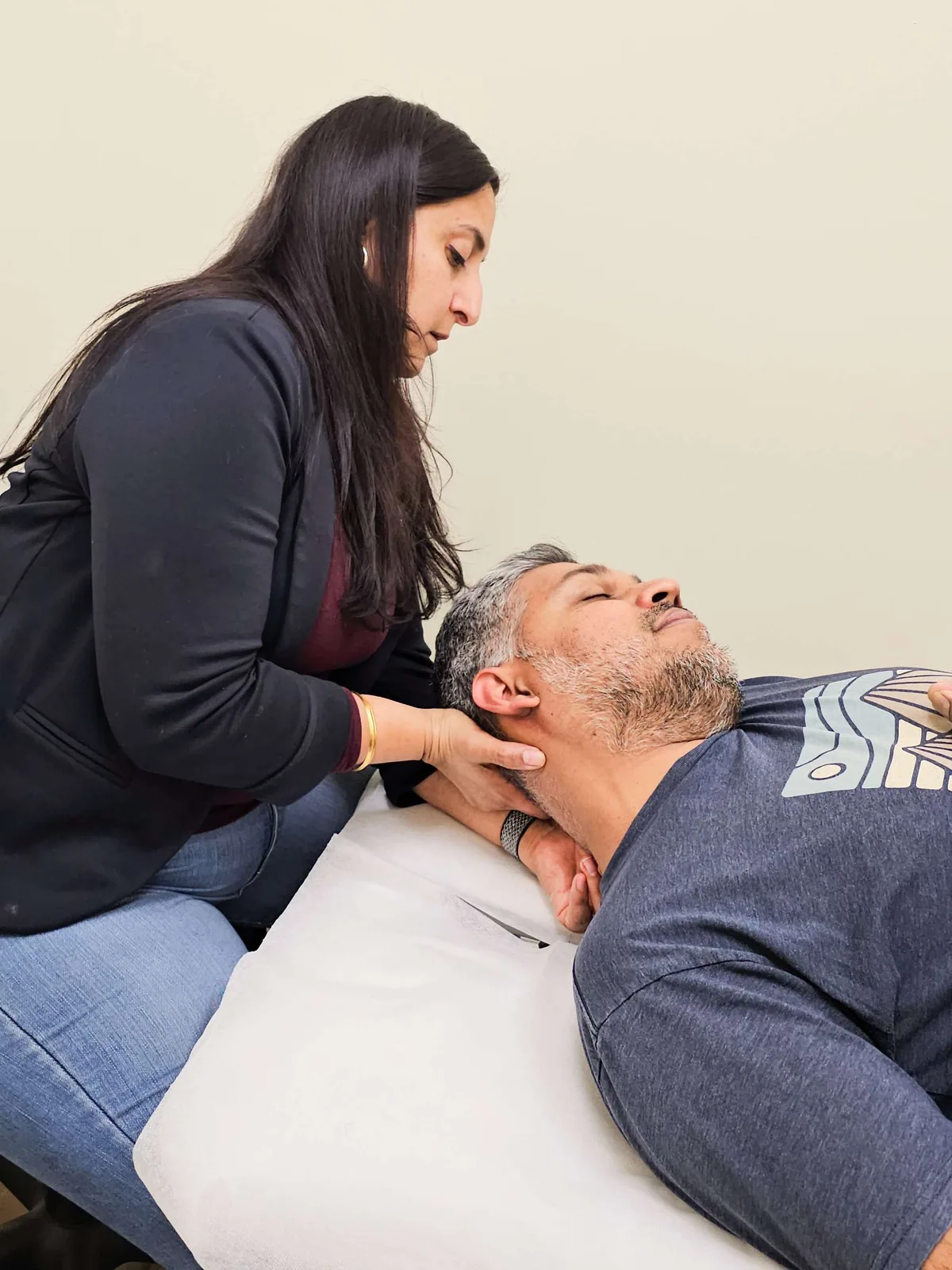
This is the centrepiece of neck pain treatment in Oakville at Wellmax. Manual therapy for the neck means:
- Cervical joint mobilization, rhythmic graded pressure applied to specific stiff joints. The upper cervical levels (C1-C3) are prioritized for headache patients.
- Suboccipital release, targeted soft tissue work on the small muscles at the base of the skull that tighten up and contribute to headaches
- Upper trapezius and levator scapulae release, the muscles that connect your neck to your shoulder blade, almost always involved
- Thoracic spine mobilization, stiffness in your upper back forces your neck to work harder. Freeing up the thoracic spine takes load off the cervical spine.
- Nerve mobilization, gentle gliding techniques when a nerve is irritated or restricted (cervical radiculopathy, disc herniations)
Research consistently shows that manual therapy combined with exercise produces better outcomes for neck pain and headaches than either alone. It’s not just about feeling loose on the table. It creates a window of reduced pain and improved mobility that lets you do the strengthening work that produces lasting change.
Deep Cervical Flexor Training
This is specific to neck pain and headaches, and it’s one of the most evidence-backed exercises in physiotherapy. The deep cervical flexors are small muscles at the front of your neck that stabilize the cervical spine. In people with neck pain and headaches, these muscles are almost always weak and inhibited, which forces the larger, superficial muscles to overwork and tighten up.
Retraining the deep cervical flexors reduces headache frequency, improves neck stability, and restores normal muscle balance. It’s a simple exercise, a gentle chin tuck and hold, but doing it correctly matters. Most people compensate with their jaw, their superficial muscles, or their breathing. We teach you the proper technique and progress it over time.
Postural Retraining
For desk workers, drivers, and anyone spending hours in forward-head positions, posture correction is a necessary part of recovery. But “sit up straight” isn’t postural training. Real postural retraining involves:
- Strengthening the muscles that hold your head and shoulders in a good position (deep cervical flexors, lower traps, serratus anterior)
- Stretching the muscles that pull you forward (pecs, upper traps, SCM)
- Setting up your workstation so your body isn’t fighting gravity all day
- Building endurance so the improved posture lasts beyond the first 20 minutes
We give specific desk setup recommendations based on your actual workstation, not generic guidelines. If you’re working from a kitchen table in Clarkson with a laptop, you’ll get different advice than someone at a standing desk in a Sheridan Park office.
What to Expect: Recovery Timelines
Honest numbers. Not promises, not guesses, what the research and our clinical experience actually show:
| Condition | Expected Outcome | Typical Timeline |
|---|---|---|
| Acute neck strain | 85-95% full recovery | 2-4 weeks |
| Cervicogenic headaches | 50-70% reduction in headache frequency | 8-12 weeks |
| Tension headaches | Significant reduction in frequency | 4-8 weeks |
| Tech neck / postural pain | 80-90% improvement | 4-8 weeks |
| Whiplash (mild-moderate) | 70-85% full recovery | 6-12 weeks |
| Cervical disc herniation | 75-85% improve without surgery | 8-16 weeks |
| Cervical arthritis | Symptom management, improved function | 4-8 weeks |
Most patients notice improvement within the first 2 to 3 visits. With headaches, some people notice a reduction in frequency within the first week of treatment. Full resolution of the pattern takes longer, 8 to 12 weeks for most cervicogenic headaches, but the trend starts early.
Your Treatment Plan: Phase by Phase
Phase 1: Pain Control and Early Mobility (Weeks 1-3)
What we’re doing:
- Gentle cervical mobilization to restore joint movement
- Suboccipital and upper trapezius muscle release
- Thoracic spine mobilization (reduces load on the neck)
- Beginning deep cervical flexor activation
- Education on sleeping position, desk setup, and activity modification
What you’ll notice:
- Neck stiffness starts improving after the first 1-2 sessions
- Headache frequency may begin decreasing
- Turning your head for driving becomes easier
- Morning stiffness duration shortens
- Pain levels drop from sharp or constant to intermittent
Your homework:
- Deep cervical flexor exercises daily (5 minutes)
- Gentle neck mobility exercises throughout the day
- Workstation adjustments (we’ll tell you exactly what to change)
- Heat on the upper traps and base of skull before bed if it helps
Why Oakville Patients Choose Wellmax for Neck Pain and Headache Treatment
We Assess the Neck When Others Don’t
One of the most common things we hear from headache patients is “nobody ever looked at my neck.” They’ve seen their family doctor, they’ve had a CT scan, they’ve tried different medications, but nobody put their hands on the cervical spine and actually tested whether the joints and muscles there were contributing to the headaches.
We check the neck in every headache patient. If the upper cervical joints reproduce the headache during testing, we’ve found a treatable source. If they don’t, we know to look elsewhere. Either way, you get an answer. Also see our Concussion Treatment in Oakville page if your headaches followed a head injury, as post-concussion headaches often have a cervical component.
Expert Care, Every Visit
Neck problems respond to treatment in layers. Week one is different from week four. Reassessing at every visit means your therapist can feel the changes in your joint mobility, track the headache pattern, and progress treatment at the right pace, with honest guidance on where you stand.
We See a Lot of People Who’ve Already Tried Somewhere Else
A good number of patients who walk into Wellmax have already done physiotherapy at another clinic. They did the exercises. They did the heat packs. And they’re still in pain. We’re not saying the other clinic did something wrong, but when standard treatment hasn’t worked, sometimes it means the assessment needs to go deeper, the treatment needs to be more specific, or the timeline needs to be more patient.
That’s something we’re comfortable with. Complex, stubborn or recurring neck pain is a large part of what we treat.
Direct Insurance Billing
We bill directly to Sun Life, Manulife, Canada Life, Desjardins, Green Shield Canada, Great-West Life, Blue Cross, and most other major providers. WSIB and MVA claims accepted. No referral needed.
Same-Day or Next-Day Appointments
Acute neck pain, especially torticollis or a sudden flare-up, shouldn’t have to wait a week. Call in the morning, and we can often see you that afternoon or the next day.
Convenient Oakville Location
We’re at 1148 Winston Churchill Blvd, Unit B3, Oakville, in the Winston Park commercial area. Easy to get to from everywhere:
- Clarkson: 5 minutes via Lakeshore Road
- Clearview: 8 minutes via Dundas Street
- Sheridan Park: 10 minutes via QEW
- Downtown Oakville: 12 minutes via Trafalgar Road
- South Mississauga: 7 minutes via Winston Churchill
- Near Sheridan College and the QEW/403 interchange
Free parking directly in front of the building. Early morning, evening, and weekend appointments available.
What to Do Before, During, and After Your First Visit
Before You Arrive
- Fill out intake forms online through JaneApp or arrive 10 minutes early
- Bring insurance card and photo ID
- Wear a top with a low neckline or something easy to move your head and shoulders in
- Note when your headaches occur, how often, and what triggers them
During Your Assessment (Full Session, One-on-One)
Your physiotherapist will:
- Go through your full neck pain and headache history
- Ask about work setup, sleeping position, stress, and activity levels
- Test cervical range of motion and strength
- Assess joint mobility at each cervical level, especially C1-C3
- Test the thoracic spine and shoulder blades
- Check for nerve involvement if arm symptoms are present
- Reproduce or change your headache with provocation tests (this tells us whether the neck is contributing)
- Explain findings in plain language
- Begin treatment in the same session
- Give you a clear plan with realistic timelines
You leave with:
- An understanding of what’s driving your neck pain and/or headaches
- Initial exercises to start immediately
- Treatment frequency recommendation
- Next appointment booked
- Honest answer to “how long will this take?”
Helpful Tips for Neck Pain and Headache Relief Between Sessions
Fix Your Desk Before It Fixes You
This matters more than most people think, especially for anyone working from home or in office settings around Oakville.
- Monitor at eye level (not a laptop on a table, that’s the fastest way to develop tech neck)
- External keyboard and mouse if using a laptop
- Chair adjusted so feet are flat on the floor and back is supported
- Take a break every 30 to 40 minutes, stand, walk, rotate your neck
- Phone at eye level, not in your lap
We’ll give you specific setup recommendations during treatment based on what your actual workstation looks like.
Sleep Right
Your pillow matters. It should keep your neck in a neutral position, not propped up too high, not sinking into nothing. Side sleepers need a thicker pillow than back sleepers. Stomach sleeping forces your neck into rotation for hours and is one of the easiest things to fix for people with recurring neck pain.
Stay Strong, Stay Moving
The maintenance exercises we give you take 10 to 15 minutes, 2 to 3 times a week. Deep cervical flexor holds, shoulder blade squeezes, thoracic rotations. Simple. Quick. Effective. The patients who do them rarely come back. The patients who stop usually show up again within 6 to 12 months.
Manage Stress (Your Neck Absorbs It)
Stress lives in the upper traps and jaw. That’s not a metaphor. When you’re stressed, you unconsciously clench your jaw and hike your shoulders toward your ears. Over time, this creates chronic tension at the base of the skull and through the neck. If stress is a significant factor, we’ll talk about management strategies as part of treatment.
When to Seek Emergency Care
Most neck pain and headaches get better with physiotherapy. But some symptoms need medical attention. See a doctor or go to an emergency room if you have:
- Severe headache that comes on suddenly and is “the worst headache of your life” (could indicate a serious vascular event, go to ER)
- Neck pain or headache with high fever and stiff neck that won’t flex forward (could indicate meningitis, go to ER)
- Numbness, tingling, or weakness in both arms or legs
- Loss of balance or coordination
- Changes in vision, speech, or consciousness
- Neck pain after significant trauma (car accident, fall from height, diving injury), get assessed before physiotherapy
- Progressive weakness in one arm that’s getting worse, not better
- Difficulty swallowing or breathing alongside neck pain
We screen for these during every assessment and will refer you to the appropriate specialist if anything concerning comes up.
What Our Patients Say
Muhammad S.“Very professional and friendly staff my long time neck pain problems treated very professionally.”
Sharon Q.“I have been having mild dizzy spells for 2 months and was getting concerned because the lightheadedness and feelings of imbalance wouldn’t go away. Went to Wellmax in Oakville and Gurmeet Rai took care of me. Her manipulations on my neck and back helped relax my tight and knotted muscles and she assured me that my lightheadedness and mild dizziness would eventually go away. There was improvement after my 1st session. Today I completed my 2nd session and I am certainly looking forward to feeling normal again. The at home exercises were also great and not too complicated. Would highly recommend. Gurmeet knows what she’s doing!”
Jessica T.“Finding the best physiotherapy clinic in Oakville was a game changer for my jaw pain. I had been dealing with TMJ issues, jaw clicking, and terrible tension headaches for months. I honestly did not even know physiotherapy could help with this until I found Wellmax. The assessment was incredibly thorough. Gurmeet took the time to explain the mechanics of my jaw and how my neck posture was contributing to the problem. The hands-on release techniques provided relief almost immediately. The whole team is genuinely invested in your recovery, and the clinic is spotless. I have already recommended them to several family members.”
Amanda S.“I’ve had very tight trap muscles greatly impact my neck, causing pain and limited flexibility/rotation for a very long time. Gurmeet has been a huge help between her education, several different exercise/stretch techniques, deep tissue massage, ultrasound and IFC sessions. My pain has subsided immensely and made huge progress in range of flexibility and rotation. Thank you!”
Bashar F.“I came to Wellmax for neck and back pain, Saw Gurmeet, she did detailed assessment and her hands on treatment, manual therapy, customised treatment plan and exercises with 2 sessions only I am feeling big difference. Her PTAs Janvi and Minahil are good at their job.”
Verified Patient“Woke up one morning and could barely open my mouth. My doctor said it was TMJ dysfunction and suggested physio. Gurmeet worked on the muscles around my jaw and into my neck and upper back. She also gave me exercises I could do at home between sessions. Within three weeks my jaw was opening normally again and the headaches I had been getting every afternoon stopped too. Turns out the jaw and the headaches were related the whole time.”
Abeer A.“The Magician, that’s the only way I can describe Dr. Gurmeet. After six months of constant shoulder and neck pain that took over my life…”
Iqbaljeet S.“I came in with chronic back and neck pain that had been bothering me for a while, and I honestly wasn’t sure how much improvement to expect. Both Dhrushi and Gurmeet are knowledgeable physiotherapists at Wellmax who were thorough from the very first assessment, they took the time to actually understand the issue rather than just going through the motions. The treatment plan they put together made a real difference, and I noticed improvement faster than I expected. The staff is professional, attentive, and genuinely invested in your recovery. Highly recommend to anyone dealing with back or neck issues.”
See all our Google reviewsRead more patient storiesLeave a review
Frequently Asked Questions
Can physiotherapy actually help headaches?+–
Yes, and there’s strong research behind it. A landmark clinical trial by Jull et al. showed that manual therapy and specific neck exercises reduced cervicogenic headache frequency by more than 50% in most patients. Tension headaches also respond well to physiotherapy that addresses the neck and upper back muscle tension driving the cycle. Not every headache is treatable with physiotherapy, but many headaches that people have been managing with medication for years turn out to be neck-driven and treatable.
How do I know if my headaches are coming from my neck?+–
Some clues: the headache is usually worse on one side, it starts at the base of the skull and wraps forward, it’s triggered or changed by neck movement, and pressing on certain spots on the upper neck reproduces or worsens the head pain. During your assessment, we use specific provocation tests to determine whether the cervical spine is contributing to your headaches. If moving your neck reliably changes your headache, that’s a strong sign.
What is tech neck and can it cause serious problems?+–
Tech neck is the posture pattern that develops from hours of looking down at phones, laptops, and tablets. The head shifts forward, the upper back rounds, and the neck muscles overwork to hold everything up. Over time, this leads to chronic neck stiffness, upper back pain, and headaches. It responds well and relatively quickly to physiotherapy.
Should I get an MRI or X-ray for my neck pain?+–
In most cases, not right away. Physical examination is more reliable than imaging for diagnosing most neck pain conditions. We recommend imaging when there are nerve symptoms (arm pain, numbness, weakness) that aren’t improving, red flag signs that need ruling out, or when surgical consultation might be needed. Many people with normal X-rays have significant pain, and many people with abnormal findings have no symptoms. We assess and treat the person, not the picture.
How long does it take for neck pain to get better with physio?+–
Acute neck strains usually improve significantly within 2 to 4 weeks. Tech neck and postural pain typically take 4 to 8 weeks. Cervicogenic headaches need 8 to 12 weeks for lasting frequency reduction. Whiplash varies widely. Mild cases may settle in 6 to 8 weeks, while more severe injuries can take 3 to 6 months. We’ll give you a realistic timeline at your first appointment.
Is it safe to crack or pop my own neck?+–
Self-manipulation gives temporary relief but doesn’t address the stiff segments that are actually causing the problem. You end up moving the segments that already move well and leaving the restricted ones stuck. Over time, this can increase instability in the mobile segments and doesn’t fix the underlying issue. If you feel the need to crack your neck regularly, that’s a sign something needs proper treatment.
Can a car accident cause neck problems months later?+–
Yes. Whiplash symptoms sometimes appear weeks or even months after the initial injury, especially milder grades. Scar tissue formation, gradual muscle deconditioning, and increased nerve sensitivity can all develop over time. If you were in an accident and are now developing neck pain or headaches, get assessed even if it’s been a while. In Ontario, you can still access MVA physiotherapy benefits. We bill your auto insurer directly.
How often do I need to come for treatment?+–
Most neck pain patients start with 2 visits per week for the first 2 to 3 weeks, then reduce to once a week, then every other week as symptoms improve. The full course of treatment is typically 8 to 12 sessions. For chronic headaches, the treatment course may be slightly longer to ensure the headache pattern is genuinely broken, not just temporarily improved.
Will my insurance cover neck pain physiotherapy?+–
Almost certainly if you have extended health benefits. Most plans cover $500 to $1,500 per year in physiotherapy. We direct bill to Sun Life, Manulife, Canada Life, Green Shield, Great-West Life, Blue Cross, Desjardins, and most other major providers. No out-of-pocket cost for most patients. WSIB and MVA claims are also accepted with direct billing.
Can stress cause neck pain and headaches?+–
Absolutely. Stress triggers unconscious muscle clenching, particularly the upper trapezius, jaw, and suboccipital muscles. Over time, this sustained tension creates trigger points, joint stiffness, and referred pain into the head. Addressing the physical tension through manual therapy and exercise is essential, but if stress is a major driver, we’ll also discuss strategies for managing it so the pattern doesn’t keep recurring.
Should I use a special pillow for neck pain?+–
Your pillow should keep your cervical spine in a neutral position, aligned with your thoracic spine, not flexed forward or extended back. Side sleepers generally need a firmer, thicker pillow. Back sleepers need something thinner. Contoured cervical pillows work well for some people but not others. We’ll give you a specific recommendation based on your sleeping position and your neck condition.
Can neck pain cause arm pain or numbness?+–
Yes. Nerves exit the cervical spine at each level and travel into the shoulder, arm, and hand. If a disc is pressing on a nerve or the nerve exit space is narrowed (cervical radiculopathy), you can feel pain, tingling, numbness, or weakness anywhere along that nerve’s path. Certain patterns, like numbness in the thumb and index finger, point to specific nerve levels. We test for this during your assessment and treat accordingly.
What is the difference between cervicogenic headache and migraine?+–
Cervicogenic headaches come from the cervical spine, typically C1-C3. They are usually one-sided, start at the base of the skull, worsen with neck movement, and are reproduced by pressing on specific neck joints. Migraines are a neurological condition with distinct features: throbbing pain, often with nausea, light sensitivity, and aura. Some people have both. The distinction matters because the treatments are completely different. A proper cervical assessment at the first visit helps clarify which is driving your headaches.
Is chiropractic care or physiotherapy better for neck pain?+–
Both can be highly effective for neck pain. Physiotherapy tends to emphasize manual therapy, deep cervical flexor retraining, postural correction, and exercise progressions. Chiropractic care focuses on spinal manipulation and joint alignment. At Wellmax, we have both physiotherapists and a chiropractor, so you can get the right approach for your specific presentation, or a combination if that’s what works best.
Related Conditions and Services
Neck pain often overlaps with or leads to other problems. Here are related conditions we treat at Wellmax:
- TMJ and Jaw Pain – The jaw and neck are closely linked. Neck dysfunction can contribute to TMJ problems, and TMJ issues can worsen neck pain and headaches.
- Back Pain and Sciatica – Upper and lower back issues often coexist with neck pain. Thoracic spine stiffness is a common contributor to cervical problems.
- Shoulder Pain – Neck problems can refer pain to the shoulder, and shoulder dysfunction can overload the neck.
- Whiplash Treatment in Oakville – Full management of motor vehicle accident neck injuries, including MVA direct billing.
- Concussion Treatment in Oakville – Post-concussion headaches are frequently cervicogenic in origin. A thorough cervical assessment is part of every concussion evaluation.
- Herniated Disc Treatment – Cervical disc herniations causing arm pain, numbness, and weakness.
- Headache and Migraine Chiropractor – Chiropractic management of headaches including migraine and cervicogenic types.
- Neck Pain Chiropractor in Oakville – Chiropractic care for cervical spine joint dysfunction.
- Chronic Pain – Long-standing neck pain with central sensitization or widespread pain components.
- Shockwave Therapy – For chronic myofascial trigger points in the neck, upper trapezius, and suboccipital region that haven’t responded to manual therapy alone.
- Deep Tissue Laser Therapy – Deep tissue laser for acute neck pain flare-ups and nerve irritation.
- Vestibular Physiotherapy – Dizziness and balance issues that can accompany neck problems, including cervicogenic dizziness.
- Motor Vehicle Accident Rehab – MVA claims accepted with direct billing to your auto insurer.
Neck Pain Treatment in Oakville: What Sets Wellmax Apart
There are a lot of physiotherapy clinics in Oakville. What makes a difference for neck pain and headaches is the quality and depth of the cervical assessment, not just the number of modalities on offer.
Most neck pain that doesn’t get better has one of three problems: the assessment wasn’t specific enough to find the real driver, the exercises were generic rather than tailored to the pattern, or the treatment stopped too early before the change was consolidated. We address all three. The assessment at the first appointment is thorough and structured. Exercises are given based on what your specific joints, muscles, and posture need. And we’re honest about timelines: some neck pain resolves in a few weeks, some needs months. We’ll tell you which category you’re in and why.
For cervicogenic headaches especially, the assessment must include specific upper cervical joint testing. This is a skill, not a checkbox. If C1-C2 reproduce your headache when loaded, that tells us something actionable. If they don’t, we keep looking. This kind of specificity is what turns a headache that’s been present for two years into something treatable.
We also treat the whole picture. A person with neck pain who also has tight pecs, rounded shoulders, and a poorly set-up desk gets a different treatment plan than someone whose pain is purely post-whiplash. A person with cervicogenic headaches who also clenches their jaw gets attention to the TMJ as part of the program. Neck pain rarely exists in isolation, and we don’t treat it as if it does. See our TMJ Treatment page if jaw clenching or clicking is part of your picture.
Book Your Neck Pain Assessment
Whether you’re dealing with chronic stiffness, headaches that keep coming back, whiplash from an accident, or neck pain that’s been building for years, we’re here to help. Neck pain treatment in Oakville at Wellmax starts with a thorough one-on-one assessment, same-day or next-day when you need it most.
Wellmax offers a free consultation for new patients. Book online or call us to get started.
Wellmax Physiotherapy
1148 Winston Churchill Blvd, Unit B3, Oakville, ON L6J 0A3
Phone: (905) 829-1100
Email: info@wellmaxphysiotherapy.ca
Proudly Serving Our Local Communities: We are conveniently located just minutes from the QEW and Winston Churchill Blvd, making us the clinic of choice for:
- East Oakville (Our Neighbours): Winston Park, Clearview, and the QEW/403 Corridor.
- South Oakville: Eastlake, Maple Grove, and Old Oakville.
- North Oakville: Joshua Creek, Falgarwood, and Upper Middle Road.
- Mississauga Border: Clarkson, Sheridan Park, and Sheridan Homelands.
Insurance: Direct billing to most major providers. WSIB and MVA claims accepted. No referral needed.
Hours: Monday to Friday: 9am to 7pm | Saturday: 9am to 2pm | Sunday: 9am to 2pm (by appointment only)
Registered & Regulated
Regulated & Recognized Across Every Discipline
Wellmax is in good standing with the regulatory colleges and leading associations for physiotherapy, chiropractic, massage therapy, and naturopathic medicine in Ontario.