Shockwave Therapy in Oakville
Evidence-Based Acoustic Wave Treatment for Chronic Tendon Pain and Stubborn Injuries
Home > Our Services > Shockwave Therapy in Oakville
A stubborn problem that has not shifted in months is the usual reason people ask about shockwave therapy in Oakville. We assess first, then tell you honestly whether shockwave suits your case.
The tendon has been bothering you for months. Maybe it’s the bottom of your foot, that sharp stab with every first step in the morning. Maybe it’s the outside of your elbow, and gripping a coffee mug has become an act of willpower. Maybe it’s your Achilles or your shoulder and you’ve been doing the exercises your physio gave you, making some progress, but you’ve hit a wall. The pain dropped from an 8 to a 4 and now it’s stuck there.
This is the pattern we see regularly at Wellmax. A patient comes in with a chronic tendon condition. They’ve been doing physiotherapy, the right exercises, the right progressions, and they’ve improved, but they’ve plateaued. The tendon has healed to a point, but something is keeping it from crossing the finish line. This is exactly where shockwave therapy in Oakville fits.
Shockwave isn’t a first-line treatment and it isn’t a magic fix. It’s a clinically proven intervention for chronic tendon conditions that have stalled despite proper rehabilitation. Used at the right time, in the right conditions, alongside a continued exercise program, shockwave therapy can restart a healing process that has gone dormant and push past a plateau that exercise alone couldn’t break.
We’re at 1148 Winston Churchill Blvd, Unit B3, Oakville, in the Winston Park area just south of the QEW. Clarkson, Clearview, Sheridan Park, and south Mississauga are all under 10 minutes away.
- Understanding How Shockwave Therapy Works
- Conditions That Respond Best to Shockwave Therapy
- When Shockwave Is the Right Choice (and When It Isn't)
- What a Shockwave Session Looks Like
- How Much Does Shockwave Therapy Cost in Oakville?
- What Results to Expect from Shockwave Therapy in Oakville
- Your Shockwave Treatment Timeline
- Why Choose Wellmax for Shockwave Therapy in Oakville
- Related Conditions and Services
- Book Your Shockwave Therapy Assessment
- Frequently Asked Questions
Understanding How Shockwave Therapy Works
Shockwave therapy (also called Extracorporeal Shockwave Therapy or ESWT) delivers focused acoustic pressure waves into damaged or degenerated tissue. These aren’t electrical shocks, they’re mechanical waves, similar in principle to the sound waves used in ultrasound imaging but at much higher energy.
When these pressure waves hit chronic tendon tissue, several things happen at the cellular level. Blood flow to the area increases significantly. In chronic tendinopathy, one of the main problems is that the degenerated tendon has poor blood supply, which is part of why it can’t heal on its own. Shockwave therapy promotes neovascularization, the formation of new blood vessels into the damaged area. More blood supply means more nutrients, more oxygen, and better conditions for tissue repair.
The pressure waves also stimulate collagen production and tendon remodeling. Chronic tendons develop disorganized collagen fibres (think of tangled threads versus neatly aligned ones). Shockwave therapy triggers a controlled inflammatory response that breaks down this disorganized tissue and stimulates the production of new, properly aligned collagen. It’s essentially restarting the healing process.
For calcific tendinopathy, conditions where calcium deposits have formed within a tendon, most commonly in the rotator cuff, shockwave has the additional effect of physically breaking down those calcium deposits, allowing the body to reabsorb them.
The therapy also reduces pain through neurological mechanisms. Shockwave stimulates the release of substance P (a pain-signaling chemical) in the short term, which is why the treatment can be briefly uncomfortable. But over the following days, substance P levels drop below baseline, reducing chronic pain signaling in the treated area.
At Wellmax, we use radial shockwave therapy (also called radial pressure wave therapy), which delivers energy over a broader area and is well-suited for the chronic tendon conditions and myofascial pain we treat most frequently. The device allows us to adjust intensity based on your tolerance and the condition being treated.
Conditions That Respond Best to Shockwave Therapy
Plantar Fasciitis
This is one of the most evidence-supported uses of shockwave therapy in physiotherapy. Chronic plantar fasciitis, the kind that has lasted more than 3 months despite stretching, orthotics, and exercise, responds consistently well to shockwave. Multiple randomized controlled trials show significant pain reduction and functional improvement after a course of 3-6 sessions.
Plantar fasciitis develops when the plantar fascia (the thick band of tissue running along the bottom of the foot from the heel to the toes) becomes irritated and degenerated from repetitive overload. Morning pain with the first steps out of bed is the classic presentation. The condition is common in runners, people who spend long hours on their feet, and people who have had a sudden increase in walking or standing activity.
When stretching, calf strengthening, and manual therapy have improved the condition but not fully resolved it, shockwave is often the intervention that gets patients across the finish line. At Wellmax, we combine shockwave therapy with ongoing calf stretching, intrinsic foot strengthening, load management, and manual therapy to the foot and ankle. This combination approach is what produces lasting results.
Tennis Elbow (Lateral Epicondylitis)
Chronic tennis elbow that hasn’t resolved with 3 or more months of progressive tendon loading exercises is an excellent candidate for shockwave therapy. The lateral epicondyle, the bony bump on the outside of the elbow, is where the forearm extensor tendons attach, and in tennis elbow these tendons become degenerated from repetitive gripping, lifting, or twisting movements.
Research shows shockwave therapy for chronic lateral epicondylitis produces significant pain reduction and improved grip strength, with results maintained at follow-up. It’s particularly effective when combined with an ongoing eccentric strengthening program. Despite the name, most people with tennis elbow don’t play tennis. It’s far more common in tradespeople, office workers, and anyone whose work involves repetitive hand and wrist movements.
Golfer’s Elbow (Medial Epicondylitis)
The same principle as tennis elbow, but on the inner side of the elbow where the flexor tendons attach. Chronic golfer’s elbow that has plateaued with exercise responds to shockwave therapy through the same mechanisms, increased blood flow, collagen remodeling, and pain reduction. Common in golfers, climbers, and workers who do heavy gripping or pulling movements.
Rotator Cuff Tendinopathy and Calcific Tendinitis
Shockwave therapy is particularly effective for two shoulder conditions. Chronic rotator cuff tendinopathy (typically supraspinatus tendon) where the tendon is degenerated but not torn responds to shockwave when it has plateaued with exercise-based rehabilitation. And calcific tendinitis, where calcium deposits form within the rotator cuff tendons, is one of the strongest indications for shockwave. The pressure waves physically fragment the calcium deposits, allowing the body to reabsorb them. Multiple studies demonstrate that shockwave resolves calcific deposits in the majority of patients without the need for surgery or injection. Patients with calcific tendinitis often experience dramatic improvement, sometimes after just 2-3 sessions, once the calcium begins breaking down.
Achilles Tendinopathy

The Achilles tendon is the largest tendon in the body and takes enormous load during walking, running, and jumping. When it becomes chronically painful, either at the mid-portion (2-6cm above the heel) or at the insertion (where it attaches to the heel bone), the first-line treatment is a progressive loading program (isometric, eccentric, and heavy slow resistance exercises). This works well for many people but some plateau.
Shockwave therapy for chronic Achilles tendinopathy is supported by good evidence, particularly for mid-portion tendinopathy. It promotes blood flow and tendon remodeling in a structure that naturally has poor blood supply. We combine it with continued progressive loading, the shockwave restarts the biological healing process while the exercise provides the mechanical stimulus the tendon needs to remodel properly.
Greater Trochanteric Pain Syndrome (Gluteal Tendinopathy / Hip Bursitis)
Pain on the outside of the hip, often diagnosed as “hip bursitis,” is more accurately a gluteal tendinopathy in many cases, the tendons of the gluteus medius and minimus muscles become degenerated where they attach to the greater trochanter. The condition is common in women over 40, runners, and people who sleep on the affected side.
First-line treatment is gluteal strengthening and load management. When 6-8 weeks of consistent strengthening hasn’t fully resolved the pain, shockwave therapy can accelerate recovery. It’s particularly effective because the gluteal tendons, like the Achilles, have relatively poor blood supply, and shockwave’s primary mechanism of increasing blood flow addresses this directly.
Patellar Tendinopathy (Jumper’s Knee)
Pain at the base of the kneecap where the patellar tendon attaches, common in basketball players, volleyball players, and runners. Chronic cases that haven’t responded to progressive loading benefit from shockwave to promote tendon remodeling and reduce pain.
Hamstring Tendinopathy
Chronic pain at the sit bone (ischial tuberosity) where the hamstring tendons attach. Common in runners and people who sit for long periods. A stubborn condition that often responds slowly to exercise alone. Shockwave can accelerate the process when it has stalled.
Chronic Myofascial Trigger Points
Persistent muscle knots that keep returning despite manual therapy and stretching, particularly in the upper trapezius, levator scapulae, and thoracolumbar region, can respond to shockwave. The pressure waves disrupt the contracture and increase blood flow to the area, breaking a chronic tension cycle that manual release alone sometimes can’t fully resolve.
When Shockwave Is the Right Choice (and When It Isn’t)
Administering Shockwave Therapy in Oakville by Expert Physiotherapist
Shockwave therapy works best when the condition is chronic (typically present for 3 or more months), the tendon has a degenerative component (tendinopathy rather than an acute tear), first-line treatment (exercise, manual therapy) has been tried and has plateaued, and the patient is committed to continuing their exercise program alongside shockwave.
When NOT appropriate:
- Acute injuries in the first few days or weeks
- Complete tendon tears (may need surgical consideration)
- Conditions where the diagnosis is unclear (assessment comes first)
- Areas over major blood vessels or nerves
- Patients on blood thinners (relative contraindication, discussed individually)
- During pregnancy (precautionary avoidance)
At Wellmax, shockwave is always part of a broader treatment plan. We don’t offer “shockwave-only” treatment because the evidence is clear: shockwave combined with exercise produces significantly better outcomes than shockwave alone. If you come to us specifically wanting shockwave, your physiotherapist will first assess whether it’s appropriate for your condition and, if it is, integrate it into a complete rehabilitation plan.
What a Shockwave Session Looks Like
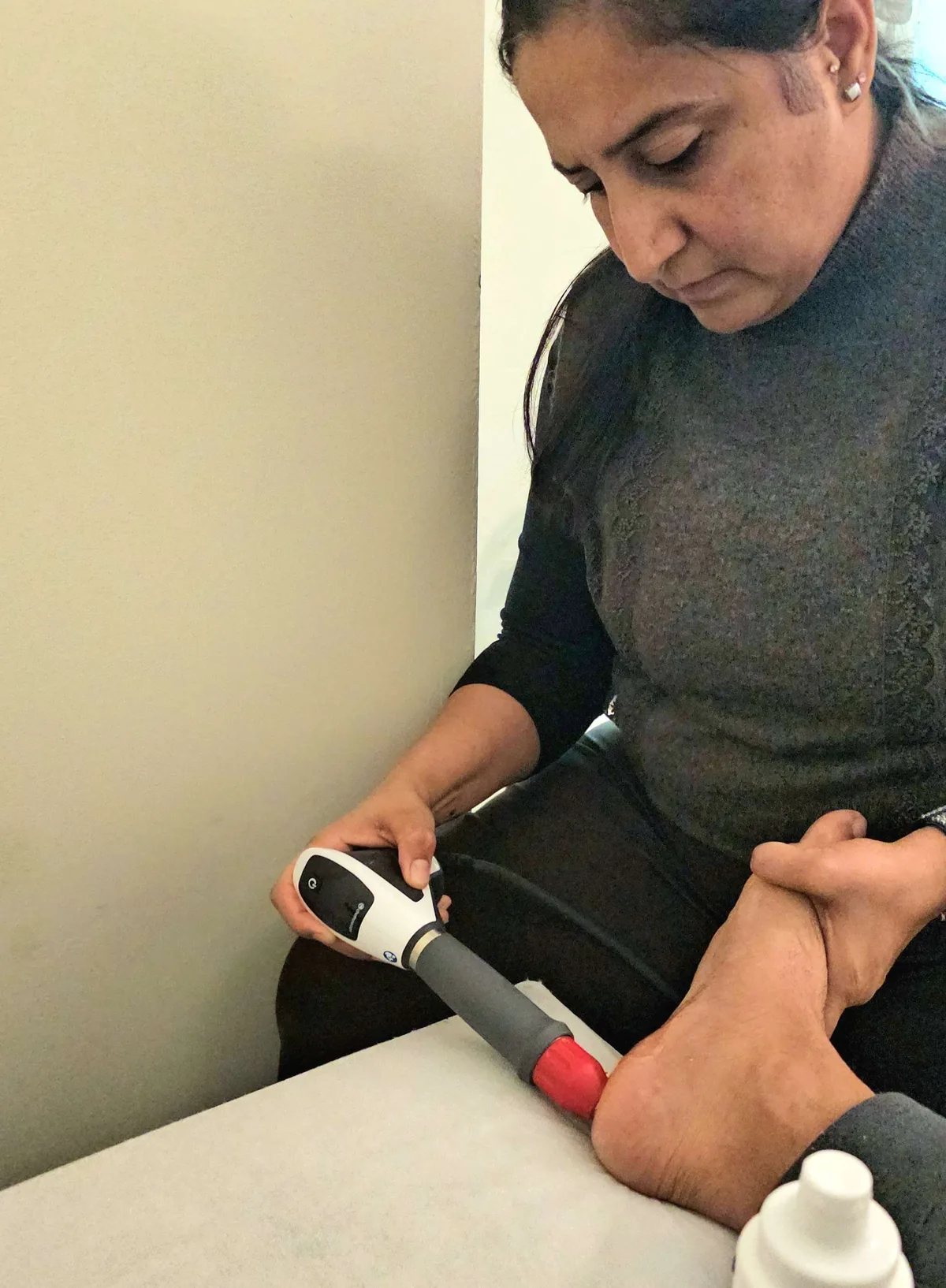
Your physiotherapist identifies the treatment area based on your assessment findings, they’ll typically press on the affected tendon to locate the point of maximum tenderness and confirm the treatment site. Ultrasound gel is applied to the skin for acoustic transmission. The shockwave handpiece is placed on the treatment area and the device is activated.
You’ll feel a rapid tapping or pulsing sensation. The first few seconds are the most intense as your body adjusts to the stimulus. Your physiotherapist adjusts the intensity based on your feedback, the goal is “firmly uncomfortable but tolerable,” not painful. Treatment takes 5-10 minutes of active shockwave application, during which the handpiece is moved slowly across the affected area.
After the session, you might feel temporary soreness in the treated area for 24-48 hours. This is normal and expected, the shockwave has triggered a controlled inflammatory response, which is part of the healing mechanism. Icing isn’t recommended immediately after shockwave because you want that inflammatory response to do its work.
Most conditions require 3-6 sessions, typically spaced one week apart. Many patients notice meaningful improvement by session 3 or 4. Some conditions, particularly calcific tendinitis, can show dramatic improvement in as few as 2-3 sessions.
How Much Does Shockwave Therapy Cost in Oakville?
There is no separate or hidden fee for shockwave therapy at Wellmax, and it is not sold as a standalone service. It is delivered inside a 30 or 45-minute physiotherapy follow-up visit, alongside the hands-on treatment and exercise that make it work. Because it is part of your physiotherapy visit, it is typically covered under the physiotherapy portion of your extended health benefits, and we direct bill most major insurers. No doctor's referral is needed to start.
What affects your total is the number of visits, not a per-session shockwave charge. Most people need 3 to 6 sessions depending on the condition and how long it has been there. For context, standalone shockwave sessions at Ontario clinics typically run $75 to $250 each, so a bundled model often works out to better value than the lowest advertised per-session price. The clearest way to get an accurate estimate for your situation is a free consultation, where we outline the likely number of visits and the plan up front, with no pressure.
- No standalone shockwave fee. It is included in a 30-minute ($90) or 45-minute ($110) physiotherapy follow-up visit, and in the $130 initial assessment where it is appropriate on day one.
- Typically covered under the physiotherapy portion of your extended health benefits.
- Direct billing to most major insurers, and no referral is needed to begin.
- Most people need 3 to 6 sessions. A free consultation gives you an accurate, personalized plan.
What Results to Expect from Shockwave Therapy in Oakville
It Starts With Getting the Assessment Right
| Condition | Response Rate | Typical Sessions | Timeline to Improvement |
|---|---|---|---|
| Plantar fasciitis (chronic) | 70-80% significant improvement | 3-6 | Noticeable by session 3-4 |
| Tennis elbow (chronic) | 65-80% significant improvement | 4-6 | Gradual over 4-6 weeks |
| Calcific tendinitis (shoulder) | 75-90% deposit reduction | 3-5 | Often dramatic by session 2-3 |
| Achilles tendinopathy | 60-75% significant improvement | 4-6 | Gradual over 6-8 weeks |
| Golfer’s elbow | 65-75% significant improvement | 4-6 | Gradual over 4-6 weeks |
| Hip bursitis / gluteal tendinopathy | 60-75% significant improvement | 4-6 | Gradual over 6-8 weeks |
| Patellar tendinopathy | 60-70% significant improvement | 4-6 | Gradual over 6-8 weeks |
These percentages reflect “significant improvement”, meaning meaningful pain reduction and functional recovery. Not everyone achieves 100% resolution, but the majority of patients with appropriate chronic tendon conditions experience clinically meaningful benefit.
Results are best when shockwave is combined with an ongoing progressive exercise program. Patients who do shockwave without continuing their rehabilitation exercises see temporary improvement that often doesn’t hold. Patients who combine the two approaches see lasting change.
Your Shockwave Treatment Timeline
Sessions 1-2: Introduction and Calibration
Your physiotherapist confirms the diagnosis, explains the treatment, and begins shockwave at an intensity you can tolerate. Some temporary soreness in the treated area for 24-48 hours after each session is normal. You continue your prescribed exercise program between sessions.
Sessions 3-4: Meaningful Change
This is where most patients notice a shift. Morning pain decreases. Functional activities become less aggravating. The tendon starts responding to the exercise program in a way it hadn’t been before. Your physiotherapist may progress your exercises and increase shockwave intensity as tolerated.
Sessions 5-6: Consolidation
Pain continues decreasing. Function continues improving. For some conditions, treatment is complete at this point. For others, a few additional sessions may be recommended. Your physiotherapist reassesses and determines the plan forward, which may include transitioning to exercise-only maintenance.
After Treatment
The healing effects of shockwave continue for 6-12 weeks after the final session. Tendons remodel slowly, so improvement often continues well beyond the end of active treatment. Continuing your exercise program during this window is essential to maintain and build on the gains.
Why Choose Wellmax for Shockwave Therapy in Oakville
- Assessment First, Always. We don’t just point the shockwave device at wherever it hurts. Your physiotherapist performs a thorough assessment to confirm the diagnosis, determine whether shockwave is appropriate for your specific condition and stage of healing, and identify any contributing factors (weakness, stiffness, biomechanical issues) that need to be addressed alongside shockwave. The treatment plan is built around you, not around the device.
- Integrated Treatment, Not Standalone Sessions. Shockwave at Wellmax is always combined with manual therapy, progressive exercise, and education. You’re not paying for a 5-minute zap and leaving. A shockwave session is part of your physiotherapy visit, which includes hands-on treatment, exercise progression, and clinical assessment of how you’re responding.
- Expert Care Every Visit. Shockwave therapy requires precise application to the right area at the right intensity, and that intensity should progress as your condition improves. Your response is tracked session to session so the treatment is precisely calibrated, not guessed at.
- Convenient Oakville Location. 1148 Winston Churchill Blvd, Unit B3, Oakville. Free parking directly in front, ground-level entrance. Clarkson: 5 minutes. Clearview: 8 minutes. Sheridan Park: 10 minutes. South Mississauga: 7 minutes.
- Direct Insurance Billing. Shockwave therapy at Wellmax is billed as part of your physiotherapy visit and is typically covered under your physiotherapy benefit. We direct bill to Sun Life, Manulife, Canada Life (formerly Great-West Life), Green Shield, Blue Cross, Desjardins, and most other major providers. WSIB and MVA claims accepted.
What Our Patients Say
Ghanshyam S.“I had an excellent experience at Wellmax Physiotherapy for my ankle pain. Gurmeet, the physiotherapist, was very knowledgeable and took the time to understand my condition and create an effective treatment plan. She recommended shockwave therapy, which helped reduce my pain and improve my mobility significantly. Janvi and Manahil the Physiotherapy Assistant were also very friendly, professional, and supportive throughout my treatment sessions. The entire team made me feel comfortable and welcomed every time I visited. The clinic is clean, well-organized, and provides outstanding patient care. I highly recommend Wellmax Physiotherapy to anyone looking for effective treatment for physio and massage.”
Robert K.“Wellmax is truly the best physiotherapy clinic in Oakville. I developed a bad case of tennis elbow from working with my hands, and my grip strength was completely gone. Dhrushi took her time during the initial visit to explain the healing process for tendons. My personalized plan included hands-on therapy, shockwave treatments, and a practical exercise routine I could easily do at home. The inflammation went down faster than I expected, and my arm feels strong again. The front desk staff is always welcoming, and my appointments always started right on time. Highly recommend this place to anyone in pain.”
Kevin O.“Look no further if you want the best physiotherapy clinic in Oakville. I was dealing with plantar fasciitis that made taking my first steps out of bed every morning absolutely agonizing. I had tried custom insoles and resting, but nothing worked permanently. Dhrushi assessed my foot mechanics and put together a great plan using shockwave therapy. I also saw Cynthia for deep tissue massage on my tight calf muscles. The combination of their treatments worked wonders. I am finally walking normally again. They are honest, professional, and do not pressure you into endless treatment packages.”
HARPREET B.“Best Physiotherapy clinic. I am going there for my workplace injury and it’s a great experience. Physiotherapist and physio assistant are extremely knowledgeable and always make sure that you get the best treatment, Clinic is very neat and clean. Highly recommend this place!!!”
Amanda L.“I was searching for the best physiotherapy clinic in Oakville after a car accident, and this clinic exceeded my expectations. Dealing with whiplash and neck stiffness was overwhelming, and the insurance paperwork was stressing me out. The team at Wellmax made the entire process so smooth. They helped manage the MVA billing directly and focused entirely on my recovery. Gurmeet used manual therapy to reduce the tension in my neck, and the gentle exercises she prescribed helped me regain my mobility safely. They truly care about their patients and the facility is incredibly clean and modern.”
Verified Patient“Got rear-ended on the QEW near Winston Churchill and started having neck pain, headaches, and dizziness about three days later. I did not know where to start with insurance and treatment. Wellmax handled everything. They explained how the auto insurance coverage works in Ontario, did direct billing so I did not pay anything out of pocket, and started treatment the same week. Gurmeet treated my neck and the dizziness component separately because she said they needed different approaches. After about eight weeks I was back to normal. The whole process from first call to discharge was smooth and I never had to chase paperwork.”
Morenita Z.“I came to see Gurmeet and Dhrushi at wellmax after my thumb and wrist injury at work under wsib. They took time to assess and explain everything to me and time i started with wellmax, I am feeling so much better and pain is less. Gurmeet’s hands on technique and manual therapy is amazing and knowledgeable. I see big difference in my condition and movement. Clinic is very clean and very positive that makes me comfortable every time I come here. I truly appreciate work they do and recommend it everyone who is looking for real physio treatment and manual therapy.”
See all our Google reviewsRead more patient storiesLeave a review
Frequently Asked Questions
Does shockwave therapy hurt?+–
It’s uncomfortable but manageable. Most patients describe it as a firm, rapid tapping or pulsing sensation. The first few seconds are the most intense. Your physiotherapist adjusts the intensity based on your tolerance, it should be ‘firmly uncomfortable but tolerable,’ not agonizing. The discomfort during treatment lasts only 5-10 minutes and subsides quickly afterward. Some soreness in the treated area for 24-48 hours post-session is normal.
How many shockwave sessions will I need?+–
Most conditions require 3-6 sessions, spaced one week apart. Some conditions, particularly calcific tendinitis, respond in as few as 2-3 sessions. Your physiotherapist will reassess your progress at each session and determine the optimal number. More isn’t always better with shockwave, there’s a therapeutic window where the benefit plateaus.
Is shockwave therapy covered by insurance?+–
Yes, in most cases. At Wellmax, shockwave is delivered as part of your physiotherapy session and is billed under your physiotherapy benefit. Most extended health plans cover physiotherapy ($500-$1,500/year is typical). We direct bill to most major providers. Check your plan for specific coverage amounts.
Can shockwave therapy replace physiotherapy exercises?+–
No, and this is important. The research is clear: shockwave combined with exercise produces significantly better and more lasting outcomes than shockwave alone. Shockwave restarts the biological healing process. Exercise provides the mechanical loading stimulus that the tendon needs to remodel properly. Without the exercise component, results from shockwave tend to be temporary. At Wellmax, shockwave is always integrated into a comprehensive rehab plan.
How soon will I notice improvement from shockwave therapy?+–
Most patients notice meaningful improvement by session 3-4 (about 3-4 weeks into treatment). For calcific tendinitis, improvement can be dramatic and faster. The healing effects of shockwave continue for 6-12 weeks after the final session, so improvement often continues well beyond the end of treatment. If no improvement is noticed after 3-4 sessions, your physiotherapist will reassess the diagnosis and treatment approach.
Are there any side effects of shockwave therapy?+–
The main side effect is temporary soreness or bruising at the treatment site for 24-48 hours after each session. This is expected and is part of the healing mechanism. Serious side effects are very rare. Your physiotherapist will screen for contraindications before beginning treatment.
Can I still exercise after a shockwave session?+–
Generally yes, but avoid high-impact loading of the treated tendon for 24-48 hours after each session. Light activity and prescribed exercises are usually fine. Your physiotherapist will give specific guidance based on your condition and the tendon being treated. Avoid icing the area immediately after treatment, the inflammatory response is therapeutic and should not be suppressed.
I've had shockwave elsewhere and it didn't work. Should I try again?+–
Possibly. Shockwave effectiveness depends heavily on accurate diagnosis, correct treatment parameters, and appropriate timing. If shockwave was applied to the wrong area, at insufficient intensity, too early in the injury process, or without an accompanying exercise program, it may have underperformed. A thorough reassessment to confirm the diagnosis and determine if shockwave is genuinely indicated for your specific condition is the right starting point.
Is shockwave therapy the same as ultrasound?+–
No. Therapeutic ultrasound uses low-energy sound waves to gently warm tissue and has limited evidence for most conditions. Shockwave therapy uses high-energy acoustic pressure waves that produce measurable biological effects, increased blood flow, collagen stimulation, calcification breakdown, and pain modulation. The two treatments are fundamentally different in both mechanism and effectiveness.
Can shockwave help with back pain?+–
Shockwave can help with chronic myofascial trigger points and muscle tension in the back, but it is not a primary treatment for disc herniations, spinal stenosis, or nerve-related back pain. For those conditions, manual therapy, exercise, and traction are more appropriate. Your physiotherapist will determine whether shockwave is indicated for your specific back condition.
What conditions is shockwave therapy most effective for?+–
The strongest evidence for shockwave therapy is in chronic tendinopathies – conditions where the tendon has failed to heal properly. The top indications are: plantar fasciitis and heel pain (response rate 70-80%), calcific tendinitis of the shoulder (70-90%), chronic Achilles tendinopathy, tennis elbow, greater trochanteric pain syndrome, and patellar tendinopathy. Shockwave also shows good results for myofascial trigger points. It works best for conditions present for more than three months that have not responded to standard physiotherapy alone.
Is there anyone who should NOT have shockwave therapy?+–
Yes. Absolute contraindications include: pregnancy, blood clotting disorders or anticoagulant therapy, active infection or malignancy in the treatment area, and pacemakers (for certain device types). Relative contraindications include cortisone injection within the previous six weeks, nerve tissue directly in the treatment path, and bone fractures. Children with open growth plates require special consideration. Your physiotherapist will screen for all contraindications at your first appointment before any treatment begins.
Can I have shockwave therapy if I recently had a cortisone injection?+–
Not immediately. Cortisone suppresses the local inflammatory and immune response. Applying shockwave within six weeks of a cortisone injection interferes with the controlled healing process shockwave is designed to trigger. The standard recommendation is to wait at least six weeks after cortisone before beginning shockwave therapy. If you are considering both treatments, it is generally better to try shockwave first, as cortisone injections can also weaken tendon tissue over multiple uses.
What is the difference between radial and focused shockwave therapy?+–
Radial shockwave generates pressure waves at the probe surface that spread outward and are best for superficial conditions at one to three centimetres depth – plantar fasciitis, tennis elbow, and Achilles tendinopathy. Focused shockwave generates waves that converge at a precise focal point deep in tissue, effective for calcific tendinitis and structures at three to ten centimetres depth. The clinical evidence supports both modalities for their respective indications, and your physiotherapist will select the appropriate type based on your specific condition and anatomy.
Can shockwave therapy treat calcific tendinitis in my shoulder?+–
Yes – calcific tendinitis is one of shockwave therapy’s strongest indications. Calcium deposits develop in the rotator cuff tendons when the repair process goes wrong and deposits crystals instead of healthy collagen. Shockwave therapy disrupts these deposits mechanically and triggers an inflammatory resorption response that allows the body to break down and absorb the calcium. Response rates for calcific tendinitis with shockwave are 70-90%, making it one of the most effective non-surgical treatments available. Some patients see dramatic relief within two to three sessions.
Will shockwave therapy make my pain worse before it gets better?+–
For many patients, yes – particularly in the first 24-48 hours after each session. Shockwave deliberately provokes an acute inflammatory response in the treated tissue, which is the mechanism behind the healing benefit. This can temporarily increase local soreness and tenderness. This post-treatment reaction is expected and is not a sign the treatment is harmful – it means the shockwave achieved its intended biological effect. Most patients find this manageable, and it typically decreases with subsequent sessions as the underlying condition improves.
How long after shockwave therapy should I wait before returning to sport or heavy activity?+–
Avoid high-impact loading of the treated area for 24-48 hours after each session. After that, your physiotherapist’s guidance on activity modification applies. You do not need to stop all exercise – prescribed loading exercises are a critical part of the recovery protocol. Most people can maintain general fitness between sessions. For return to high-load sport such as running, jumping, or heavy lifting, the timeline depends on the condition being treated and your individual response, not just the shockwave schedule.
How much does shockwave therapy cost in Oakville?+–
Shockwave is not sold on its own at Wellmax. It is included within a 30-minute ($90) or 45-minute ($110) physiotherapy follow-up visit, so there is no separate shockwave fee and no per-zone surcharge. Because it is part of your physiotherapy visit, it is usually covered under your extended health physiotherapy benefit, and we direct bill most major insurers with no referral needed. Since most people need 3 to 6 sessions depending on the condition, a free consultation is the easiest way to get an accurate plan and estimate.
How do I know if shockwave therapy near me is right for me?
The assessment answers that. We examine the area, ask how long it has been going on and what you have already tried, then explain where shockwave fits alongside hands-on treatment and loading. If it is not the right tool for your case, we will say so. Sessions are short and most people carry on with their day afterwards. We review your progress as we go and stop treatment once you no longer need it.
Related Conditions and Services
- Plantar Fasciitis Treatment in Oakville, shockwave is one of the most effective treatments for chronic plantar fasciitis
- Tennis Elbow Treatment in Oakville, chronic tennis elbow that has plateaued with exercise is a strong candidate for shockwave
- Golfer’s Elbow Treatment in Oakville, medial epicondylitis treated with progressive loading and shockwave
- Rotator Cuff Treatment in Oakville, tendinopathy and calcific tendinitis respond well to shockwave combined with progressive strengthening
- Achilles Tendinopathy Treatment in Oakville, shockwave promotes blood flow and tendon remodeling in chronic Achilles conditions
- Bursitis Treatment in Oakville, greater trochanteric pain syndrome (gluteal tendinopathy) is a common shockwave indication
- IT Band Syndrome Treatment in Oakville
- Deep Tissue Laser Therapy in Oakville, often combined with shockwave for enhanced tendon healing
- Running Injuries Physiotherapy in Oakville
Book Your Shockwave Therapy Assessment
If you’ve been dealing with a chronic tendon condition, plantar fasciitis, Achilles tendinopathy, tennis elbow, rotator cuff tendinopathy, or calcific tendinitis, that isn’t fully responding to exercise and manual therapy, shockwave therapy in Oakville may be the next step. Your physiotherapist will assess whether shockwave is appropriate for your specific condition and build it into a comprehensive treatment plan. Wellmax offers a free consult for new patients. No referral needed. Direct billing to most major insurance providers.
Registered & Regulated
Regulated & Recognized Across Every Discipline
Wellmax is in good standing with the regulatory colleges and leading associations for physiotherapy, chiropractic, massage therapy, and naturopathic medicine in Ontario.