Custom Orthotics and Braces in Oakville
Home > Our Services > Custom Orthotics and Braces in Oakville
Searching for custom orthotics in Oakville? Nothing is ordered until we have looked at how you walk and what you wear on your feet, and the prescription is written from that assessment.
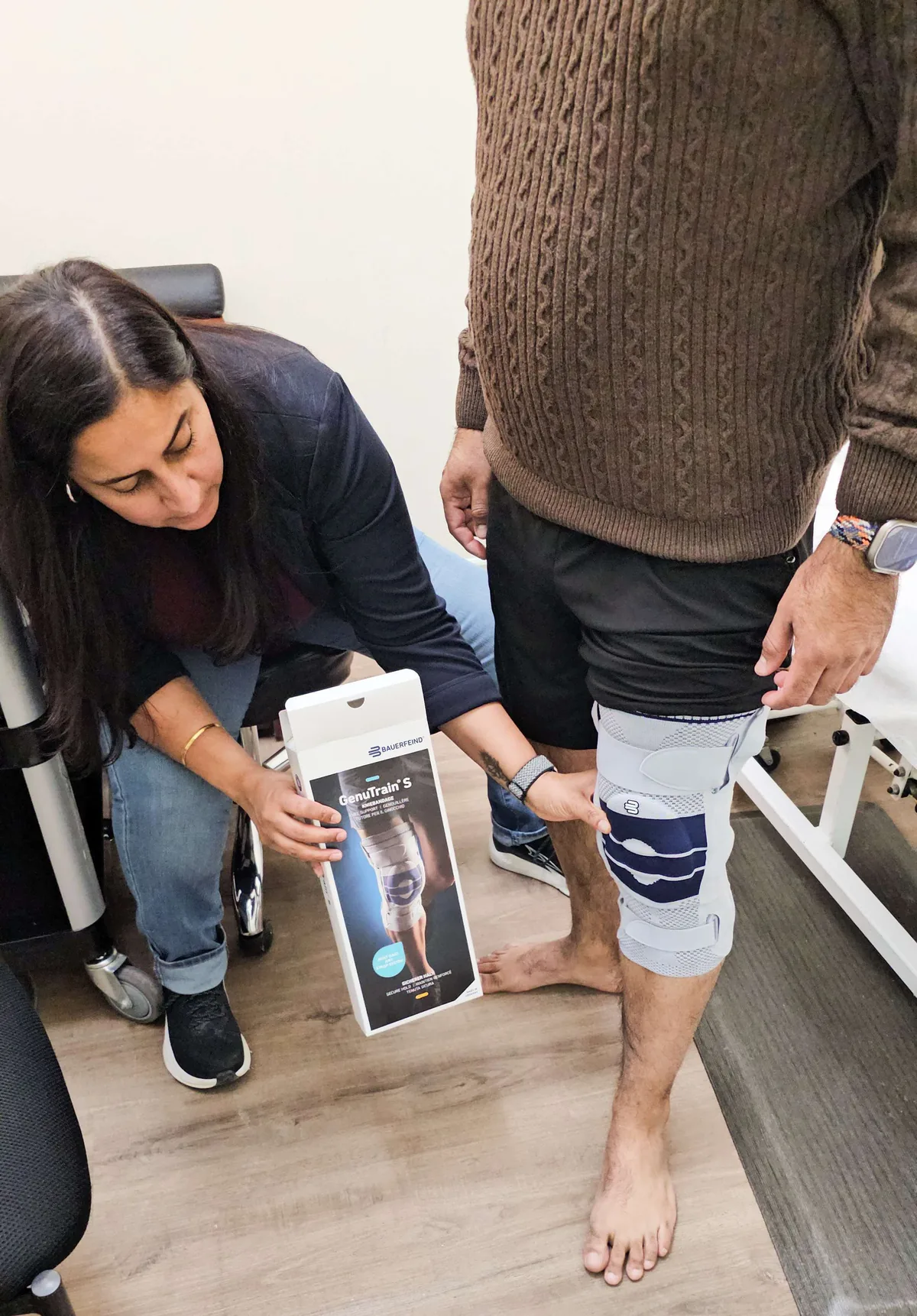
Your knee is holding you back, not because of the injury itself, but because the support you have isn’t working?
An injury should not be what defines your season. Or your year. At Wellmax Physiotherapy in Oakville, we fit medical-grade custom braces and custom orthotics as part of your complete rehab plan, not as an add-on. Pay and submit, with paperwork provided. No referral needed.
The difference between getting back to your sport safely and getting sidelined again often comes down to one thing: the quality of support your joint has during recovery.
Wellmax Physiotherapy provides custom orthotics and medical-grade braces in Oakville for sports injuries, post-surgical recovery, osteoarthritis, plantar fasciitis, flat feet, and chronic joint instability. We assess, fit, and adjust every device as part of your rehabilitation plan.
- Targeted Support for Every Joint
- Custom Orthotics in Oakville
- Types of Braces We Provide
- Bracing Solutions for Your Sport
- How Custom and Medical-Grade Braces Help
- The Medical-Grade Difference
- How the Custom Fitting Process Works
- Why Get Fitted by a Physiotherapist?
- Insurance Coverage and Receipts
- Why Oakville Patients Choose Wellmax for Orthotics and Bracing
- Related Pages
- Book Your Custom Orthotics or Brace Fitting in Oakville
- Frequently Asked Questions
Targeted Support for Every Joint
The soft sleeve from the pharmacy shelf has its place. But it does not stabilize a reconstructed ACL. It does not offload a knee grinding through bone-on-bone osteoarthritis. And it does not protect a wrist or ankle that needs real structural support to heal properly. Medical-grade custom bracing and custom orthotics do.
At Wellmax Physiotherapy in Oakville, we fit, measure, and adjust braces and orthotics as part of your complete rehab plan. We serve patients from Joshua Creek, Clearview, Clarkson, Sheridan Park, Winston Park, and throughout the QEW and Highway 403 corridor. We are at 1148 Winston Churchill Blvd, Unit B3, Oakville.
- Knee bracing: Post-surgical ACL rigid braces, OA unloader braces, meniscus and patellofemoral supports, soft compression sleeves.
- Ankle and foot support: Figure-8 strapping, rigid lateral splints, custom foot orthotics for plantar fasciitis, flat feet, and heel spurs.
- Elbow and wrist bracing: Shock-absorbing tendon straps for tennis elbow, stabilizing wrist splints for repetitive strain injuries and carpal tunnel.
- Back and core support: Medical-grade lumbar belts to stabilize the lower spine during heavy lifting or physically demanding work.
Custom Orthotics in Oakville
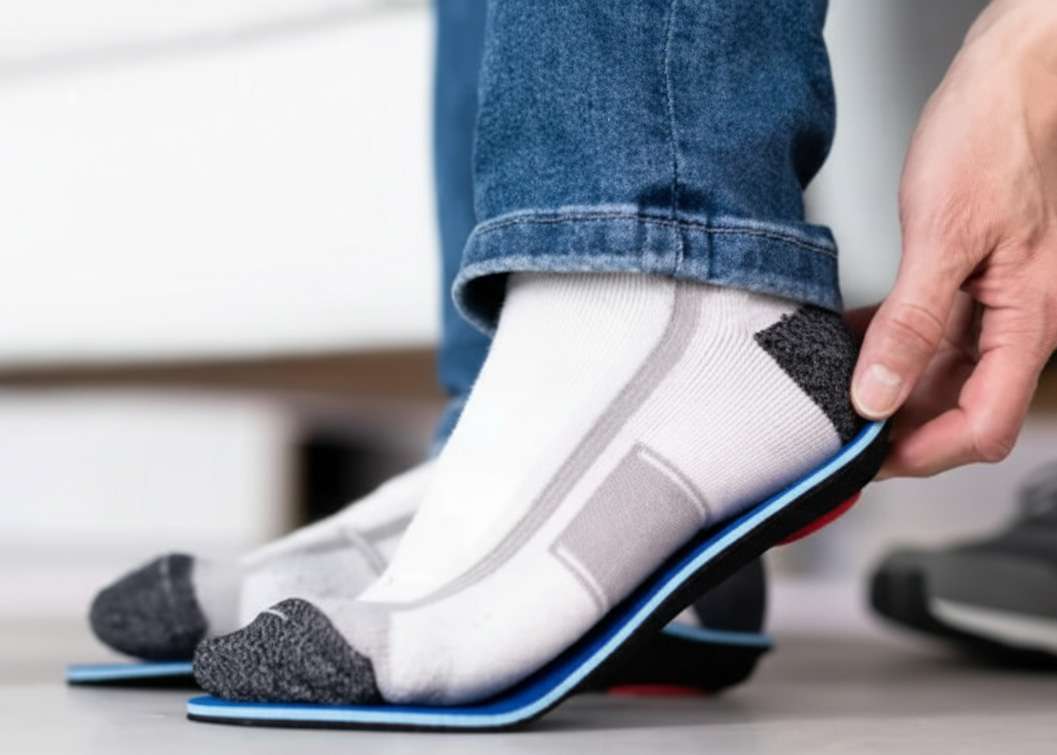
Custom orthotics are prescription shoe inserts fabricated to the exact contours of your foot. They are not the generic padded insoles you find at the drugstore. A custom orthotic is designed to correct the specific mechanical problem causing your pain, whether that is the way your arch collapses under load, the angle your heel strikes the ground, or the way force travels through your foot into your knee and hip.
At Wellmax, the orthotics process starts with a full biomechanical assessment: your chiropractor evaluates your foot posture, arch height, gait pattern, and the alignment of your ankle, knee, and hip. This is not a quick foot scan at a mall kiosk. It is a clinical evaluation that identifies the mechanical cause of your symptoms and informs exactly what correction the orthotic needs to provide.
Conditions Custom Orthotics Help
Custom orthotics are used for a wide range of conditions where foot mechanics are contributing to pain:
- Plantar fasciitis: The most common cause of heel pain. Custom orthotics offload the plantar fascia and redistribute pressure away from the inflamed tissue. Combined with physiotherapy, most patients see significant relief within 4 to 6 weeks.
- Flat feet (pes planus): When the arch collapses, force is distributed unevenly through the foot, ankle, and lower leg. An orthotic with medial arch support restores a more neutral foot posture and reduces strain on the tibialis posterior tendon and ankle ligaments.
- High arches (pes cavus): High-arched feet absorb shock poorly. A custom orthotic with cushioning and lateral support improves shock absorption and reduces the risk of stress fractures, ankle sprains, and ball-of-foot pain.
- Heel spurs: Bony growths at the base of the heel are often associated with plantar fasciitis. Orthotics with heel cups and cushioning reduce pressure on the heel during standing and walking.
- Achilles tendinopathy: A slight heel raise built into the orthotic reduces tension through the Achilles tendon during weight-bearing activities, allowing the tendon to heal while you continue activity.
- Knee pain and patellofemoral syndrome: Foot mechanics directly influence knee alignment. Orthotics that correct excessive pronation (inward rolling) reduce the inward rotation of the tibia and take pressure off the patellofemoral joint.
- Hip pain and leg length discrepancy: A heel lift built into one orthotic corrects a functional leg length difference and reduces compensatory stress on the hip and lower back.
- Metatarsalgia and morton’s neuroma: Pain and pressure under the ball of the foot responds well to metatarsal pads built into the orthotic shell, which redistribute load away from the irritated nerve or inflamed metatarsal heads.
Types of Custom Orthotics
Not every custom orthotic is the same. Your chiropractor selects the appropriate design based on your assessment, activity level, and footwear:
- Rigid orthotics: Made from firm polypropylene or graphite. Used when strong motion control is needed, excessive pronation, posterior tibial tendon dysfunction, or severe flat foot deformity. Typically worn in closed athletic shoes or dress shoes.
- Semi-rigid orthotics: A flexible shell with firmer posting. The most common type. Balances support with some shock absorption. Works well for runners, athletes, and active adults managing plantar fasciitis or knee malalignment.
- Soft (accommodative) orthotics: Full-contact, cushioned devices made from soft materials. Used when pressure relief is the primary goal, diabetic foot care, arthritic feet, severe heel pain, and elderly patients who need comfort over motion control.
The Orthotics Casting and Fabrication Process
At Wellmax, we cast orthotics on-site. The casting is done with the foot in a neutral subtalar joint position to capture the optimal foot shape for correction. We use foam box casting, which produces an accurate three-dimensional impression of the foot in the corrected position. The prescription, including the degree of posting, material choice, arch height, and any accommodations, is written specifically for your biomechanical assessment findings and sent to the orthotic lab.
Turnaround time is typically 2 to 3 weeks from casting. When your orthotics arrive, we do a fitting appointment: you wear them, we watch you walk, and we make any spot adjustments needed to ensure comfort and correct function. A break-in period of 2 to 4 weeks is normal as your foot and leg muscles adapt to the new alignment.
Types of Braces We Provide

Custom Knee Braces for ACL and Ligament Injuries
ACL and ligament injuries are among the most common reasons patients come to Wellmax from Joshua Creek, Clearview, Clarkson, and the Mississauga border. After reconstruction surgery, the graft needs time to integrate and strengthen. During that window, a custom functional knee brace provides the structural support the graft cannot yet provide on its own.
Unlike off-the-shelf alternatives, a custom knee brace is measured directly to your leg. The hinge positioning, flexion and extension stops, and padding placement are specific to your anatomy and your stage of rehabilitation. As your rehab progresses and strength returns, the brace settings are adjusted to reflect where you are in the recovery process. We also fit custom braces for MCL injuries, multi-ligament reconstructions, and athletes with chronic instability who need protection during high-demand sport. See our ACL injury physiotherapy page for the full rehabilitation approach.
Osteoarthritis (OA) Unloader Knee Braces
Osteoarthritis of the knee is a mechanical problem as much as it is a biological one. When cartilage wears unevenly, the load shifts to one compartment of the joint. That is what creates the sharp pain on one side of the knee during walking, stairs, or standing.
An OA unloader brace applies a corrective three-point force that shifts the load away from the damaged compartment. The result is real pain reduction during activity, often within days of getting the brace correctly fitted and adjusted. For patients in Sheridan Park, Winston Park, and surrounding areas managing knee osteoarthritis, an OA unloader brace can be the difference between staying active and backing off everything that aggravates the pain. It works best as part of a rehab plan that also addresses the strength and movement patterns around the joint. Learn more about arthritis management at Wellmax.
Ankle, Wrist, and Elbow Supports
Not every brace needs to be fully custom. For ankle sprains, wrist injuries, and lateral elbow conditions like tennis elbow, we fit medical-grade prefabricated supports, in stock or ordered in, that provide significantly more structure than pharmacy options.
The difference is in the fitting process. We assess which support is appropriate for your injury, how it should be positioned and tensioned, and whether any modifications are needed. A lateral elbow strap worn in the wrong position does very little. Positioned and fitted correctly, it reduces the tensile load through the extensor tendon and takes pressure off the irritated tissue. We also fit custom wrist braces for athletes returning to contact or racquet sports, and ankle braces for patients with recurrent sprains who need reliable lateral support during sport. Learn about wrist and hand pain physiotherapy at Wellmax.
Bracing Solutions for Your Sport
Different sports place different demands on your joints. We dispense and fit medical-grade braces designed to withstand the specific forces of your activity, keeping you protected without restricting your performance.
Running and Trail
Patellar tracking braces and Achilles supports to manage repetitive impact and keep you logging miles. For runners dealing with running injuries, the right orthotic or brace is often a key part of returning to full training load.
Hockey and Court Sports
Low-profile, high-stability knee and ankle braces that fit under gear and handle aggressive lateral direction changes. We work with hockey players from Oakville’s arenas and court sports athletes needing protection through quick cutting movements.
Gym and Training
Medical-grade compression and joint supports for heavy lifting, CrossFit, and overhead stability. The right support keeps you training without aggravating a recovering injury.
Golf and Racquet Sports
Targeted elbow straps and wrist supports that absorb tendon shock without altering your swing mechanics. Tennis elbow and golfer’s elbow both respond well to correctly fitted counterforce straps combined with physiotherapy.
How Custom and Medical-Grade Braces Help
A well-fitted brace does three things that a generic sleeve cannot. It stabilizes the joint within controlled, safe ranges of motion. It reduces pain and swelling by offloading the structures that are irritated or healing. And it restores confidence in movement, which matters more than people realize.
When a joint feels unpredictable, the body braces against it automatically. Muscles guard. Movement becomes hesitant and altered. That pattern creates new problems over time. A properly fitted brace interrupts that cycle. It gives the joint something reliable to work within while the healing process catches up.
Custom and medical-grade braces can:
- Stabilize injured or post-surgical joints during recovery and return to sport
- Reduce pain and protect healing tissue from further stress
- Offload specific compartments of the knee in osteoarthritis
- Support return to physical activity, sport, and work after injury
- Protect against re-injury risk during the vulnerable stages of rehabilitation
The Medical-Grade Difference
Not all braces are created equal. The neoprene sleeves you find at the pharmacy offer basic compression, but they lack the structural integrity to physically prevent a joint from giving out. At Wellmax, we dispense medical-grade and custom-fabricated braces. What does that mean for you?
- Anatomical Contouring: The brace is mapped to the exact shape of your muscles and bones, preventing it from slipping down your leg when you sweat or run.
- Targeted Compression: Medical-grade knit provides graduated compression to actively pump swelling out of the joint while you move.
- Mechanical Offloading: For conditions like osteoarthritis, our unloader braces physically push the joint open, removing the bone-on-bone friction that causes sharp pain.
- Rigid Hinge Technology: Post-surgical braces use aircraft-grade aluminum hinges to stop your joint from hyperextending or buckling inward.
How the Custom Fitting Process Works
1. Clinical Assessment
We do not just hand you a box. Your physiotherapist evaluates your injury, measures your joint mechanics, and determines exactly which level of support your recovery requires. This assessment also considers your activity goals, your footwear or equipment, and your insurance coverage so the device we select actually fits into your life.
2. Precision Fitting
We take exact measurements of your limb to order or configure your brace. When it arrives, we fit it to your body, adjusting the hinges, straps, and stops for perfect alignment. For custom orthotics, we cast your foot on-site in a neutral position and write a precise prescription to the lab.
3. Integration with Rehab
A brace or orthotic is a tool, not a cure. We show you how to wear it, when to wear it, and integrate it into a broader physiotherapy plan to strengthen the muscles around the joint. The device supports your recovery while the physiotherapy addresses the underlying movement patterns and strength deficits that led to the problem.
Why Get Fitted by a Physiotherapist?
The brace itself is one part of the equation. The fitting is the other part, and it is where most over-the-counter solutions fall short.
At Wellmax, a brace fitting is not a 10-minute transaction. Your physiotherapist takes precise measurements of the limb, reviews your current stage of rehabilitation, and selects or orders a brace that matches your anatomy and your recovery goals.
Once it arrives, there is a fitting appointment to check alignment, pressure distribution, and range of motion settings. Adjustments are made on the spot. Follow-up adjustments are included.
More importantly, your brace is integrated into your rehab plan. If you are six weeks post-ACL reconstruction and getting into Phase 2 strengthening, the brace settings reflect that. When you advance to sport-specific loading and change-of-direction work, the brace is adjusted again. It is not a static product. It is a tool that evolves with your recovery.
Patients from Winston Churchill Blvd, Clearview, Clarkson, and Sheridan Park come to Wellmax specifically because they want the brace to actually work within a real treatment plan, not just sit in a box on a shelf.
Insurance Coverage and Receipts
Most extended health insurance plans in Ontario cover both custom orthotics and custom bracing, but under separate benefit categories. Understanding this ahead of your visit can help you maximize your coverage.
Custom Orthotics Coverage
Custom orthotics are typically covered under the “orthotics” or “custom orthotics” benefit, which is separate from your physiotherapy benefit. Coverage amounts range widely, from $150 to $500 per pair per year depending on your plan. Many plans require a written prescription from a regulated health professional (physiotherapist, chiropodist, or physician) and a detailed assessment note. We provide all required documentation. Some plans also require that the orthotics be made from a cast or scan, not from a standing impression, ours always are.
Custom Bracing Coverage
Custom braces are covered under the “orthopedic appliance” or “bracing” benefit, which again is separate from your physiotherapy benefit. Coverage varies significantly. We recommend calling your insurance provider before your appointment to confirm your brace benefit amount and whether a prescription or letter of medical necessity is required. We provide the documentation your plan requires.
Custom orthotics and braces are pay-and-submit: you pay at the clinic and we give you the paperwork to submit to your extended health insurer. WSIB and MVA (motor vehicle accident) claims are also accepted. No referral needed to book your assessment.
Why Oakville Patients Choose Wellmax for Orthotics and Bracing
Assessment-First, Not Product-First
We start with a biomechanical assessment, not a product catalogue. The right device for your injury and your body is identified through clinical evaluation, not by matching your symptoms to the nearest shelf item. This is the difference between a device that works and one that collects dust.
On-Site Casting for Orthotics
We cast orthotics on-site, in neutral subtalar joint position. You do not need to go to a separate orthotics lab. The assessment, the cast, and the follow-up fitting all happen at our clinic on Winston Churchill Blvd in Oakville.
Integrated with Physiotherapy
Every brace and orthotic we dispense is integrated with a physiotherapy plan. We address the strength deficits, movement patterns, and tissue injuries that the device is supporting. The goal is not dependency on the device long-term, it is to build the capacity to function without it, or to use it strategically for high-demand activities.
All Services Under One Roof
Patients who need bracing or orthotics often benefit from our other services: physiotherapy for the underlying joint injury, sports physiotherapy for return-to-sport planning, massage therapy for soft tissue work around the braced joint, shockwave therapy for plantar fasciitis and Achilles conditions, and deep tissue laser therapy for tissue healing. All under one roof.
Frequently Asked Questions
Are custom orthotics worth it compared to store-bought insoles?+–
For mild discomfort on flat terrain, a quality off-the-shelf insole can help. But for diagnosable conditions like plantar fasciitis, flat feet, Achilles tendinopathy, or knee malalignment caused by foot mechanics, custom orthotics are significantly more effective. They are made from a cast of your foot in a corrected position and prescribed to address your specific mechanical problem. Generic insoles are sized, not prescribed. Most patients with a true biomechanical issue find that custom orthotics reduce pain more reliably and last 3 to 5 years.
Are custom orthotics covered by insurance in Ontario?+–
Most extended health plans in Ontario cover custom orthotics under a separate orthotics benefit, typically ranging from $150 to $500 per pair per year. Coverage usually requires a written prescription or assessment note from a regulated health professional. Some plans specify that the orthotics must be made from a cast or scan. At Wellmax, we cast on-site and provide all required documentation for insurance submission. We recommend calling your insurer before your appointment to confirm your specific benefit and any requirements.
How long do custom orthotics last?+–
A well-made pair of custom orthotics typically lasts 3 to 5 years with regular use. The shell (the rigid or semi-rigid foundation) is durable, but the top cover and padding wear down faster and can be replaced without replacing the entire orthotic. Children’s orthotics need to be replaced more frequently as their feet grow, typically every 12 to 18 months. If your activity changes significantly, for example, you take up running after years of sedentary work, a reassessment may be warranted even if the orthotic looks intact.
Do custom orthotics hurt at first?+–
A break-in period of 2 to 4 weeks is normal and expected. During this time, your foot, ankle, and leg muscles are adapting to the new alignment the orthotic is providing. Some mild soreness in the arch, lower leg, or even hip during the break-in period is common and not a sign that the orthotic is wrong. Start by wearing the orthotic for 2 to 3 hours per day and gradually increase over 2 weeks. If you have sharp pain, significant discomfort that does not settle, or the pain is in a completely different location than before, contact your physiotherapist for a fitting adjustment.
How are custom orthotics cast and made?+–
At Wellmax, we cast orthotics using a foam impression box with your foot held in a neutral subtalar joint position. This captures the corrected three-dimensional shape of your foot. We then write a detailed prescription specifying the shell material, degree of arch support, heel posting, and any accommodations needed for your condition. The cast and prescription go to an orthotics lab, which fabricates the device from your exact mold. Turnaround is typically 2 to 3 weeks. When the orthotics arrive, we do a fitting appointment and make any final adjustments.
Who needs custom orthotics?+–
Custom orthotics are appropriate when foot mechanics are contributing to pain or injury. Common candidates include people with plantar fasciitis, flat feet causing ankle or knee pain, Achilles tendinopathy, stress fractures from high-impact activity, knee pain linked to overpronation, hip pain from leg length discrepancy, and metatarsalgia. Athletes who run high weekly mileage or play court sports are also strong candidates if they have recurring lower limb injuries. A biomechanical assessment determines whether orthotics are the right intervention or whether physiotherapy alone will resolve the issue.
What is the difference between orthotics and braces?+–
Orthotics are custom insoles worn inside your shoe that correct foot mechanics and alignment during walking and activity. Braces are external devices worn around a joint, most commonly the knee, ankle, wrist, or elbow, that provide structural support, stability, and protection during movement. Orthotics address foot-driven mechanical problems that travel up the kinetic chain. Braces address joint instability, post-surgical protection, or compartment offloading. Many patients benefit from both: an OA knee brace combined with orthotics that correct the foot mechanics contributing to uneven joint loading, for example.
Do I need a doctor's referral to get custom orthotics or a brace?+–
No referral is needed at Wellmax. You can book a brace fitting assessment or orthotics assessment directly. If your brace is part of a post-surgical protocol and your surgeon has specific requirements, bring any documentation to your first appointment and we will work within those parameters. For insurance purposes, some plans require a prescription from a regulated health professional, a physiotherapist qualifies, and we provide the required paperwork.
How much do custom orthotics cost in Ontario?+–
Custom orthotics in Ontario typically cost $350 to $600 per pair, depending on the design, materials, and clinic. Most extended health plans cover a portion of this cost under the orthotics benefit. After insurance reimbursement, many patients pay $50 to $200 out of pocket. The 30-minute orthotic assessment and casting with our chiropractor is free. We recommend calling your insurer before your visit to understand your coverage so there are no surprises.
Can orthotics help with knee or hip pain?+–
Yes, when the knee or hip pain is caused or worsened by foot mechanics. Excessive pronation (inward rolling of the foot) creates inward rotation of the tibia, which increases stress on the medial knee and alters hip alignment. An orthotic that corrects pronation can reduce knee and hip pain significantly. A leg length discrepancy, even a small one, can create asymmetrical hip loading and low back pain that resolves with a heel lift built into the orthotic. Your chiropractor assesses whether your knee or hip problem has a foot-mechanics component before prescribing orthotics.
How long does it take to get custom orthotics?+–
The casting appointment takes about 30 to 45 minutes as part of your biomechanical assessment. The orthotics are fabricated at an offsite lab, which typically takes 2 to 3 weeks. When they arrive, we schedule a fitting appointment (about 20 minutes) to check fit, watch your gait, and make any adjustments. So from your first appointment to having the finished orthotics in your shoes, expect 3 to 4 weeks total. Common medical-grade prefabricated braces for ankles, wrists, and elbows may be in stock at the clinic, and any others are ordered in for you.
Can children wear custom orthotics?+–
Yes. Custom orthotics are appropriate for children with flat feet causing pain, in-toeing or out-toeing gait that is affecting their activity, growing pains with a mechanical component, or Sever’s disease (heel pain from growth plate irritation common in active children aged 8 to 14). Children’s feet are still developing, so orthotics for kids are typically softer and more accommodative. Because children’s feet grow, their orthotics need to be reassessed every 12 to 18 months and replaced when the child’s foot size has changed significantly.
Where can I get custom orthotics near me, and do I need a referral?
You can get them at Wellmax on Winston Churchill Blvd, and no referral is needed to be assessed. We check your gait and your footwear, then take a foam box cast of your feet on site. The prescription goes to the lab, and your orthotics are usually ready in two to three weeks, with a fitting appointment when they arrive. Medical-grade and custom braces are fitted here too. Some insurers ask for a doctor’s note before they reimburse, so check your plan.
Related Pages
- Knee Pain Physiotherapy: Learn more about rehabilitation for ACL tears, meniscus injuries, and patellofemoral pain.
- Arthritis Management: Discover how physiotherapy combined with OA unloader bracing can delay knee replacement surgery.
- Pre and Post-Surgical Rehab: Structured rehabilitation protocols for after your ligament reconstruction or joint surgery.
- Sports Injury Physiotherapy: Comprehensive treatment plans for athletes dealing with acute sprains, strains, and contact injuries.
- Ankle and Foot Pain: Targeted therapy for recurrent ankle sprains, Achilles tendinopathy, and plantar fasciitis. Read more about Plantar Fasciitis Physiotherapy.
- Shop Braces, Orthotics & Recovery Products: Supports, recovery tools, and orthopaedic products, in stock at the clinic or ordered in for you.
Book Your Custom Orthotics or Brace Fitting in Oakville
Whether you are recovering from ACL reconstruction, managing knee osteoarthritis, dealing with plantar fasciitis, or returning to a sport that demands reliable joint support, the right device fitted correctly makes a real difference in how your recovery goes. Wellmax offers a free 30-minute consult if you want to talk it through first.
Book a Free Consultation Call (905) 829-1100
Wellmax Physiotherapy
1148 Winston Churchill Blvd, Unit B3, Oakville, ON L6J 0A3
Phone: (905) 829-1100
Email: info@wellmaxphysiotherapy.ca
Hours: Monday to Friday 9am to 7pm; Saturday 9am to 2pm; Sunday 9am to 2pm (by appointment only).
Proudly Serving Our Local Communities:
- East Oakville: Winston Park, Clearview, and the QEW/403 Corridor.
- South Oakville: Eastlake, Maple Grove, Lorne Park, and Old Oakville.
- North Oakville: Joshua Creek, Falgarwood, Iroquois Ridge, and Upper Middle Road.
- Mississauga Border: Clarkson, Sheridan Park, Sheridan Homelands, and Southdown.
Insurance: Orthotics and braces are pay-and-submit: we give you the paperwork for your insurer. Our physiotherapy visits are direct billed to most major insurers. WSIB and MVA claims accepted. No referral needed.
Find Us in Oakville
Registered & Regulated
Regulated & Recognized Across Every Discipline
Wellmax is in good standing with the regulatory colleges and leading associations for physiotherapy, chiropractic, massage therapy, and naturopathic medicine in Ontario.