
SI Joint Pain Treatment in Oakville
Sacroiliac joint assessment and hands-on treatment from physiotherapists and a chiropractor who also treat the pelvic floor. Same-day treatment, direct billing, no referral needed.
Home > Conditions We Treat > SI Joint Pain Treatment in Oakville

SI joint pain treatment in Oakville at Wellmax Physiotherapy starts with a proper assessment of the sacroiliac joints, the two joints where the base of your spine meets your pelvis. Pain from these joints is one of the most common causes of low back and buttock pain that does not respond to the usual back treatment, and it is a frequent source of pain during and after pregnancy. Our physiotherapists and chiropractor assess the joint, the muscles that stabilise it, and the way you move, then treat it hands-on and with a plan you can finish. If you would rather ask a few questions first, book a free 15 minute consult.
This page explains what the SI joint does, why it becomes painful, how we tell SI joint pain apart from other causes of low back pain, what treatment involves at Wellmax, and how long recovery usually takes. The same low back pain can have several different causes, and each needs different treatment, which is why the first visit is an assessment rather than a guess.
- What is the sacroiliac (SI) joint?
- What does SI joint pain feel like?
- Why does the SI joint become painful?
- How we assess SI joint pain in Oakville
- SI joint pain treatment at Wellmax
- SI joint pain during and after pregnancy
- What you can do at home while you wait for your appointment
- How long does SI joint pain take to get better?
- Why choose Wellmax for SI joint pain treatment in Oakville?
- Book your SI joint assessment in Oakville
- Frequently Asked Questions
What is the sacroiliac (SI) joint?
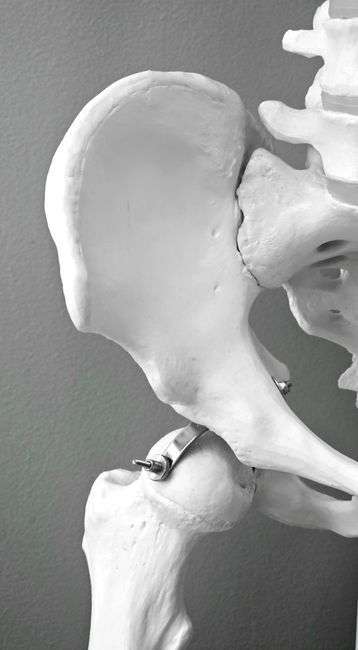
You have two sacroiliac joints, one on each side, where the sacrum (the triangular bone at the base of the spine) meets the ilium (the large wing of the pelvis). They are strong joints held together by some of the thickest ligaments in the body, and they move only a few millimetres. Their job is to transfer load between the spine and the legs every time you stand, walk, lift or climb stairs.
Because they move so little, the SI joints depend on the muscles around them for stability: the deep abdominal muscles, the gluteal muscles, the pelvic floor and the muscles along the spine. When those muscles are weak, fatigued or not working together, the joint is asked to tolerate more shear than it is built for, and it becomes irritated. When the ligaments themselves are stretched, as they are in pregnancy, the same thing happens from the other direction.
What does SI joint pain feel like?
People describe sacroiliac pain in fairly consistent ways, although no single symptom confirms it and the assessment is what settles the question. Patterns we hear most often in the clinic include:
- Pain low and to one side of the spine, over the dimples at the top of the buttocks, rather than in the centre of the back.
- Pain that spreads into the buttock, groin or the back of the thigh, usually stopping above the knee. Pain that travels below the knee with numbness or tingling points more towards sciatica or a disc problem, which is why we check for both.
- Pain with transitions: standing up from a chair, getting out of the car, rolling over in bed, or stepping onto one leg to put trousers on.
- Pain standing on one leg or climbing stairs, because each step loads one SI joint fully.
- Stiffness after sitting or first thing in the morning that eases with movement.
- A feeling that the pelvis is “out” or unstable. The joint is not actually dislocated, but the sensation is real and comes from the joint and its ligaments being irritated.
If any of this sounds like you, or you are not sure, book an assessment and we will work out where the pain is actually coming from. Pain in the same area can also come from the hip joint, the lumbar spine, the gluteal tendons and bursa, or the piriformis muscle, and treating the wrong structure is the main reason SI joint pain drags on.
Why does the SI joint become painful?
Sacroiliac dysfunction is usually described as either too much movement (hypermobility or instability) or too little (hypomobility or stiffness). Both irritate the joint, and the treatment is different for each, which is one more reason the assessment matters. Common triggers include:
- Pregnancy and the months after birth. The hormone relaxin loosens the pelvic ligaments so the pelvis can widen for birth, the growing belly shifts your centre of gravity forward, and the deep core and pelvic floor are stretched. SI joint pain is one of the most common forms of pregnancy pelvic girdle pain, and it often persists after delivery until the stabilising muscles are retrained. Our postpartum physiotherapy page covers the after-birth side in detail.
- A fall, a lift gone wrong, or a car accident. Landing on one buttock, stepping into an unexpected hole, or the jolt of a rear-end collision can strain the joint. SI joint pain is common after a motor vehicle accident and after workplace lifting injuries.
- Repetitive one-sided loading. Running, golf, hockey, carrying a toddler on the same hip, or standing with your weight on one leg for hours.
- Leg length differences and gait changes, including limping after a knee, ankle or foot injury, which loads one side of the pelvis more than the other.
- Weak or poorly coordinated gluteal and core muscles, often after a long period of sitting, a previous back injury, or a pregnancy.
- Inflammatory conditions. Ankylosing spondylitis and related conditions can inflame the SI joints, particularly in younger adults with morning stiffness that lasts more than an hour. When the history points that way we refer you back to your doctor for investigation alongside physiotherapy.
- Previous spinal fusion or hip surgery, which changes how load moves through the pelvis.
How we assess SI joint pain in Oakville
Your first appointment is a full 60 minute assessment with one-on-one care at Wellmax, led by a registered physiotherapist or chiropractor. We start with your history: when the pain began, what makes it worse, what you have tried, whether you have been pregnant, and any injuries or surgeries. Then we look at how you move.
The physical assessment includes a screen of the lumbar spine and hips to rule those in or out, a set of SI joint provocation tests (there is no single reliable test, so we use a cluster of them together, which research supports as the most accurate way to identify a painful SI joint without imaging), a check of pelvic alignment and how each side moves, and a look at how well your gluteal muscles, deep abdominals and pelvic floor switch on when you load the leg. We also watch you walk, stand on one leg and get up from a chair, because those are the movements that hurt.
Imaging is rarely needed for SI joint pain. X-rays and MRIs often look normal even when the joint is clearly the source, and they often show age-related changes that are not causing the pain. If your history suggests an inflammatory cause, a fracture or nerve involvement, we will say so and coordinate with your physician.
By the end of the first visit you will know what we think is driving the pain, what we are going to do about it, and roughly how many visits it should take. Treatment starts the same day.
SI joint pain treatment at Wellmax
There is no single fix for sacroiliac pain, because a stiff, irritated joint and a loose, unstable one need almost opposite approaches. Treatment at Wellmax combines hands-on care to settle the joint with a progressive strengthening programme to keep it settled. A typical plan includes:
- Manual therapy. Mobilisation of the SI joint, lumbar spine and hips to restore normal movement, and soft tissue work on the gluteals, piriformis, hip flexors and low back muscles that tighten around a painful joint. Our chiropractor provides adjustment where the joint is stiff and an adjustment is appropriate for you.
- Muscle energy techniques and pelvic re-alignment, which use your own gentle muscle contractions to rebalance the position of the pelvis. These often give immediate relief when one side is sitting differently from the other.
- Stabilisation and strengthening. This is what makes the result last. We retrain the deep core, the gluteus maximus and medius, and the pelvic floor to share the load, then progress to standing, single-leg and functional strength. The programme is specific to whether your joint is stiff or unstable.
- An SI belt in the short term when the joint is unstable, particularly in pregnancy and early postpartum. It is a bridge while the muscles catch up, not a permanent solution. We can fit one and show you how to wear it. See our braces and supports page.
- Acupuncture or dry needling for stubborn muscle tension and pain around the joint, offered through our acupuncture and cupping service.
- Movement and habit changes. How to get out of bed and the car, how to lift a child, sleeping positions, and how to break up long sitting, so you stop re-irritating the joint between visits.
- Return to activity. A graded plan back to running, sport, lifting or whatever the pain has taken from you, with the loading built up in stages rather than all at once.
Because Wellmax is a multidisciplinary clinic, your physiotherapist, chiropractor and massage therapist can work on one plan for the same problem rather than giving you three different opinions. Massage therapy is often added for the surrounding muscle tension, particularly in pregnancy.
SI joint pain during and after pregnancy
Roughly one in five pregnant women develops pelvic girdle pain, and the sacroiliac joints are involved in most of those cases. The pain is often worst in the third trimester, with walking, turning in bed and standing on one leg, and it can continue for months after birth if the deep core and pelvic floor are not retrained. It is common, but it is not something you have to put up with until the baby arrives.
Treatment in pregnancy is gentle and adapted to your stage: side-lying positioning, hands-on work to settle the joint, a support belt if the joint is unstable, and simple stabilisation exercises you can do at home. Our prenatal chiropractor, pelvic health physiotherapist and registered massage therapists work together on pregnancy pelvic pain, so you can be seen by the right person without being sent elsewhere. After birth, a postpartum physiotherapy assessment checks the pelvis, core and pelvic floor in one visit.
What you can do at home while you wait for your appointment
These are a safe starting point, not a treatment plan, and they will not fix an unstable or stiff joint on their own. If any of them increases your pain, stop.
- Keep your knees together when you roll in bed and get out of the car. Swing both legs as one unit. This alone reduces the shearing that sets the joint off.
- Avoid standing on one leg to dress. Sit down to put on socks, shoes and trousers.
- Break up sitting every 30 to 40 minutes. Long sitting stiffens the joint; a short walk usually eases it.
- Gentle glute activation. Lying on your back with knees bent, squeeze your buttocks and lift the hips a few centimetres, hold for five seconds, lower slowly. Ten repetitions, twice a day, if it is pain-free.
- Heat over the low back and buttock for 15 minutes for muscle tension. Ice for the first two days after a clear injury.
How long does SI joint pain take to get better?
Most people with a recent flare feel a clear change within the first two or three visits, and a typical plan runs six to ten visits over six to eight weeks, with the strengthening continuing at home after that. Long-standing pain, pain after a car accident, or pain that started in pregnancy and has lasted months usually takes longer, because the muscles have had more time to switch off and the movement habits have had more time to set in. You will be given an expected number of visits at your first assessment, and the plan is built to finish, not to keep you coming back.
Why choose Wellmax for SI joint pain treatment in Oakville?
- Sixty minute assessments with one-on-one care. SI joint pain is misdiagnosed as generic back pain more often than almost any other condition. We take the time to tell the difference.
- Physiotherapy, chiropractic, massage and pelvic health under one roof. One plan, one clinic, and the pelvic floor and core are included, which matters for anyone who has been pregnant.
- Level 3 pelvic health certification on the team. Gurmeet Rai is a Registered Physiotherapist with Level 3 pelvic health training and 16 years of experience, so pregnancy and postpartum SI joint pain is treated properly rather than approached as an ordinary back problem.
- Direct billing. We bill most major insurers directly, and you do not need a referral to be seen. See insurance coverage and direct billing.
- Located at Winston Churchill Boulevard and the QEW, minutes from south-east Oakville, Clarkson and Erin Mills, with free parking.
Book your SI joint assessment in Oakville
If your low back or buttock pain has not responded to rest, stretching or general back treatment, or if it started in pregnancy and has not gone away, the sacroiliac joint is worth assessing properly. Book an assessment online or call (905) 829-1100. If you are not sure whether physiotherapy or chiropractic is the right first step, start with a free 15 minute consult and we will point you to the right clinician.
What Our Patients Say
Danuta K.“After struggling with my SI joint pain for long time, Gurmeet and manual therapy techniques made a huge difference. She gave me personalized exercise plan. Now I can move freely and feel a huge difference”
Helen O.“I began seeing Gurmeet as I was struggling with a painful shoulder and limited range of motion. Her knowledge and experience were evident from the start and within a short period of time I not only got relief from the pain but begin to see a change in how I was able to use my shoulder. Gurmeet and her staff employ a hands on approach which I appreciate and have found great success with. She was provided a recovery plan and exercises, which have been very effective. I have also began seeing her for sciatic/SI joint pain and already I am seeing a difference. I also appreciate that they are always able to accommodate my appointments!”
R. Singh.“I had an incredible experience with Gurmeet at Wellmax Physio, she is highly skilled and takes the time to explain everything in a way that makes you feel informed and confident in your treatment. Her techniques are effective, and you can tell she’s very knowledgeable in what she does. What stood out most was her attentiveness, she really listens and tailors the treatment to what your body needs. If you’re dealing with back pain or need physiotherapy, I would absolutely recommend her without hesitation.”
Kelly H.“So happy I decided to go here, my back is finally better! I wrecked it shovelling snow and nothing was helping until I came to Wellmax. Amazing service, got me moving again. Everyone working there is so nice; Gurmeet is amazing and I love her ha ha. I highly recommend!”
Bashar F.“I came to Wellmax for neck and back pain, Saw Gurmeet, she did detailed assessment and her hands on treatment, manual therapy, customised treatment plan and exercises with 2 sessions only I am feeling big difference. Her PTAs Janvi and Minahil are good at their job.”
Linda G.“I have spinal stenosis in my lower back. Today I asked to use the decompression table and was put on it. I was also given a tissue massage and ultrasound. The physiotherapist is very knowledgeable and professional and the rooms are very clean. I would recommend this physio place for sure.”
Tanzy R.“I had an excellent experience at Wellmax physiotherapy clinic with Gurmeet for my back problem. Gurmeet was extremely knowledgeable, patient, and took the time to clearly explain the cause of my pain and the recovery plan. The treatment and exercises were very effective, and I noticed significant improvement within 2-4 weeks. I truly appreciated the constant support and personalized care throughout my recovery. Highly recommend Gurmeet and WellMax Clinic to anyone dealing with back pain.”
Richard B.“Excellent, My lower back is better than ever after seeing Gurmeet, and the team at Wellmax Physiotherapy”
See all our Google reviewsRead more patient storiesLeave a review
Frequently Asked Questions
How do I know if my back pain is coming from the SI joint?+–
Sacroiliac pain usually sits low and to one side, over the dimples at the top of the buttocks, and is worse with transitions such as standing up, rolling in bed, getting out of the car or standing on one leg. It can spread into the buttock, groin or back of the thigh but rarely below the knee. No single symptom confirms it, and hip, disc and gluteal tendon problems can feel similar, so an assessment using a cluster of SI joint tests is the reliable way to find out.
Should I see a physiotherapist or a chiropractor for SI joint pain?+–
Either can treat it, and at Wellmax they work together. A stiff SI joint often responds well to chiropractic adjustment and mobilisation, while an unstable or hypermobile joint, which is common in pregnancy and after birth, needs a strengthening and stabilisation programme led by physiotherapy. You do not have to decide first. The assessment tells us which pattern you have, and we route you to the right clinician or combine both.
Can SI joint pain go away on its own?+–
A mild flare after an awkward lift or a long drive sometimes settles within a couple of weeks with sensible movement. Pain that keeps returning, pain that started in pregnancy, or pain that has lasted more than a few weeks usually means the muscles that stabilise the joint are not doing their job, and that does not fix itself. The earlier it is assessed, the shorter the treatment tends to be.
Why is my SI joint pain worse at night or when I roll over in bed?+–
Rolling over twists the pelvis while the muscles that normally brace it are relaxed, which shears the joint. Lying on your side also lets the top leg drop forward and rotate the pelvis. A pillow between the knees, keeping the knees together as you roll, and moving as one unit rather than leading with one leg usually help right away. Persistent night pain still needs an assessment, because the same symptom can have several causes.
Is SI joint pain common in pregnancy, and can it be treated safely?+–
Yes. Roughly one in five pregnant women develops pelvic girdle pain, and the SI joints are involved in most of those cases, because the hormone relaxin loosens the pelvic ligaments while the growing belly shifts your centre of gravity. Treatment in pregnancy is gentle: side-lying hands-on care, a support belt if the joint is unstable, and simple stabilisation exercises. Our prenatal chiropractor and pelvic health physiotherapist treat it regularly. Tell us you are pregnant when you book so the appointment is set up properly.
Do I need an X-ray or MRI for SI joint pain?+–
Usually not. Imaging often looks normal even when the SI joint is clearly the source, and it often shows age-related changes that are not causing the pain, so it rarely changes treatment. Imaging becomes important if your history suggests a fracture, an inflammatory condition such as ankylosing spondylitis, or nerve involvement. If your assessment raises any of those, we will tell you and coordinate with your doctor.
Does an SI joint belt help?+–
It can, in the short term, when the joint is unstable rather than stiff. A belt worn low around the pelvis compresses the SI joints and often makes walking and standing more comfortable, which is why it is used in pregnancy and early postpartum. It is a bridge while the deep core and gluteal muscles are retrained, not a long-term answer, and it does nothing for a stiff joint. We can fit one and show you how to wear it during your assessment.
How many visits will SI joint treatment take?+–
A recent flare usually takes six to ten visits over six to eight weeks, with most people noticing a clear change within the first two or three. Long-standing pain, pain after a car accident, or pain that has continued for months after a pregnancy usually takes longer because the stabilising muscles have been switched off for longer. You will be given an expected number of visits at your first assessment, and the plan is built to finish rather than to keep you on an open-ended schedule.
Can I keep running or working out with SI joint pain?+–
Often yes, with changes. Running and single-leg loading are the movements most likely to irritate the joint, so in the early stages we usually swap them for cycling, swimming or strength work that does not provoke pain, then rebuild running in stages once the joint is stable. Stopping everything tends to make the muscles weaker and the problem longer. Your physiotherapist will tell you exactly what to keep and what to pause.
Is SI joint pain treatment covered by insurance, and do I need a referral?+–
Physiotherapy, chiropractic and massage therapy are covered by most extended health plans in Ontario under paramedical benefits, usually with separate annual limits for each. Wellmax direct bills most major insurers, so you pay only the portion your plan does not cover. You do not need a doctor’s referral to be assessed or treated, although a few plans ask for one before they reimburse, so check your policy wording. Motor vehicle accident and WSIB claims are handled separately and we can guide you through both.
Registered & Regulated
Regulated & Recognized Across Every Discipline
Wellmax is in good standing with the regulatory colleges and leading associations for physiotherapy, chiropractic, massage therapy, and naturopathic medicine in Ontario.


