
Pickleball Injuries Are Rising Fast. Here’s What Players Over 40 Need to Know.
Pickleball has exploded. What started as a casual backyard game is now the fastest-growing sport in North America, with participation increasing over 200% since 2020. Courts are going up at community centres, parks, and athletic clubs across Oakville and the GTA. The appeal is obvious: it is social, accessible, easier to pick up than tennis, and genuinely fun.
But here is the other side of that growth. Pickleball-related injuries presenting to emergency departments in the United States jumped from roughly 1,300 in 2014 to over 24,000 in 2023. Healthcare costs from pickleball injuries reached an estimated $350 million in a single year. And the sport is producing a very specific pattern of injuries that physiotherapy clinics, including ours, are seeing more and more frequently.
This is not an argument against playing pickleball. The cardiovascular benefits, the social connection, and the joy of competition are real and valuable. This is an argument for understanding the physical demands the sport places on your body, particularly if you are over 40, and knowing how to prevent and treat the injuries that are showing up in clinics across the country. At Wellmax Physiotherapy in Oakville, pickleball injuries are becoming one of our most common sport presentations. See our sports physiotherapy page for our approach to athletic injury management.
Why Pickleball Causes More Injuries Than People Expect
The “Low Impact” Myth
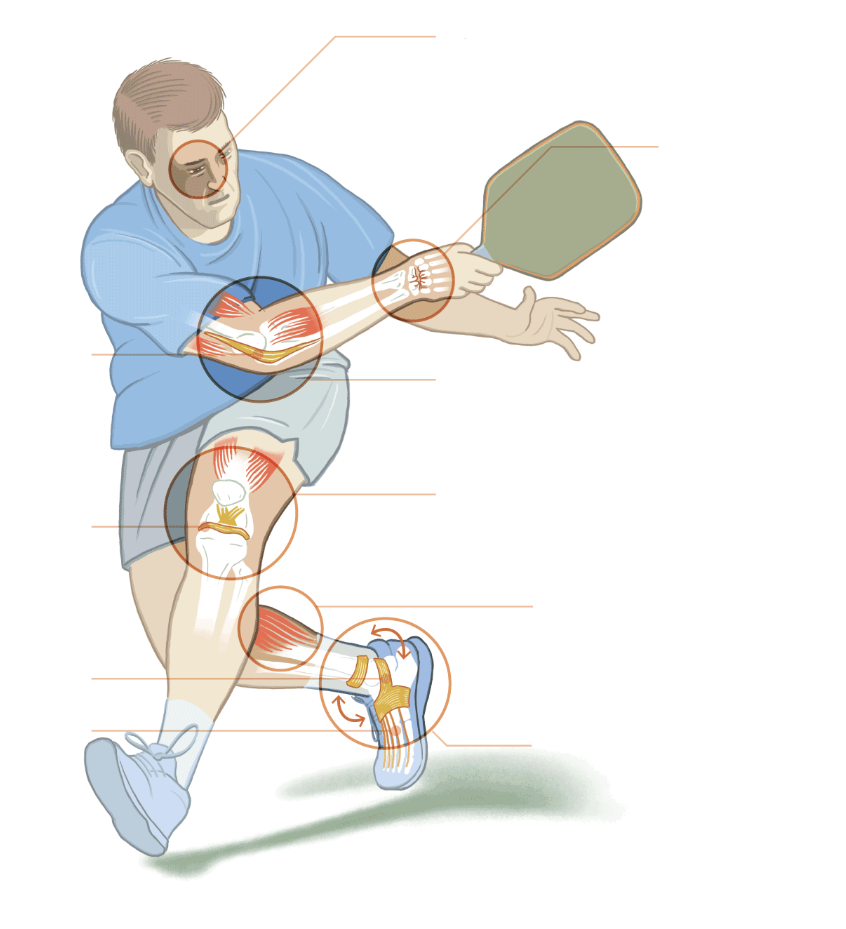
Pickleball is often marketed as a low-impact, easy-on-the-body alternative to tennis. Compared to tennis, it is lower impact. The court is smaller, the paddle is lighter, and the ball travels slower. But “lower impact” is not “no impact,” and the sport’s accessibility creates a specific problem: people go from doing very little physical activity to playing 3 to 4 times per week within a matter of weeks. The body simply has not had time to adapt to the demands being placed on it.
The Demands Are Real
Pickleball requires rapid lateral movement (shuffling side to side at the kitchen line), quick direction changes (lunging forward for a dink, then retreating for a lob), overhead reaching (smashes and serves), repetitive wrist and forearm loading (hundreds of paddle contacts per session), and sustained crouching in a ready position. These are the same movement patterns that produce injuries in tennis, badminton, and squash. The fact that the court is smaller does not eliminate these forces. It concentrates them.
The Age Factor
The largest demographic of pickleball players is adults over 50. Research published in the American Journal of Sports Medicine found that most pickleball injuries presenting to emergency departments affected people aged 60 to 79 years. Players over 40 have reduced tendon elasticity, slower tissue recovery between sessions, less baseline muscle mass and strength, and joint surfaces that have accumulated more wear. None of this means you should not play. It means the body needs more preparation, more recovery time, and smarter load management than a 25-year-old’s body does.
The 6 Most Common Pickleball Injuries (and How to Treat Them)
1. Shoulder Pain (Rotator Cuff Tendinitis and Impingement)
The overhead smash is the highest-force movement in pickleball. Repeated overhead reaching, serving, and smashing loads the rotator cuff tendon and can cause tendinitis, impingement (pinching of the tendon under the acromion bone), or in more significant cases, partial rotator cuff tears. You will feel pain in the front or side of the shoulder, especially with overhead movements, and it may progress to pain at rest or difficulty sleeping on the affected side.
Treatment: Progressive rotator cuff strengthening and scapular stabilization exercises. Manual therapy for joint mobility. Activity modification (reducing overhead shots while the tendon recovers, not stopping play entirely). Shoulder pain treatment details here. For more significant rotator cuff issues, see our rotator cuff page.
2. Tennis Elbow (Lateral Epicondylalgia)
Despite the name, tennis elbow is one of the most common pickleball injuries. The repetitive gripping, wrist extension, and impact vibration from hundreds of paddle contacts per game overloads the forearm extensor tendons at the outside of the elbow. It typically starts as a mild ache after playing and progresses to pain during play, gripping, lifting, and even opening jars.
Treatment: Progressive tendon loading exercises (isometric holds progressing to eccentric and heavy slow resistance exercises). Grip and wrist strengthening. Paddle grip review (too small a grip increases tendon load). Shockwave therapy is particularly effective for tennis elbow that has not responded to 6 to 8 weeks of exercise. Tennis elbow treatment details here.
3. Knee Pain
The sustained crouching position at the kitchen line, combined with repeated lunging and pivoting, loads the patellofemoral joint (kneecap) and the patellar tendon. Players over 40 with existing knee arthritis often find that pickleball aggravates symptoms that were previously manageable. Meniscus irritation from twisting on a planted foot is also common.
Treatment: Quadriceps and gluteal strengthening (the muscles that absorb knee forces during lunging). Activity pacing (reducing session frequency or duration during flare-ups). Footwear review (court shoes with lateral support, not running shoes). Knee pain treatment details here.
4. Achilles Tendinopathy
The Achilles tendon takes enormous force during the push-off, lunging, and quick direction changes of pickleball. Achilles tendinopathy is increasingly common in pickleball players over 40, whose tendons have less elasticity and slower recovery capacity. You will notice pain and stiffness in the back of the ankle or lower calf, usually worst first thing in the morning or after sitting, and worse with activity.
Treatment: Progressive loading is critical. The Achilles needs to be gradually strengthened, not rested into weakness. An evidence-based eccentric and heavy slow resistance exercise protocol combined with calf strengthening is the gold standard. Complete rest is usually counterproductive. Controlled loading promotes healing. Achilles tendinopathy treatment details here.
5. Ankle Sprains
Quick lateral movements on sometimes uneven outdoor court surfaces make ankle sprains one of the most common acute pickleball injuries. Most are lateral (inversion) sprains affecting the ligaments on the outside of the ankle. Falls are the number one mechanism of injury in pickleball, and most falls happen during rapid lateral movement at the kitchen line.
Treatment: Early mobilization and progressive loading (not RICE and rest for weeks). Balance and proprioception training to rebuild ankle stability. Strengthening of the peroneal muscles that protect against repeat sprains. Players with a history of ankle sprains should consider prophylactic bracing or taping during play. Ankle sprain treatment details here.
6. Lower Back Pain
The crouched ready position, combined with rapid rotation during forehands and backhands, loads the lumbar spine in ways that many recreational players are not conditioned for. Players who spend most of their week sitting at a desk and then play aggressive pickleball on weekends are particularly vulnerable to lower back strains and disc irritation.
Treatment: Core and spinal strengthening program. Hip mobility work (tight hips transfer rotational forces to the spine). Activity modification during flare-ups. Education about warming up before play rather than using the first game as the warmup. Back pain treatment details here.
How to Prevent Pickleball Injuries
Warm Up Before You Play
This is the single most ignored injury prevention strategy in pickleball. Most players walk onto the court, pick up their paddle, and start hitting. Your muscles, tendons, and joints need 5 to 10 minutes of preparation before handling the demands of lateral movement, lunging, and overhead reaching. A proper warmup includes light jogging or brisk walking, dynamic stretches (leg swings, arm circles, trunk rotations), bodyweight lunges and squats, and some gentle overhead reaching. The first game should not be your warmup.
Build Strength Off the Court
Playing pickleball builds pickleball-specific endurance. It does not build the strength reserves needed to protect your joints and tendons from injury. A basic strength program done 2 to 3 times per week, focusing on squats, lunges, calf raises, shoulder external rotation, and core stability, gives your body the capacity to handle the forces of the sport without breaking down. This is especially important for players over 40 whose natural strength and tendon resilience are declining.
Manage Your Playing Volume
The most common pattern we see: someone discovers pickleball, loves it, and goes from zero to playing 4 to 5 times per week within the first month. The body has not had time to adapt. The tendons, which adapt to loading much more slowly than muscles, get overloaded and break down. If you are new to pickleball, start with 2 sessions per week with at least one rest day between them. Build to 3 sessions after 3 to 4 weeks. Add a 4th session after 6 to 8 weeks. Let the body catch up to the enthusiasm.
Wear Court Shoes, Not Running Shoes
Running shoes are designed for forward motion. They have cushioned, rounded soles that are unstable during lateral movement. Pickleball requires constant side-to-side shuffling. Wearing running shoes on a pickleball court significantly increases ankle sprain risk. Court shoes (tennis shoes, volleyball shoes, or dedicated pickleball shoes) have flat, wide soles with lateral support built in. This is one of the simplest and most effective injury prevention measures.
Listen to Niggles
A mild ache in the elbow after playing that goes away by the next morning is your body’s early warning system. If you ignore it and keep playing at the same volume, it will progress to pain during play, then pain at rest, then a tendon problem that takes 3 to 4 months to resolve instead of 3 to 4 weeks. Early assessment and treatment of minor symptoms prevents major injuries. This is not being soft. This is being smart.
Pickleball Injuries in Oakville: Where Our Players Come From
We treat pickleball players from courts across the local area. Glen Abbey Community Park, Iroquois Ridge Community Centre, Bronte Athletic Park, River Oaks Recreation Centre, and the indoor courts at Sixteen Mile Sports Complex all produce patients who walk through our door with the same pattern: they love the sport, they played a bit too much or a bit too intensely, and now something hurts.
The good news is that the vast majority of pickleball injuries respond well to physiotherapy. Most do not require imaging, most do not require time completely away from the court (modification rather than cessation), and most resolve within 6 to 12 weeks with the right treatment approach. The key is addressing the injury early and making the training load adjustments that prevent it from recurring.
Frequently Asked Questions About Pickleball Injuries
Is pickleball really low impact?
It is lower impact than tennis, but lower impact is not no impact. The court is smaller, the paddle is lighter and the ball is slower. The sport still asks for fast side to side movement, lunging, overhead reaching and hundreds of paddle contacts a session. Because it is easy to pick up, many people go from very little activity to playing three or four times a week within weeks. That jump is where most problems start.
Why does my elbow ache after playing?
Aching around the elbow after paddle sports is common. The repeated gripping, wrist extension and vibration from hundreds of paddle contacts load the forearm tendons, and a grip that is too small adds to that load. The same symptom can have several different causes though, and each one needs different treatment. If the ache has moved from after play to during play, get it assessed rather than guessing.
Do I have to stop playing completely if something hurts?
Usually not. Most treatment plans change what you do rather than stopping you altogether. That might mean fewer overhead shots while a shoulder settles, or shorter and less frequent sessions during a knee flare. Complete rest often leaves the muscles and tendons weaker than before. A physiotherapist can tell you which shots and how much playing volume are sensible for you right now.
How often should I play if I am new to pickleball?
Start with two sessions a week and at least one rest day between them. Build to three sessions after three or four weeks, and add a fourth after six to eight weeks. Tendons adapt to loading far more slowly than muscles do, so going from zero to four or five sessions in the first month is the pattern behind many pickleball injuries. Let the body catch up to the enthusiasm.
Do court shoes really make a difference?
Yes, and it is one of the simplest changes you can make. Running shoes are built for forward motion, with cushioned rounded soles that feel unstable when you shuffle sideways. Pickleball is constant side to side movement. Court shoes, whether tennis, volleyball or pickleball specific, have flat wide soles with lateral support built in, which lowers ankle sprain risk. If you buy one piece of gear, buy these.
How long do pickleball injuries take to settle?
Most respond well to physiotherapy and settle within six to twelve weeks. Most do not need imaging, and most do not need complete time away from the court, since modifying play usually beats stopping. The bigger factor is how early you have it looked at. A mild ache caught early can settle in weeks, while the same problem ignored for months often takes much longer.
I am over 60. Is pickleball still a good idea?
For most people, yes. The cardiovascular benefit, the social side and the enjoyment are all real. What changes with age is preparation, not permission. Tendons are less elastic, tissues recover more slowly between sessions, and baseline strength tends to be lower. So the warm up matters more, rest days matter more, and off court strength work matters more. Play, and build the base that lets you keep playing.
What should a pickleball warm up actually look like?
Five to ten minutes before you step on court. Start with light jogging or brisk walking, then dynamic movements such as leg swings, arm circles and trunk rotations, then a few bodyweight lunges and squats, and some gentle overhead reaching. The first game should not be your warm up. This is the most commonly skipped prevention step in the sport, and it costs nothing but time.
What strength work helps most for pickleball?
A simple program done two to three times a week: squats, lunges, calf raises, shoulder external rotation and core stability work. Playing builds pickleball endurance, but it does not build the strength reserve that protects joints and tendons when you lunge, push off and reach overhead. This matters most for players over 40. Your physiotherapist can set the starting level so it is not too much too soon.
When should I stop playing and get it looked at?
Get medical care the same day if you felt a sudden pop or snap in the calf, ankle or shoulder, if you cannot put weight on the leg, or if a joint gave way and swelled quickly. Chest pain or unusual breathlessness on court needs emergency care. For an ache that keeps coming back after play, book an assessment. No referral is needed in Ontario, and Wellmax offers a free 15 minute consult.
You Might Also Like

Gurmeet Rai, Registered Physiotherapist
Gurmeet is a Registered Physiotherapist with the College of Physiotherapists of Ontario and the Clinic Director and co-owner of Wellmax Physiotherapy in Oakville, with 16+ years of clinical experience. She focuses on complex, stubborn cases where earlier treatment has not worked, with advanced training in pelvic health, TMJ, vestibular, and sports and MSK rehab. Expect expert care from assessment to discharge, with honest guidance along the way. Read Gurmeet’s full profile or meet the team.
This article is for educational purposes only and does not replace a professional clinical assessment. Every body and condition is different. If you are experiencing pain or symptoms, book an assessment with a qualified clinician for advice specific to your situation. If you are experiencing a medical emergency, call 911 or visit your nearest emergency department.
