
For chronic plantar fasciitis, the best available head-to-head research finds shockwave therapy and laser therapy broadly comparable. One 2024 randomised trial favoured low-level laser in the short term, while two 2026 meta-analyses pooling the trials together found no clear winner on pain. So the honest answer is that the machine is rarely the deciding factor. What decides it is the tissue being treated, how much discomfort you are willing to sit through, how often you can get to a clinic, and what you are prepared to spend.
Before we go further, a disclosure. We offer both shockwave therapy and deep tissue laser therapy at Wellmax in Oakville, so this is not a pitch for one machine over the other. We have no reason to talk you into either. What follows is what the research measured, what each treatment feels like in the room, and how a physiotherapist actually chooses between them.
Key Takeaways
- Pooled trial evidence finds shockwave and laser broadly comparable for chronic plantar fasciitis. Neither has earned the title of clear winner.
- Session rhythm differs a lot. Shockwave is usually about once a week for 3 to 6 visits. Laser is usually two or three times a week for 6 to 12 visits.
- Shockwave is briefly uncomfortable for most people. Laser is almost always painless. That difference matters more than patients expect.
- Neither machine is a standalone fix. Both do their best work inside a loading and strengthening plan built around the cause of the problem.
Short answer: Shockwave therapy uses mechanical pressure waves to stimulate blood flow and remodel irritated tendon tissue, while laser therapy uses light energy absorbed by cells to calm pain and inflammation. For chronic plantar fasciitis the two perform similarly in head-to-head trials, so the practical choice comes down to the tissue involved, your pain tolerance, how many visits per week you can manage, and cost. Both work best alongside a progressive loading programme, not instead of one.
| Shockwave therapy | Laser therapy | |
|---|---|---|
| How it works | Pressure waves stimulate blood flow and remodel irritated tendon tissue. | Light energy absorbed by cells to calm pain and support healing. |
| Best evidence for | Chronic plantar fasciitis, calcific shoulder tendinopathy, mid-portion Achilles. | Chronic plantar fasciitis, superficial tendons, painful irritable flare-ups. |
| Sessions needed | Usually 3 to 6, spaced about one week apart. | Usually 6 to 12, given two or three times a week. |
| What it feels like | Firm, rapid tapping. Briefly uncomfortable for most people. | Gentle warmth or nothing at all. Almost always painless. |
| Treatment time per session | About 5 to 15 minutes of actual machine time. | About 5 to 15 minutes of actual machine time. |
| Downtime | None. Mild soreness or redness for a day is common. | None. Reported side effects are rare. |
| Strength of the evidence | Good for several tendon problems. Weaker for insertional Achilles. | Good for chronic plantar fasciitis. Thinner for deep tendons. |
| Typical Ontario cost per session | Roughly $100 to $200, or a $40 to $60 add-on. | Roughly $50 to $150, or a $30 to $60 add-on. |
| Not suitable if | Tumour, active infection, open growth plates, clotting problems. | Over the eyes, over a known cancer, over a pregnant abdomen. |
Ontario costs as of September 2026. Evidence summary reflects studies cited in this article.
What does the research actually say about shockwave therapy vs laser therapy?
This is a question with real answers, because researchers have put the two machines head to head. Not many treatments get compared that directly, so it is worth reading what the trials measured rather than what the brochures claim.
The 2024 randomised trial that favoured laser
Timurtas and colleagues published a randomised controlled trial in the Journal of the American Podiatric Medical Association in 2024 comparing extracorporeal shockwave therapy with low-level laser therapy for plantar fasciitis. Forty-seven people took part. The shockwave group was treated once a week and the laser group three times a week, both for three weeks.
Outcomes were measured with the Foot Function Index, which scores pain, disability and activity limitation. The laser group showed significant improvement across all three subscales, and the trial reported clinically meaningful improvement in 95 percent of laser participants compared with 48 percent of shockwave participants. The authors concluded that low-level laser was superior for short-term management.
That sounds decisive, so read the small print. This was a single trial of 47 people, measured immediately after three weeks of treatment, with no longer follow-up reported. Short-term results in one small trial are a signal, not a verdict.
What happens when you pool all the trials
Two systematic reviews published in 2026 gathered the evidence together, and the picture flattens out considerably.
Wu and colleagues, writing in Bioengineering in 2026, pooled five randomised trials covering 120 people treated with high-intensity laser and 116 treated with shockwave. On pain there was no significant difference at all: morning pain, resting pain and activity pain all came out level. On foot function the pooled numbers leaned slightly toward shockwave in the short and medium term, but the authors were careful to note the effect sizes were small.
Alotaibi and colleagues, writing in Lasers in Medical Science in 2026, went wider still. They pooled 10 prospective studies covering 803 patients across three treatment arms: shockwave, high-intensity laser and low-level laser. Their conclusion was that all three demonstrate similar efficacy for chronic plantar fasciitis, with no significant advantage for any one of them.
“When two treatments keep tying in the research, the machine stops being the interesting question. What you do between sessions becomes the interesting question.”
Shockwave or laser for plantar fasciitis: which should you pick?
If the evidence will not pick for you, four practical things will.
How often you can get to the clinic. Laser protocols in the trials ran two or three times a week. Shockwave ran about once a week. If you work shifts or commute out of town, six visits over three weeks is a very different commitment from three visits over three weeks.
How you feel about discomfort. Shockwave is not agony, but it is a firm, fast tapping on a spot that already hurts. Laser you barely feel. If your heel is exquisitely sensitive first thing in the morning, starting with laser and adding shockwave once things settle is a reasonable sequence.
How long it has been going on. The comparative trials were run in people with chronic heel pain, generally months of it, not a week of soreness. Early, irritable heel pain often responds to load management, footwear changes and hands-on treatment without any machine at all.
What is actually driving it. This is the part the machine conversation skips. Heel pain can come from the plantar fascia at its attachment, from calf and Achilles stiffness pulling through the back of the heel, from a nerve, from a change in training load, or from a combination. Those need different plans. Our plantar fasciitis physiotherapy page walks through how that assessment works.
Which one works better for Achilles and other tendons?
Plantar fasciitis is where the head-to-head research lives. For other tendons the comparison is thinner, so we lean on what each treatment has been tested on separately.
Achilles tendinopathy
Shockwave has the larger body of evidence here, but it is not uniform. Systematic reviews of randomised trials suggest shockwave can improve pain and function in mid-portion Achilles tendinopathy for at least three months. For insertional Achilles tendinopathy, where the tendon meets the heel bone, the results are weaker and one adequately powered trial found no difference from sham when shockwave was added to exercise. Laser has been studied in Achilles pain too, but with fewer and smaller trials. Either way, tendon loading remains the backbone of care, which is why our Achilles tendinopathy physiotherapy plans are built around progressive calf work first.
Tennis elbow
Shockwave has been studied extensively for lateral epicondylitis, and the results are genuinely mixed. A 2024 meta-analysis in Orthopaedic Surgery comparing shockwave with corticosteroid injection found shockwave came out behind at one month but ahead at three months, which tells you something useful about timelines. Some reviews report clear benefit, others find it close to placebo. Laser tends to be used here for pain relief in an irritable elbow rather than as the main driver of change. Grip strengthening and load management do the heavy lifting, as covered on our tennis elbow physiotherapy page.
Shoulder tendinopathy
This is where the tissue really matters. Shockwave has good supporting evidence for calcific tendinopathy of the rotator cuff, where calcium deposits have formed in the tendon. For non-calcific rotator cuff tendinopathy the evidence is much more contested. An assessment, and sometimes imaging, tells you which of those you are dealing with, and that changes the answer completely.
Does shockwave or laser therapy hurt?
Honest answer: shockwave can, laser almost never does.
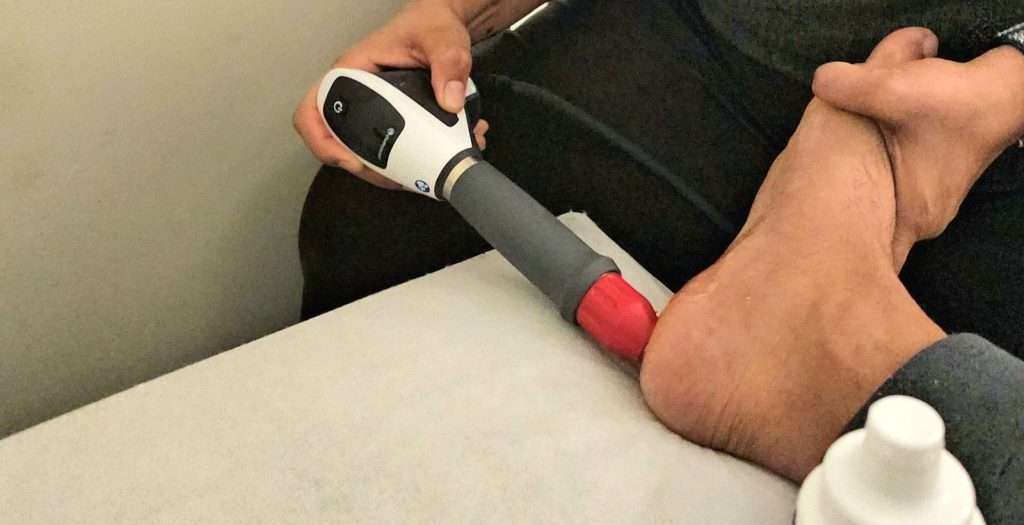
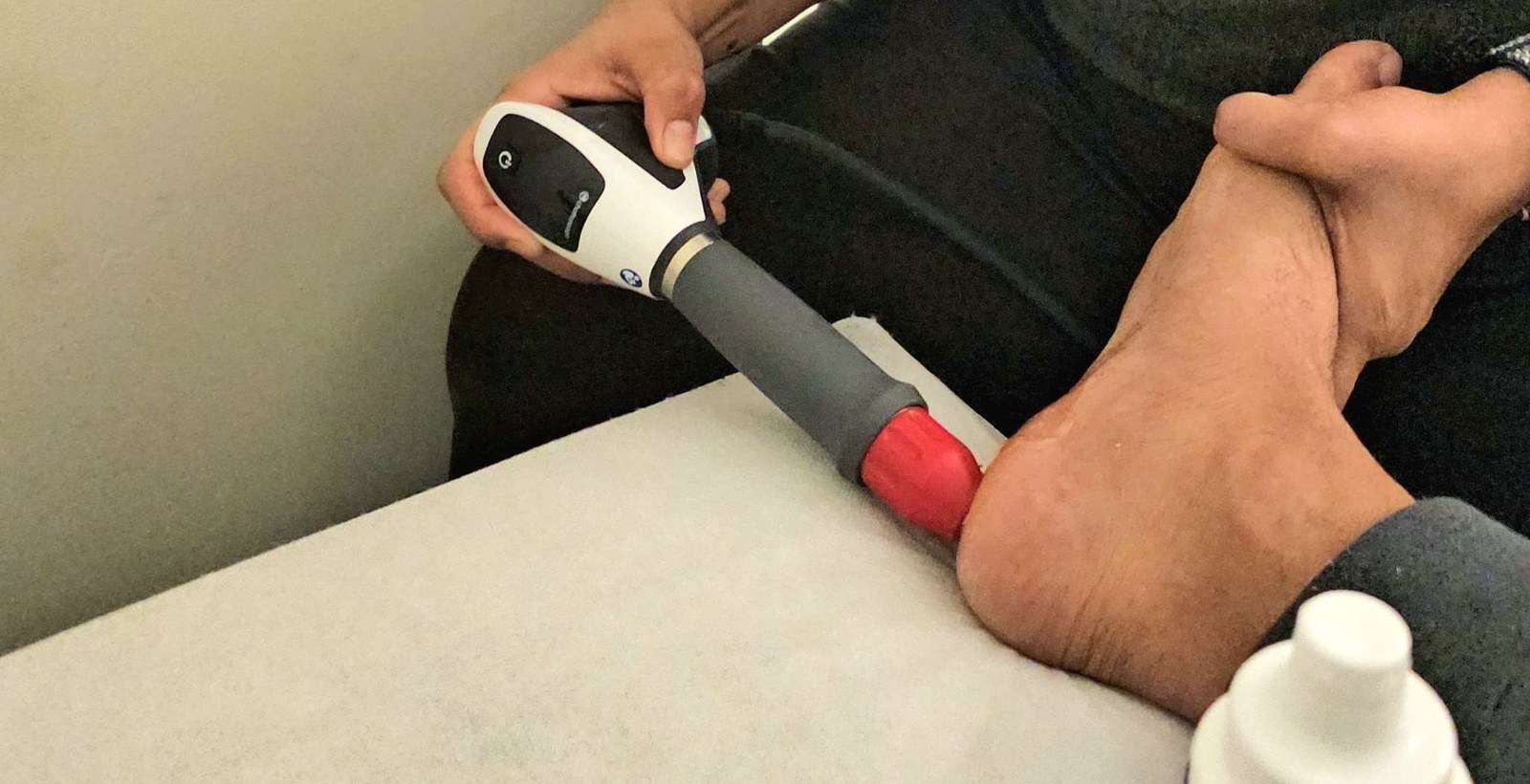
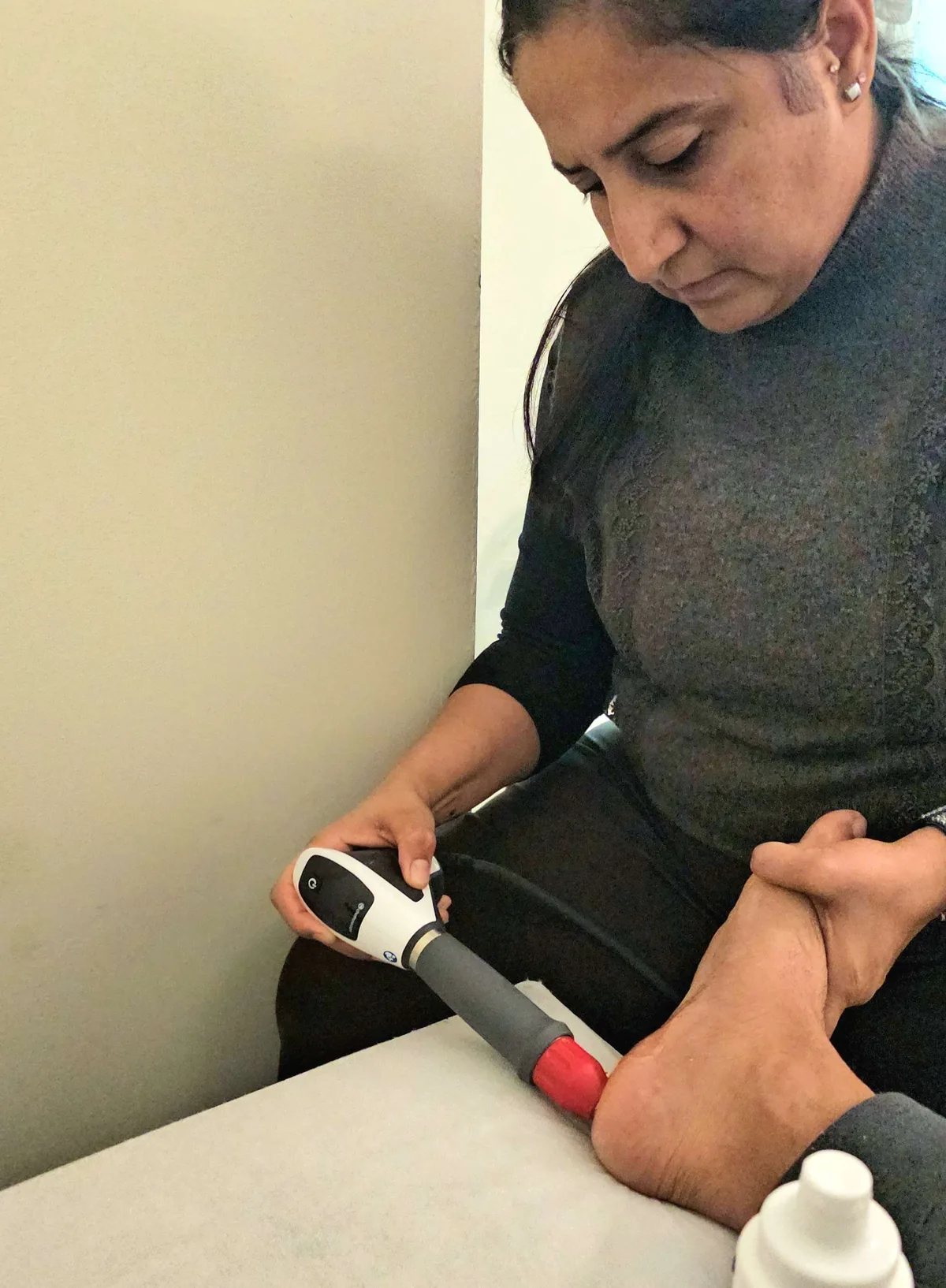
Shockwave feels like rapid, firm tapping directly on the sore area. Most people describe it as uncomfortable rather than painful, and it stops the moment the machine stops. A systematic review of shockwave complications in plantar fasciitis found the common reports were pain during treatment and temporary skin redness afterwards, along with occasional bruising, swelling or a throbbing sensation. Serious complications were not expected at one-year follow-up. Intensity is adjustable, and a good therapist starts low and builds.
Laser therapy is different. Most people feel nothing at all, or a mild warmth over the area. There is no downtime with either treatment, and you can walk out and carry on with your day.
How many sessions do you need, and what does it cost in Ontario?
Session counts
Shockwave protocols in the research typically run 3 to 6 sessions, spaced about a week apart, because the tissue needs that gap to respond. Some calcific shoulder protocols run longer. Laser protocols run more frequently and for more visits, commonly 6 to 12 sessions delivered two or three times a week over a few weeks. In the 2026 Bioengineering review, the included trials used 6 to 10 laser sessions and 3 to 6 shockwave sessions, both over two to three weeks.
Neither is meant to be endless. If you have had eight sessions of anything and nothing has shifted, the plan needs reviewing, not repeating.
Cost in Ontario
Most Ontario clinics charge roughly $100 to $200 per standalone shockwave session, with some as low as $75 and specialty clinics higher. Many physiotherapy clinics instead add shockwave to a regular visit for around $40 to $60 on top of the appointment fee. Laser therapy generally runs a little less, roughly $50 to $150 standalone, or a $30 to $60 add-on.
Run the arithmetic on the whole course, not the sticker price. Four shockwave sessions at $150 and ten laser sessions at $70 land in a similar place. Neither is covered by OHIP at a private clinic, but both are commonly claimable under extended health physiotherapy benefits when delivered as part of a physiotherapy visit, and motor vehicle accident and WSIB claims can apply in eligible cases. We direct bill most major insurers.
Who should not have shockwave or laser therapy?
Both are considered low-risk treatments, but neither is for everyone, and this is exactly the sort of thing your physiotherapist screens for at the assessment before any machine comes out. This is a general list, not a judgement about you.
Shockwave is generally avoided:
- Over a tumour or a known cancerous area
- Over an active infection in the area
- Over open growth plates in children and adolescents
- With caution if you take blood thinners or have a clotting disorder
Laser therapy is generally avoided:
- Over or near the eyes, which is why eye protection is worn
- Over an area of known malignancy
- Over the abdomen during pregnancy
There are other situations that call for care, including pacemakers, recent cortisone injections and certain medications. Bring your full medication list and health history to the assessment and let your therapist make that call.
Can you have both shockwave and laser therapy?
Yes, and in practice plenty of people do, though they are usually sequenced rather than stacked on the same spot in the same visit.
A common pattern looks like this. An irritable, very painful tendon is settled first with laser, hands-on treatment and load management. Once the tissue tolerates pressure, shockwave is introduced weekly to drive the remodelling side while strengthening progresses in parallel. Some people never need the second machine at all.
What we avoid is running both indefinitely because a package was purchased. The point of any passive treatment is to open a window in which you can load the tissue properly.
Why neither machine fixes this on its own
This is the part that gets lost in the shockwave versus laser argument. In almost every trial we have discussed, the machine was tested as an addition to, or against a background of, stretching and exercise. Neither device is a standalone treatment, and neither addresses why the tissue became overloaded in the first place.
Tendons and the plantar fascia respond to load. They get stronger with graded, progressive loading and they get irritable when load changes faster than they can adapt. A machine can reduce pain and improve tissue conditions for a while. Only loading changes capacity.
That is why a first appointment at Wellmax is a full 60 minutes. Our lead physiotherapist, Gurmeet Rai, is a Registered Physiotherapist and Clinic Director with more than 16 years of experience, and her approach is hands-on manual therapy paired with finding the root cause, not switching on a machine and hoping. We serve Oakville and Mississauga, and the goal is always a pain-free graduation, not a standing appointment forever.
Not sure where to start?
Book a free consultation and we will point you to the right care, with no pressure.
Frequently Asked Questions
Is shockwave therapy better than laser therapy?+
Not according to the pooled evidence. A 2026 systematic review in Lasers in Medical Science covering 803 patients found shockwave, high-intensity laser and low-level laser produced similar results for chronic plantar fasciitis. A 2026 review in Bioengineering found no significant difference in pain, with a small lean toward shockwave on foot function. One 2024 trial favoured low-level laser short term. The tissue involved, your pain tolerance, visit frequency and cost are the practical deciders.
Shockwave or laser for plantar fasciitis: which should I choose?+
Either is reasonable, because head-to-head trials find them comparable for chronic heel pain. Choose laser if your heel is very sensitive or you would rather avoid discomfort, and if you can attend two or three times a week. Choose shockwave if you prefer fewer visits, roughly once a week for three to six weeks, and can tolerate brief discomfort during treatment. An assessment first matters more than the machine choice.
How many shockwave sessions do I need for plantar fasciitis?+
Most protocols run three to six sessions, spaced about one week apart, which is the pattern used in the trials comparing shockwave with laser. The gap between sessions is deliberate, since the tissue response takes time. Many people notice change part way through the course rather than after the first visit. If nothing has shifted by the end of the planned sessions, the plan should be reviewed rather than simply extended.
Does shockwave therapy hurt?+
It is usually described as uncomfortable rather than painful. It feels like rapid, firm tapping on the sore area, and it stops the instant the machine stops. A systematic review of shockwave complications in plantar fasciitis reported pain during treatment and temporary skin redness as the common effects, with occasional bruising or swelling and no complications expected at one-year follow-up. Intensity is adjustable, so tell your therapist and they will dial it back.
Does laser therapy hurt or have side effects?+
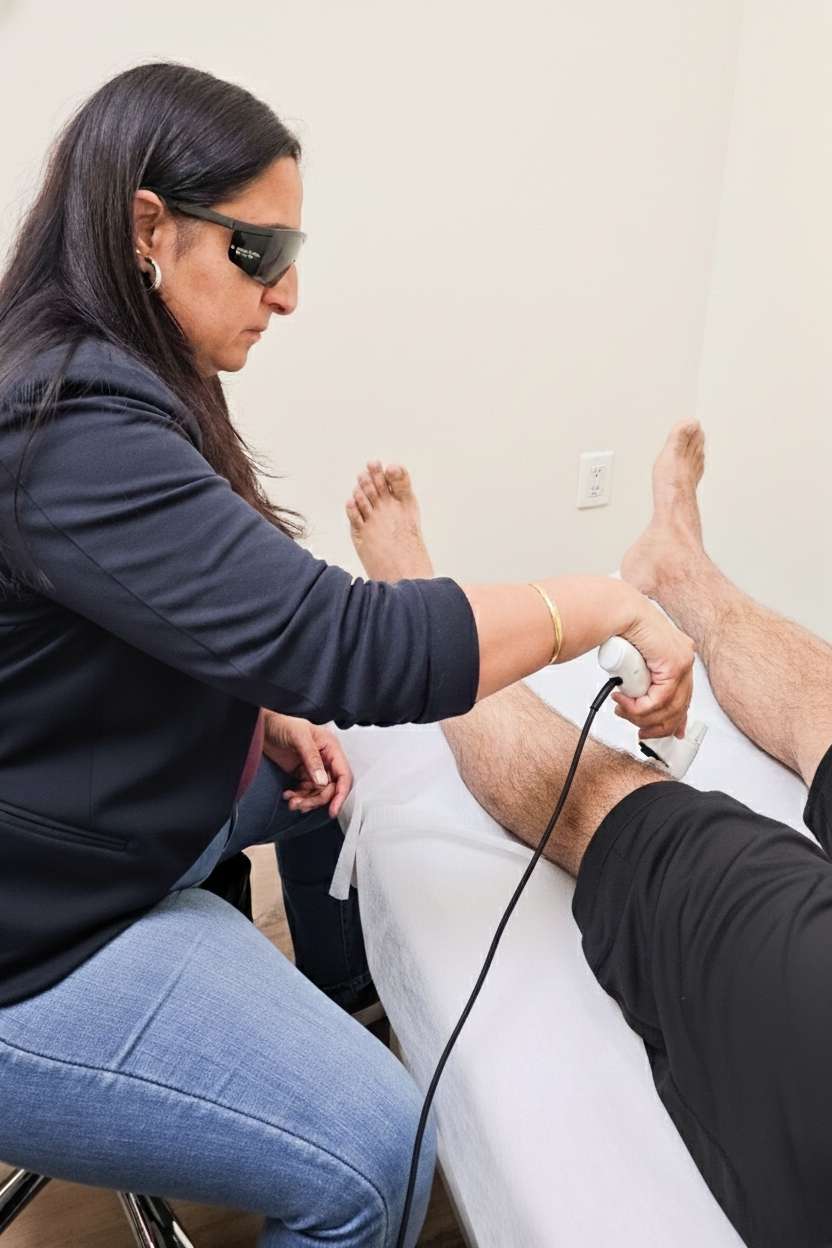
Most people feel nothing at all, or a gentle warmth over the treated area. Reported side effects are rare, and there is no downtime, so you can go straight back to your day. You will wear protective eyewear during treatment because laser light must never be directed at the eyes. Laser is generally avoided over a known malignancy and over the abdomen during pregnancy, which your therapist screens for beforehand.
How much does shockwave therapy cost in Ontario?+
Standalone sessions typically run about $100 to $200, with some clinics closer to $75 and specialty providers charging more. Many physiotherapy clinics instead add shockwave to a regular visit for roughly $40 to $60 on top of the appointment fee, which usually works out cheaper because you also get hands-on treatment and exercise rehab in the same appointment. Laser generally runs a little less. OHIP does not cover either at a private clinic.
Can you have shockwave and laser therapy together?+
Yes, though they are usually sequenced rather than applied to the same spot in the same session. A common approach is to settle a very irritable tendon with laser and hands-on treatment first, then introduce weekly shockwave once the area tolerates pressure, with strengthening running throughout. Many people only ever need one of the two. Running both indefinitely is not the goal, since the machines exist to create a window for loading.
How long does it take for shockwave or laser therapy to work?+
Most of the comparative trials measured results after two to three weeks of treatment, and reported improvement over that window. Some people notice change after two or three sessions, others toward the end of the course, and tendon problems that have been present for months generally take longer than recent flare-ups. Improvement usually continues in the weeks after the sessions finish, especially if a loading programme is running alongside.
You Might Also Like


Gurmeet Rai, Registered Physiotherapist
Gurmeet is a Registered Physiotherapist with the College of Physiotherapists of Ontario and the Clinic Director and co-owner of Wellmax Physiotherapy in Oakville, with 16+ years of clinical experience. She focuses on complex, stubborn cases where earlier treatment has not worked, with advanced training in pelvic health, TMJ, vestibular, and sports and MSK rehab. Expect expert care from assessment to discharge, with honest guidance along the way. Read Gurmeet’s full profile or meet the team.
This article is for educational purposes only and does not replace a professional clinical assessment. Every body and condition is different. If you are experiencing pain or symptoms, book an assessment with a qualified clinician for advice specific to your situation. If you are experiencing a medical emergency, call 911 or visit your nearest emergency department.
